
Last letters from the living dead man
David Patterson (Spirit) Hatch
THE CLASSIC COLLECTION · 1904
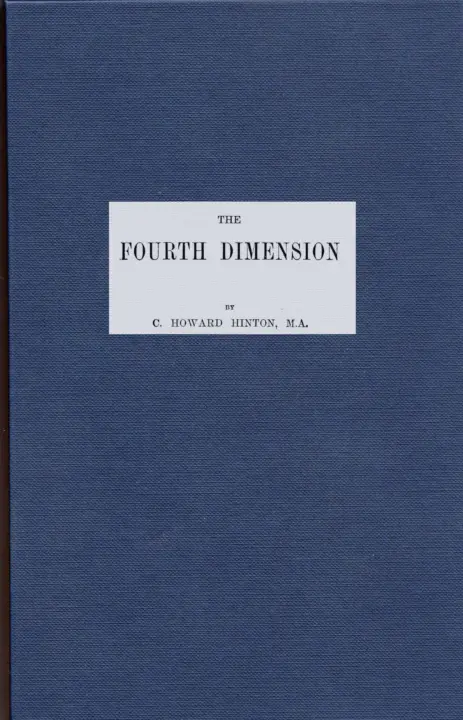
"The Fourth Dimension" by Charles Howard Hinton is a scientific treatise written in the late 19th century. The work explores the concept of higher dimensional space, specifically the fourth dimension, aiming to present the idea in a way that is accessible to readers without a strong mathematical background. The text delves into the implications and significance of a four-dimensional existence and its relationship with our three-dimensional perceptions. The opening of "The Fourth Dimension" introduces the central themes of the book by discussing the limitations of human perception and understanding in the context of higher dimensions. Hinton draws an analogy between our world and a hypothetical plane world to illustrate how beings in a two-dimensional existence might perceive their reality, unaware of the third dimension. He suggests that just as a being in a plane cannot fully comprehend the existence of height, we too might struggle to grasp the fourth spatial dimension. This sets the stage for exploring the properties, applications, and philosophical implications of four-dimensional space as Hinton aims to unravel the complexities surrounding this abstract concept.
Introduction adapted from the source catalogue; source summaries may be automatically generated.
Free to read · English · 76,056 words · No account needed
MAKE TIME FOR A GOOD BOOK
On by default. Untick to stop anonymous reading totals. Each page counts after 10 seconds in view. How this works.
Anonymous counting is on unless you have switched it off.
We will first consider the red line alone. Let us take a cube with the red line in it and the yellow and blue axes.
The cube with the yellow, red, blue axes is shown in fig. 113. If the red line is moved equally in the yellow and in the blue direction by four equal motions of ¼ inch each, it takes the positions 11, 22, 33, and ends as a red line.
Now, the whole of this red, yellow, blue, or brown cube appears as a series of faces on the successive sections of the tesseract starting from the ochre cube and letting the blue axis run in the fourth dimension. Hence the plane traced out by the red line appears as a series of lines in the successive sections, in our ordinary way of representing the tesseract; these lines are in different places in each successive section.
Thus drawing our initial cube and the successive sections, calling them b{0}, b_{1}, b_{2}, b_{3}, b__{4}, fig. 115, we have the red line subject to this movement appearing in the positions indicated.
We will now investigate what positions in the tesseract another line in the pink face assumes when it is moved in a similar manner.
Take a section of the original cube containing a vertical line, 4, in the pink plane, fig. 115. We have, in the section, the yellow direction, but not the blue.
From this section a cube goes off in the fourth dimension, which is formed by moving each point of the section in the blue direction.
Drawing this cube we have fig. 116.
Now this cube occurs as a series of sections in our original representation of the tesseract. Taking four steps as before this cube appears as the sections drawn in b{0}, b_{1}, b_{2}, b_{3}, b_{4}, fig. 117, and if the line 4 is subjected to a movement equal in the blue and yellow directions, it will occupy the positions designated by 4, 4{1}, 4{2}, 4{3}, 4_{4}.
Hence, reasoning in a similar manner about every line, it is evident that, moved equally in the blue and yellow directions, the pink plane will trace out a space which is shown by the series of section planes represented in the diagram.
Thus the space traced out by the pink face, if it is moved equally in the yellow and blue directions, is represented by the set of planes delineated in Fig. 118, pink face or 0, then 1, 2, 3, and finally pink face or 4. This solid is a diagonal solid of the tesseract, running from a pink face to a pink face. Its length is the length of the diagonal of a square, its side is a square.
Let us now consider the unlimited space which springs from the pink
face extended.
Your reading position is saved on this browser. Take it to another device with a library code. Reading pages adapt to text, rather than matching a printed edition.
BEHIND THE BOOK
This eBook is for the use of anyone anywhere in the United States and most other parts of the world at no cost and with almost no restrictions whatsoever. You may copy it, give it away or re-use it under the terms of the Project Gutenberg License included with this eBook or online at www.gutenberg.org. If you are not located in the United States, you will have to check the laws of the country where you are located before using this eBook. Read the source licence.
The original source file, including credits and licence, is retained by this library. Request an original-format copy at no charge. Please include the book title and Project Gutenberg identifier #67153.
KEEP YOUR CURIOSITY GOING
David Patterson (Spirit) Hatch
Coulson Kernahan

Ralph Waldo Emerson
Frances Wright

Edwin Abbott Abbott

Joseph Droz