THE CLASSIC COLLECTION✦The House of the ArrowCLASSIC FREE BOOKS
The House of the Arrow
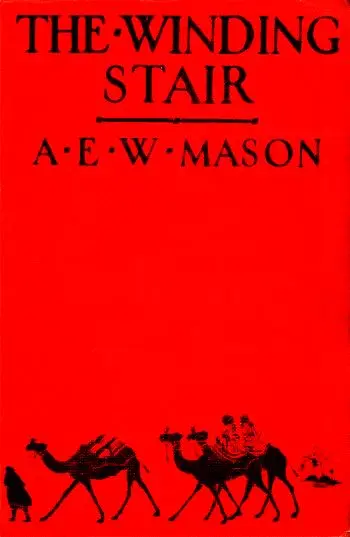
A. E. W. (Alfred Edward Woodley) Mason
THE CLASSIC COLLECTION · 1917
"The Four Corners of the World" by A. E. W. Mason is a novel written in the early 20th century. The story appears to blend elements of mystery and drama, centering around interpersonal relationships complicated by dark circumstances. The narrative hints at themes of ambition, jealousy, and perhaps even betrayal, as various characters navigate their connections with one another amidst troubling events. The opening of the novel introduces Mr. Twiss, a solicitor, who is concerned about his client Archie Cranfield, who has recently acquired a peculiar reputation for maintaining a solitary lifestyle in a remote house. Following a strange incident involving Captain Brayton, a friend of Cranfield, the plot thickens when Brayton's mysterious death leads to a complex web of relationships and implications. Twiss's unease deepens after he receives a telegram from Cranfield asking for urgent help, prompting him to return to the ominous house. The tension escalates with the discovery of Cranfield’s grim fate and the unclear motivations that surround the characters, setting the stage for a gripping tale filled with suspense and intrigue.
Introduction adapted from the source catalogue; source summaries may be automatically generated.
Free to read · English · 100,468 words · No account needed
MAKE TIME FOR A GOOD BOOK
On by default. Untick to stop anonymous reading totals. Each page counts after 10 seconds in view. How this works.
Anonymous counting is on unless you have switched it off.
Challoner began dimly to understand the tragedy which had happened. Ranks was well known amongst mountaineers. Forty years old, the right age for endurance, he was known for a passion for long expeditions undertaken with very small equipment; and for a rather dangerous indifference as to the companions he climbed with. He had at once proposed the Schalligrat ascent to the two Englishmen. They had gone down to Randa, slept the night there, and in bad weather had walked up to the Weisshorn hut, with provisions for three days. Nothing more had been heard of the party until this very afternoon, when Ranks and George Listen, both exhausted and the latter terribly frost-bitten, staggered into the Randa hotel.
"That's terrible," said Challoner. But still more terrible was the story which the Austrian had to tell. He had written it out at once very briefly, and sent it up to the Riffelalp. The manageress handed the letter to Challoner.
"We stayed in the hut two days," it ran, "hoping that the weather would lift. The next morning there were promising signs, and taking our blankets we crossed the Schalliberg glacier, and camped on the usual spur of the Schallihorn. We had very little food left, and I know now that we ought to have returned to Randa. But I did not think of the youth of my companions. It was very cold during the night, but no snow fell, and in the morning there was a gleam of sunshine. Accordingly we started, and reached the Schallijoch in four hours and a half. Under the top of the col we breakfasted, and then attacked the ridge. The going was very difficult; there was often a glaze of black ice upon the rocks, and as not one of us knew the ridge at all, we wasted much time in trying to traverse some of the bigger gendarmes on the western side, whereas they were only possible on the east. Moreover, the sunlight did not keep its promise: it went out altogether at half-past ten; the ridge became bitterly and dangerously cold, and soon after midday the wind rose. We dared not stop anywhere, and our food was now altogether exhausted. At two o'clock we found a shelter under a huge tower of red rock, and there we rested. Frobisher complained of exhaustion, and was clearly very weak. Liston was stronger, but not in a condition for a climb which I think must always be difficult and was now hazardous in the extreme. The cold had made him very sleepy. We called a council of war. But it was quite evident to me that we could not get down in the state in which we were, and that a night upon the ridge without food or drink was not to be thought of. I was certain that we were not very far from the top, and I persuaded my friends to go forward. I climbed up and over the red tower by a small winding crack in its face, and with great difficulty managed, by the help of the rope, to draw my friends up after me. But this one tower took more than an hour to cross, and on a little snow-col like a knife-edge on the farther side of it, Frobisher collapsed altogether. What with the cold and his exhaustion his heart gave out. I swear that we stayed with him until he died--yes, I swear it--although the wind was very dangerous to the rest of us, and he was evidently dying. We stayed with him--yes. When all was over, I tied him by the waist with a piece of spare rope we carried to a splinter of rock which cropped out of the col, and went on with Liston. I did not think that we should either of us now escape, but the rock-towers upon the arete came to an end at last, and at six o'clock we stood on the mountain-top. Then we changed the order, Liston going now first down the easy eastern ridge. The snow was granulated and did not bind, and we made very slow progress. We stopped for the night at a height, I should think, of thirteen thousand feet, with very little protection from the wind. The cold was terrible, and I did not think that Liston would live through the night. But he did, and today there was sunlight, and warmth in the sunlight, so that moving very carefully we got down to the hut by midday. There, by a happy chance, we found some crusts and odds and ends of food which we had left behind; and after a rest were able to come on to Randa, getting some milk at the half-way chalet on the way down. Liston is frost-bitten in the feet and hands, but I think will be able to be moved down to the clinic at Lucerne in a couple of days. It is all my fault. Yes. I say that frankly. I alone am to blame. I take it all upon my shoulders. You can say so freely at the Riffelalp. 'Ranks takes all the blame.' I shall indeed write to-morrow to the Zurich papers to say that the fault is mine."
Your reading position is saved on this browser. Take it to another device with a library code. Reading pages adapt to text, rather than matching a printed edition.
A. E. W. (Alfred Edward Woodley) Mason
A. E. W. (Alfred Edward Woodley) Mason
A. E. W. (Alfred Edward Woodley) Mason
A. E. W. (Alfred Edward Woodley) Mason
BEHIND THE BOOK
This eBook is for the use of anyone anywhere in the United States and most other parts of the world at no cost and with almost no restrictions whatsoever. You may copy it, give it away or re-use it under the terms of the Project Gutenberg License included with this eBook or online at www.gutenberg.org. If you are not located in the United States, you will have to check the laws of the country where you are located before using this eBook. Read the source licence.
The original source file, including credits and licence, is retained by this library. Request an original-format copy at no charge. Please include the book title and Project Gutenberg identifier #38664.
KEEP YOUR CURIOSITY GOING
Cécile Tormay

Moritz Busch
Coulson Kernahan
John L. Ransom

Maurice Baring
Frances Wright