THE CLASSIC COLLECTION✦An outlaw’s diary: the CommuneCLASSIC FREE BOOKS
An outlaw’s diary: the Commune
Cécile Tormay
THE CLASSIC COLLECTION · 1866
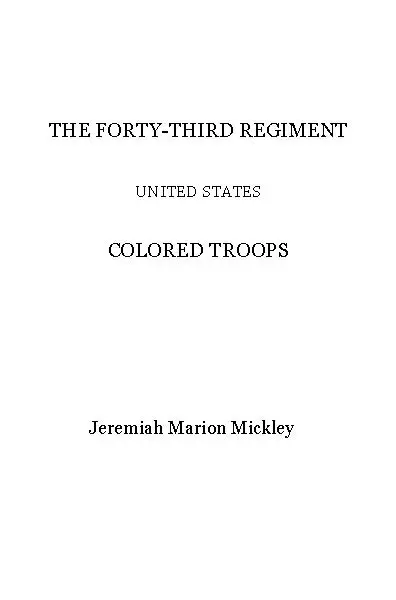
"The Forty-third Regiment United States Colored Troops" by Jeremiah Marion Mickley is a historical account written in the late 19th century. This work chronicles the experiences and military history of the 43rd Regiment of United States Colored Troops, emphasizing their significant contributions to the Union's efforts during the Civil War. The text aims to not only document the valor of the individuals within the regiment but also to argue against prevalent biases regarding the capabilities and worthiness of African American soldiers. At the start of the account, the author sets the tone by explaining the purpose behind the publication, which is to document the significant role of the colored troops and to highlight their discipline, bravery, and potential for intellectual growth in service to the Union. The introduction includes brief biographies of key officers within the regiment, detailing their backgrounds, military careers, and contributions to the war effort. Noteworthy figures such as Brevet Brigadier General S. B. Yeoman are introduced, showcasing their impressive military records and the various battles they participated in, including the pivotal Capture of Richmond. These initial insights into the lives and achievements of these soldiers lay a foundation for understanding the broader narrative of African American troops during a critical period in American history.
Introduction adapted from the source catalogue; source summaries may be automatically generated.
Free to read · English · 17,358 words · No account needed
MAKE TIME FOR A GOOD BOOK
On by default. Untick to stop anonymous reading totals. Each page counts after 10 seconds in view. How this works.
Anonymous counting is on unless you have switched it off.
EDWARD S. PERKINS, (white) of Athens, Pa., and Hospital Steward, U.S. A., was assigned to this Regiment, March 11th, 1864. At the battle of Hatchie's Run, Oct. 27th and 28th, 1864, he was taken prisoner by the enemy, and confined in Libby Prison until Feb. 5th, 1865, when he was paroled. Upon discharge of this Regiment he was assigned to the 62nd U.S.C.T.
We take pleasure in mentioning the patriotism, energy and great activity of the Supervisory Committee who had in charge the recruiting and organizing of colored troops at Philadelphia, during the war. Their success in the undertaking, resulted not only complimentary to themselves, but it was also most opportune to the Government, by adding to our armies an important element to aid in obtaining the complete victory; and according to another view of the case, by introducing the stone that had been so long rejected, or preserved only as a stumbling stone, but which the builders would then take up in establishing and cementing a stronger and better Union.
The First Battalion of the 43rd Regt. U.S.C.T., composed of Companies A, B, C, D, E and F, was recruited and organized, March, 1864, at Camp William Penn, Philadelphia, and left Camp, April 18th, under command of Lieut. Col., now Brevet Col., H. Seymour Hall. It proceeded by railroad and steamer to Annapolis, Md., and there joined the 9th Corps, under command of General Burnside. It was associated with the 1st Brig. of the 4th Div. of this Corps, commanded by General Ferrero. The Corps took up its march April 23d, to join the Army of the Potomac. On their way through Washington they were reviewed by President Lincoln, in the presence of many other public officers, and a large assembly of citizens. As these were the first colored troops destined to the Potomac Army, their soldierly appearance and movements were closely scanned. In passing in Review they saluted gracefully with their Colors and by loud hurrahs that Great Emancipator of their race. This, as President Lincoln afterwards expressed himself, was most gratifying to him, and riveted the confidence he had in the devotion of the Freedmen, and their efficiency to do a full share in the struggle. According to the public press, also, the occasion inspired the hearts of the large assembly who witnessed it, with a great degree of favor and interest. On that same day they crossed the Long Bridge into Virginia, and camped near Alexandria. They had now returned under the Starry Flag to the soil of their oppressors, ready by great achievements in the field and with their lives, to express their sincere gratitude to "Massa Lincoln," and seal their devotion to the Union. Much as the so-called Confederacy and its emissaries in the North feigned contempt and ridicule in the case of employing this troop, the true sequel is that they regarded its advent with no flattering prospects for the success of the Rebellion, but rather, as it was, a stunning blow. Going from Alexandria by way of Fairfax C.H., and Centerville, they arrived at Manassas Junction, and were immediately stationed to do guard duty on the railroad. Afterwards they were quickly marched by Rappahannock Station and over the Rapidan to reinforce the right of the army, which had been partially broken on that day. During the celebrated Wilderness Campaign, and up to Cold Harbor and Old Church, their position was on the right flank of the army. In these engagements they manifested great steadiness and intrepidity under severe fire, and immediately proved themselves a reliable troop. Their losses in these actions were comparatively light. Company G, under command of Capt. A. D. Wright, joined the First Battalion of the Regiment, June 6th, near Old Church, Va. June 12th, they marched by White House Landing and New Kent C.H., crossing the Chickahominy at Jones' Bridge, to the James River, where they took up a position protecting the crossing of the army. They passed over the James on the 17th, and next day marched to the front before Petersburg. Here they were employed by working parties in the trenches and on fortifications, under the almost constant fire of the enemy. The field works and the "Covered Way," leading to the front line were mostly constructed by the colored troops.
Your reading position is saved on this browser. Take it to another device with a library code. Reading pages adapt to text, rather than matching a printed edition.
BEHIND THE BOOK
This eBook is for the use of anyone anywhere in the United States and most other parts of the world at no cost and with almost no restrictions whatsoever. You may copy it, give it away or re-use it under the terms of the Project Gutenberg License included with this eBook or online at www.gutenberg.org. If you are not located in the United States, you will have to check the laws of the country where you are located before using this eBook. Read the source licence.
The original source file, including credits and licence, is retained by this library. Request an original-format copy at no charge. Please include the book title and Project Gutenberg identifier #46181.
KEEP YOUR CURIOSITY GOING
Cécile Tormay

Moritz Busch
John L. Ransom
Frances Wright
Cécile Tormay

Mabel Potter Daggett