
The slave ship
Mary Johnston
THE CLASSIC COLLECTION · 1915
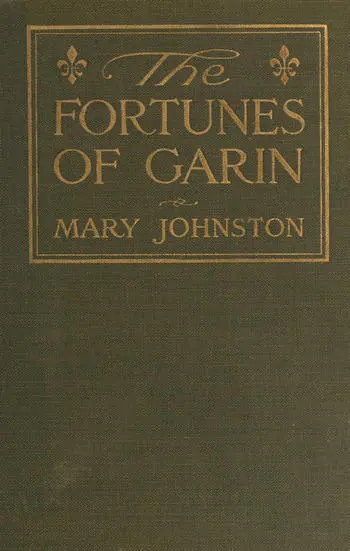
"The Fortunes of Garin" by Mary Johnston is a historical novel written in the early 20th century. The book is set in a medieval landscape, taking readers through the life of a young squire named Garin de Castel-Noir as he grapples with significant life choices and the pursuit of honor. Themes of chivalry, ambition, and the dichotomy between religious duty and martial aspiration underpin Garin's journey. At the start of the story, Garin finds himself in a cathedral bathed in both physical and spiritual light, contemplating his future. He is influenced by different voices in his life—his brother Foulque, the Abbot of Saint Pamphilius who offers him a path to the clergy, and his feudal lord, Raimbaut the Six-fingered, who represents the knightly path. This inner turmoil is mirrored by his unexpected encounter with a knight whom he nobly rescues from a bandit, showcasing Garin's emerging sense of agency and honor. As the narrative unfolds, Garin must navigate the complex interplay of duty, love, and ambition that defines his fate in a richly depicted medieval world.
Introduction adapted from the source catalogue; source summaries may be automatically generated.
Free to read · English · 91,819 words · No account needed
MAKE TIME FOR A GOOD BOOK
On by default. Untick to stop anonymous reading totals. Each page counts after 10 seconds in view. How this works.
Anonymous counting is on unless you have switched it off.
“I am Elias of Montaudon,” he said. “I understand that, and how to play the jongleur, and that if peril comes and stands like a giant and questions us, I am no jongleur of Roche-de-Frêne nor allied there—”
“Say that you are of Limousin.”
“I have not dropped from the sky into the camp of Cap-du-Loup, but have been singing and playing, telling japes and tales, merry or sad, vaulting and wrestling elsewhere in the host—”
“With the men of Aquitaine. Say that in Poitou Duke Richard himself
praised you.”
“And should they question me of you?”
“I also am of Limousin. There I watched sheep, but now I am your mie and a traveller with you.”
“By what name am I to call you?”
“I am Jael the herd. You will call me Jael.”
They were moving this while up the stream. Did any come upon them now, it would hardly be held that they had flown from the battlements of Roche-de-Frêne. The ground was rough, the trees, crowding together, shut out the light from the moon, while the fires at the end of vistas grew ruddier. The muttering and humming also of the host in the night increased.
Jael the herd stood still. “It will not suit us to stumble in the dark upon some wild band! Here is Saint Laurent’s garden of safety. Let us rest on the pine-needles until cock-crow.”
They lay down, the jongleur wrapped in his mantle, the herd-girl in hers. “We must gather sleep wherever it grows,” said the latter. “I will sleep and you will watch until the moon rounds the top of that great pine. Wake me then, and look, Elias, that you do it!”
She pillowed her head upon the scrip or wallet which she carried slung over her shoulder, and lay motionless. The jongleur watched.... The barred moon mounted higher, the night wheeled, eastern lands were knowing light. Garin, resting against a pine trunk, lute and wallet beside him on the earth, kept his gaze from the sleeper, bestowed it instead upon the silver, gliding boat of the moon, or upon the not-distant, murky glare of unfriendly fires. But gaze here or gaze there, space and time sang to one presence! Wonder must exist as to this night and the morrow and what journey was this. Mind could not but lift the lanthorn, weigh likelihoods, pace around and around the subject. That quest drew him, but it was not all, nor most that drew.... Jael the herd! Jael the herd! Here came impossibilities—dreams, phantasies, rain of gold and silver, impossibilities! He remembered clearly now a herd-girl, and that when he had asked her name she had answered “Jael.” Many shepherdesses trod the earth, and a many might be named Jael! Moreover sheer, clear impossibility must conquer, subdue and dispose of all this mad thinking. She who lay asleep was like that herd-girl—he saw it now—shape, colouring, voice—That and the name she had happened to choose—that and the torn, shepherdess garb—to that was owed this dizzy dreaming, this jewelled sleet of fancy, high tide of imagination, flooding every inland.... Things could not be different, yet the same—beings could not be separate, yet one—or in some strange, rich world, could that be so? But here was mere impossibility! Garin strove to still the wider and wider vibrations. The Fair Goal—The Fair Goal!... The moon rounded the top of the pine tree.
Your reading position is saved on this browser. Take it to another device with a library code. Reading pages adapt to text, rather than matching a printed edition.
Mary Johnston
Mary Johnston

Mary Johnston

Mary Johnston
BEHIND THE BOOK
This eBook is for the use of anyone anywhere in the United States and most other parts of the world at no cost and with almost no restrictions whatsoever. You may copy it, give it away or re-use it under the terms of the Project Gutenberg License included with this eBook or online at www.gutenberg.org. If you are not located in the United States, you will have to check the laws of the country where you are located before using this eBook. Read the source licence.
The original source file, including credits and licence, is retained by this library. Request an original-format copy at no charge. Please include the book title and Project Gutenberg identifier #53394.
KEEP YOUR CURIOSITY GOING
Cécile Tormay

Moritz Busch
Coulson Kernahan
John L. Ransom

Maurice Baring
Frances Wright