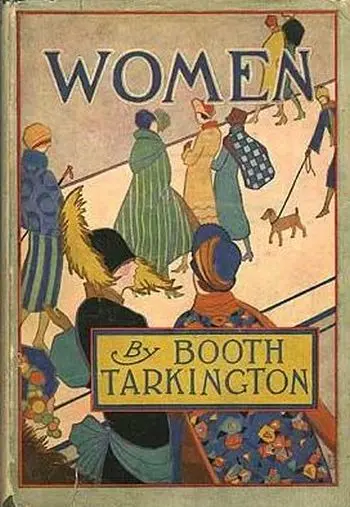
Women
Booth Tarkington
THE CLASSIC COLLECTION · 1913
"The Flirt" by Booth Tarkington is a novel written in the early 20th century. The story follows Valentine Corliss, a young man returning to his hometown after years abroad. His arrival reintroduces romantic complexities as he finds himself at the center of attention among local social circles, particularly concerning the beautiful Cora Madison and her perceived affections. At the start of the novel, we meet Valentine Corliss as he strolls down Corliss Street on a hot summer day, reflecting on the changes in his hometown. He reminisces about past events and encounters familiar faces that spark memories, particularly relating to childhood rivalries. Shortly thereafter, he visits the Madison household, where he encounters Cora and her sister, Laura. Their contrasting personalities and interactions set the stage for emerging romantic tensions, with Cora being particularly captivated by Corliss's charm. The opening chapter establishes a rich sense of place, character dynamics, and the themes of attraction and social observation that will undoubtedly unfold throughout the novel.
Introduction adapted from the source catalogue; source summaries may be automatically generated.
Free to read · English · 71,608 words · No account needed
MAKE TIME FOR A GOOD BOOK
On by default. Untick to stop anonymous reading totals. Each page counts after 10 seconds in view. How this works.
Anonymous counting is on unless you have switched it off.
"Well," suggested Corliss, "you refused a drink in it."
"Even more wonderful than that," said Ray, glancing about the place curiously. "It may be a sense of something painful that already has happened here--perhaps long ago, before your occupancy. It has a pathos."
"Most hotel rooms have had something happen in them," said Corliss lightly. "I believe the managers usually change the door numbers if what happens is especially unpleasant. Probably they change some of the rugs, also."
"I feel----" Ray paused, frowning. "I feel as if some one had
killed himself here."
"Then no doubt some of the rugs have been changed."
"No doubt." The caller laughed and waved his hand in dismissal of the topic. "Well, Mr. Corliss," he went on, shifting to a brisker tone, "I have come to make my fortune, too. You are Midas. Am I of sufficient importance to be touched?"
Valentine Corliss gave him sidelong an almost imperceptibly brief glance of sharpest scrutiny--it was like the wink of a camera shutter--but laughed in the same instant. "Which way do you mean that?"
"You have been quick," returned the visitor, repaying that glance with equal swiftness, "to seize upon the American idiom. I mean: How small a contribution would you be willing to receive toward your support!"
Corliss did not glance again at Ray; instead, he looked interested in the smoke of his cigar. "`Contribution,'" he repeated, with no inflection whatever. "`Toward my support.'"
"I mean, of course, how small an investment in your oil company."
"Oh, anything, anything," returned the promoter, with quick amiability. "We need to sell all the stock we can."
"All the money you can get?"
"Precisely. It's really a colossal proposition, Mr. Vilas." Corliss spoke with brisk enthusiasm. "It's a perfectly certain enormous profit upon everything that goes in. Prince Moliterno cables me later investigations show that the oil-field is more than twice as large as we thought when I left Naples. He's on the ground now, buying up what he can, secretly."
"I had an impression from Richard Lindley that the secret had been
discovered."
"Oh, yes; but only by a few, and those are trying to keep it quiet
from the others, of course."
"I see. Does your partner know of your success in raising a large
investment?"
"You mean Lindley's? Certainly." Corliss waved his hand in light deprecation. "Of course that's something, but Moliterno would hardly be apt to think of it as very large! You see he's putting in about five times that much, himself, and I've already turned over to him double it for myself. Still, it counts--certainly; and of course it will be a great thing for Lindley."
Your reading position is saved on this browser. Take it to another device with a library code. Reading pages adapt to text, rather than matching a printed edition.
Booth Tarkington
Booth Tarkington
Booth Tarkington
Booth Tarkington
BEHIND THE BOOK
This eBook is for the use of anyone anywhere in the United States and most other parts of the world at no cost and with almost no restrictions whatsoever. You may copy it, give it away or re-use it under the terms of the Project Gutenberg License included with this eBook or online at www.gutenberg.org. If you are not located in the United States, you will have to check the laws of the country where you are located before using this eBook. Read the source licence.
The original source file, including credits and licence, is retained by this library. Request an original-format copy at no charge. Please include the book title and Project Gutenberg identifier #297.
KEEP YOUR CURIOSITY GOING
Coulson Kernahan

Maurice Baring
Frances Wright
Cécile Tormay

Frederic Jesup Stimson

W. H. P. (William Henry Pope) Jarvis