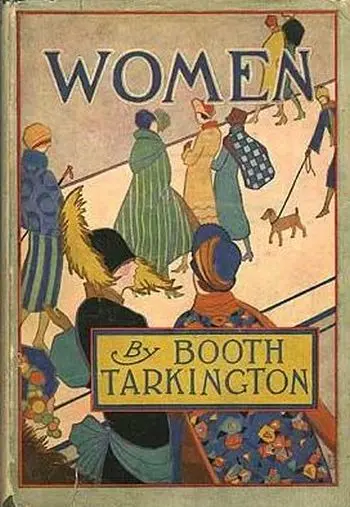
Women
Booth Tarkington
THE CLASSIC COLLECTION · 1913
"The Flirt" by Booth Tarkington is a novel written in the early 20th century. The story follows Valentine Corliss, a young man returning to his hometown after years abroad. His arrival reintroduces romantic complexities as he finds himself at the center of attention among local social circles, particularly concerning the beautiful Cora Madison and her perceived affections. At the start of the novel, we meet Valentine Corliss as he strolls down Corliss Street on a hot summer day, reflecting on the changes in his hometown. He reminisces about past events and encounters familiar faces that spark memories, particularly relating to childhood rivalries. Shortly thereafter, he visits the Madison household, where he encounters Cora and her sister, Laura. Their contrasting personalities and interactions set the stage for emerging romantic tensions, with Cora being particularly captivated by Corliss's charm. The opening chapter establishes a rich sense of place, character dynamics, and the themes of attraction and social observation that will undoubtedly unfold throughout the novel.
Introduction adapted from the source catalogue; source summaries may be automatically generated.
Free to read · English · 71,608 words · No account needed
MAKE TIME FOR A GOOD BOOK
On by default. Untick to stop anonymous reading totals. Each page counts after 10 seconds in view. How this works.
Anonymous counting is on unless you have switched it off.
Valentine Corliss drew in his breath with a sound murmurous of delight, and for a time they did not speak.
"Yes," he said, finally, "I think I do."
"There are meetings in the desert," he went on, slowly. "A lonely traveller finds another at a spring, sometimes."
"And sometimes they find that they speak the same language?"
His answer came, almost in a whisper:
"`Even as you and I.'"
"`Even as you and I,'" she echoed, even more faintly.
"Yes."
Cora breathed rapidly in the silence that followed; she had every appearance of a woman deeply and mysteriously stirred. Her companion watched her keenly in the dusk, and whatever the reciprocal symptoms of emotion he may have exhibited, they were far from tumultuous, bearing more likeness to the quiet satisfaction of a good card-player taking what may prove to be a decisive trick.
After a time she leaned back in her chair again, and began to fan
herself slowly.
"You have lived in the Orient, haven't you, Mr. Corliss?" she said
in an ordinary tone.
"Not lived. I've been East once or twice. I spend a greater part
of the year at Posilipo."
"Where is that?"
"On the fringe of Naples."
"Do you live in a hotel?"
"No." A slight surprise sounded in his voice. "I have a villa
there."
"Do you know what that seems to me?" Cora asked gravely, after a pause; then answered herself, after another: "Like magic. Like a strange, beautiful dream."
"Yes, it is beautiful," he said.
"Then tell me: What do you do there?"
"I spend a lot of time on the water in a boat."
"Sailing?"
"On sapphires and emeralds and turquoises and rubies, melted and
blown into waves."
"And you go yachting over that glory?"
"Fishing with my crew--and loafing."
"But your boat is really a yacht, isn't it?"
"Oh, it might be called anything," he laughed.
"And your sailors are Italian fishermen?"
Hedrick slew a mosquito upon his temple, smiting himself hard. "No, they're Chinese!" he muttered hoarsely.
"They're Neapolitans," said Corliss.
"Do they wear red sashes and earrings?" asked Cora.
"One of them wears earrings and a derby hat!"
"Ah!" she protested, turning to him again. "You don't tell me. You let me cross-question you, but you don't tell me things! Don't you see? I want to know what life is! I want to know of strange seas, of strange people, of pain and of danger, of great music, of curious thoughts! What are the Neapolitan women like?"
"They fade early."
She leaned closer to him. "Before the fading have you--have you
loved--many?"
Your reading position is saved on this browser. Take it to another device with a library code. Reading pages adapt to text, rather than matching a printed edition.
Booth Tarkington
Booth Tarkington
Booth Tarkington
Booth Tarkington
BEHIND THE BOOK
This eBook is for the use of anyone anywhere in the United States and most other parts of the world at no cost and with almost no restrictions whatsoever. You may copy it, give it away or re-use it under the terms of the Project Gutenberg License included with this eBook or online at www.gutenberg.org. If you are not located in the United States, you will have to check the laws of the country where you are located before using this eBook. Read the source licence.
The original source file, including credits and licence, is retained by this library. Request an original-format copy at no charge. Please include the book title and Project Gutenberg identifier #297.
KEEP YOUR CURIOSITY GOING
Coulson Kernahan

Maurice Baring
Frances Wright
Cécile Tormay

Frederic Jesup Stimson

W. H. P. (William Henry Pope) Jarvis