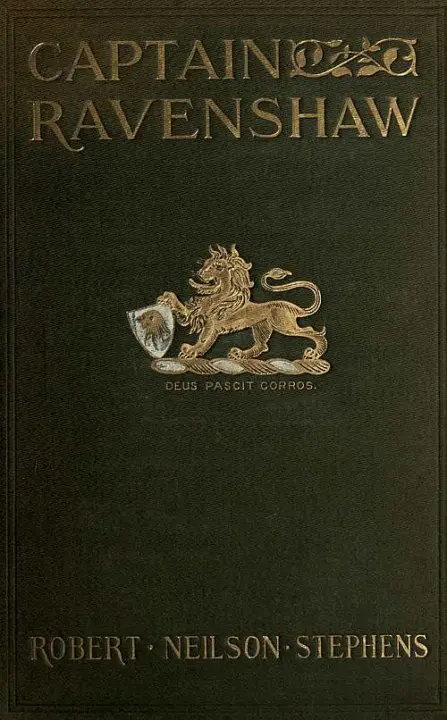
Captain Ravenshaw; Or, The Maid of Cheapside. A Romance of Elizabethan London
Robert Neilson Stephens

THE CLASSIC COLLECTION · 1905
"The Flight of Georgiana: A Story of Love and Peril in England in 1746" by Robert Neilson Stephens is a historical novel written in the early 20th century. The narrative centers around Georgiana Foxwell, a young lady returning to her family estate after an education away from home, as well as the complicated dynamics with her uncle, Mr. Foxwell, and the tension surrounding local figures like Squire Thornby. The book weaves themes of love, social conflict, and danger during a tumultuous period in English history. At the start of the story, we are introduced to various characters that set the stage for the unfolding drama. A gentleman's servant arrives at an inn, revealing the imminent return of his master, Mr. Foxwell, and his niece, Georgiana. Their arrival is contrasted with the unsettled atmosphere in the town, where discussions about the repercussions of recent uprisings hint at the underlying tension of the era. As conversations reveal personal histories and social rivalries, the narrative builds anticipation for Georgiana's homecoming, her relationship with her uncle, and the inevitable conflicts that will arise, suggesting that her return may not be the peaceful reunion she hopes for.
Introduction adapted from the source catalogue; source summaries may be automatically generated.
Free to read · English · 73,529 words · No account needed
MAKE TIME FOR A GOOD BOOK
On by default. Untick to stop anonymous reading totals. Each page counts after 10 seconds in view. How this works.
Anonymous counting is on unless you have switched it off.
“If you would indeed be content with that—and his freedom—” Foxwell still seemed to halt in doubt.
“I will be,” Georgiana declared, emphatically; “only say he shall live.”
“If you would abandon any dreams you may have entertained of marriage—of future meetings with him—of correspondence, in the event of my saving him from the gallows—”
“I will abandon whatever you require,—only to know that he goes free, only to feel that somewhere in the world he lives!”
“Well,” said Foxwell, slowly, “I will let him go free—”
Georgiana uttered a cry of joy.
“—if,” continued Foxwell, “you will accept the proposal—the very advantageous proposal—which Mr. Thornby has done you the honour of making.”
“Accept the proposal—of Mr. Thornby?” repeated Georgiana, in utter
surprise.
“Yes—give your consent to the marriage, of your own free will, letting it be clear that there has been no force or compulsion to influence you.”
“But,” Georgiana faltered, looking distressedly toward the door by which Everell had left the room, “I cannot love Mr. Thornby.”
“’Tis not absolutely necessary you should love him,” replied Foxwell,
dryly.
“Oh, no, no!” cried Georgiana, as her imagination fully mastered the case. “I cannot! ’Twould be like—’twould be horrible!”
“’Twould be saving your Everell’s life,” said Foxwell, dispassionately.
“’Tis an excellent match, dear,” put in Lady Strange, softly, “if Mr. Thornby’s estate is what I take it to be.”
“Oh, but, Lady Strange,—you are a woman—you should understand.”
“I do, child,” replied the elder lady, with an inward sigh, “but—these matters reconcile themselves in time. ’Twill not be so intolerable, believe me. And who knows—” Whatever it was that who knew, Lady Strange abruptly broke off to another line of thought. “The point is, to save your lover’s life, my dear.”
“Ay,” said Foxwell, beginning to show impatience, “ere the opportunity is gone. Now lookye, Georgiana, I must hear your answer without more ado. I am going to have a horse saddled at once. It shall carry either your acceptance to Mr. Thornby, or word of this rebel to those who will not be slow in securing him. ’Tis for you to say which, and before many minutes.”
Instead of calling a servant, Foxwell went out to the hall to give the
order, consigning Georgiana by a look to the persuasions of Lady
Strange.
“Come, my dear,” said that lady, bending kindly over Georgiana, who had sunk weeping into a chair by the table; “’tis but marrying him you love not, for the sake of him you love.”
“’Tis being false to him I love,” sobbed the girl.
Your reading position is saved on this browser. Take it to another device with a library code. Reading pages adapt to text, rather than matching a printed edition.
Robert Neilson Stephens
Robert Neilson Stephens
Robert Neilson Stephens
Robert Neilson Stephens
BEHIND THE BOOK
This eBook is for the use of anyone anywhere in the United States and most other parts of the world at no cost and with almost no restrictions whatsoever. You may copy it, give it away or re-use it under the terms of the Project Gutenberg License included with this eBook or online at www.gutenberg.org. If you are not located in the United States, you will have to check the laws of the country where you are located before using this eBook. Read the source licence.
The original source file, including credits and licence, is retained by this library. Request an original-format copy at no charge. Please include the book title and Project Gutenberg identifier #56364.
KEEP YOUR CURIOSITY GOING
Cécile Tormay

Moritz Busch
Coulson Kernahan
John L. Ransom

Maurice Baring
Frances Wright