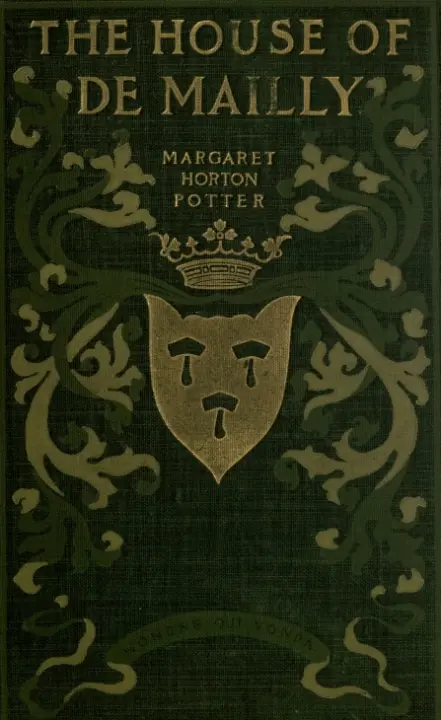
The House of de Mailly
Margaret Horton Potter
THE CLASSIC COLLECTION · 1904
"The Flame-Gatherers" by Margaret Horton Potter is a historical novel written in the early 20th century. The narrative unfolds in and around the year 1205, in the ancient Indian principality of Mandu, providing a vivid exploration of its culture, social hierarchies, and the intricacies of human emotion. The story primarily revolves around Fidá, a captive prince, whose grace and bearing create a captivating juxtaposition against the backdrop of his status as a slave in the household of the Rajah, Rai-Khizar-Pál. At the start of the novel, the reader is introduced to the serene yet tumultuous world of Mandu as sunlight casts a warm glow on the landscape. The narrative takes a swift turn as the Rajah returns from a victorious campaign, followed by the spectacle of surrendering captives, including Fidá, the son of the enemy's leader. The complexity of Fidá's character is revealed through his interactions with his captors and the striking Ranee Ahalya, who seeks her own freedom from the constraints of palace life. As intrigue unfolds, the tragedy of unrequited love, the weight of duty, and the unbreakable bonds of fate come to the forefront, setting the stage for a rich tapestry of emotions and societal critique that will resonate throughout the story.
Introduction adapted from the source catalogue; source summaries may be automatically generated.
Free to read · English · 108,141 words · No account needed
MAKE TIME FOR A GOOD BOOK
On by default. Untick to stop anonymous reading totals. Each page counts after 10 seconds in view. How this works.
Anonymous counting is on unless you have switched it off.
“Ah, it is one of Krishna’s nights,” murmured Kota, dreamily.
For answer, Oman sighed; and the sigh came from his soul.
Kota turned and looked at the young man. Hitherto, Oman’s heart had been strange to her; she had never thought of questioning the workings of his brain. Now, suddenly, his humanity was apparent; and her heart went out to his human sorrow as she asked, gently: “Dost thou mourn, Oman?”
Oman, for whom no human voice had ever taken on this tone, felt a throb of gratitude. But he answered: “I do not mourn, mother. I do not mourn. And yet it is the time of love; and for me there is no love.”
Though caste forbade it, she went over and sat down at his side, and took his two hands in hers. “Thinkest thou there is none to love thee?” she asked, tenderly.
Oman’s head drooped to his knees; and, resting it there, he let some part of his sorrow find expression for the woman, and her tears rained down with his, while, forgetting all but her motherhood, she clasped him to her heart.
After Oman’s emotion had spent itself, and he had become quiet, Kota remained at his side, and together they looked off upon the village, over which the half-grown moon was now shedding a bluish silver light. The two sat silent, watching, till the moon was past mid-heaven, and halfway down the sky. Gokarna had not returned. He would evidently sleep that night with the snatakas and priests in the square of sacrifice. But at last Kota, rising reluctantly, left the night behind, and sought her rest in the house, while Oman lay down in his accustomed corner of the veranda, and, after a little, slept.
When he opened his eyes again, the sun was nearly in mid-sky. He would unquestionably get a beating from the master weaver, when he reached his loom. However, it must be faced; and, without pausing for food, he rose, thinking to make his ablutions at a fountain on the way. Reaching the veranda step, however, he paused. A man was standing there, silently: a man clad in mud-stained yellow robes, holding in his hand a wooden bowl. Oman looked at him with some curiosity. A century or two before, such men had overrun all India. Now, so rarely was one seen that he was an object of interest to every beholder. In the days when the wild Brahmanic leader, Kumarila Bhatta, had raised his brethren against the Buddhists, it had been death to this man to stand thus at a Brahman’s door; for, unquestionably, he was a Bhikkhu, a Buddhist mendicant monk, come out of Bágh, the one remaining stronghold of Buddhism in Malwa, one of the few left in all India. And the man stood here, quite still, silently asking alms. Pity and curiosity were nowadays the only sentiments with which even Brahmans regarded these harmless men. And Oman, after a moment’s halt, would have hurried on, but that he caught the expression in the wanderer’s eyes, and paused to look again.
Your reading position is saved on this browser. Take it to another device with a library code. Reading pages adapt to text, rather than matching a printed edition.
Margaret Horton Potter
Margaret Horton Potter
Margaret Horton Potter
BEHIND THE BOOK
This eBook is for the use of anyone anywhere in the United States and most other parts of the world at no cost and with almost no restrictions whatsoever. You may copy it, give it away or re-use it under the terms of the Project Gutenberg License included with this eBook or online at www.gutenberg.org. If you are not located in the United States, you will have to check the laws of the country where you are located before using this eBook. Read the source licence.
The original source file, including credits and licence, is retained by this library. Request an original-format copy at no charge. Please include the book title and Project Gutenberg identifier #69721.
KEEP YOUR CURIOSITY GOING
Cécile Tormay

Moritz Busch
Coulson Kernahan
John L. Ransom

Maurice Baring
Frances Wright