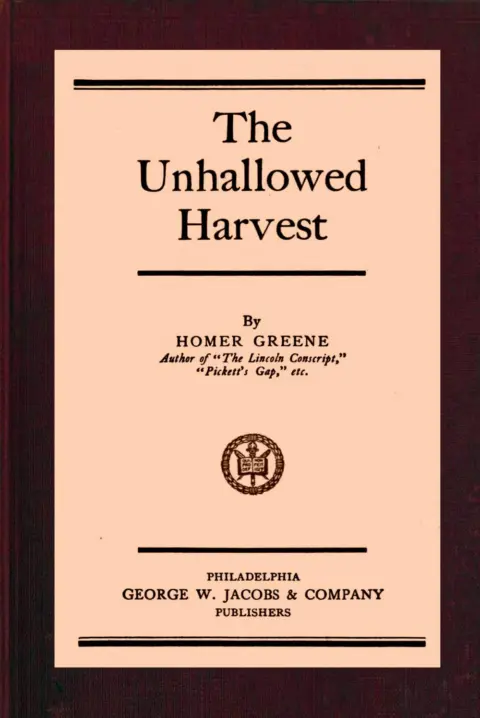
The unhallowed harvest
Homer Greene
THE CLASSIC COLLECTION · 1917
"The Flag" by Homer Greene is a novel written in the early 20th century. The story revolves around Penfield Butler, a fourteen-year-old boy living in the village of Chestnut Hill, where rivalries between local youth lead to playful yet intense conflicts. The narrative opens against a backdrop of snowy winter, highlighting Pen's interactions with family and friends as well as his involvement in a school initiative to raise money for an American flag. At the start of the book, we are introduced to Pen and his family, including his strict yet loving Aunt Millicent and his grandfather, Colonel Butler. The tension between the Hilltops and the Riverbeds, two boyhood factions, is evident as excitement grows for a more significant "battle" involving snowball fights. As the story unfolds, Pen's determination to see off his grandfather on a train is interrupted by an accident during coasting, which inadvertently leads to rivalry and competition for the flag being the centerpiece of their conflicts. The opening chapters set the stage for a tale of youthful conflict, camaraderie, and the exploration of patriotism, setting up deeper themes of honor and self-reflection.
Introduction adapted from the source catalogue; source summaries may be automatically generated.
Free to read · English · 57,191 words · No account needed
MAKE TIME FOR A GOOD BOOK
On by default. Untick to stop anonymous reading totals. Each page counts after 10 seconds in view. How this works.
Anonymous counting is on unless you have switched it off.
Then, as he turned toward the street door, a strange thing happened. A familiar figure emerged from a side corridor and came out into the main lobby in full view of the departing boy. It needed no second glance to convince Pen that this was indeed his grandfather. The stern face, the white, drooping moustache, the still soldierly bearing, could belong to no one else. The colonel stopped for a minute to make inquiry and obtain information from a hotel attendant, then, having apparently learned what he wished to know, he stood looking searchingly about him.
Pen stood still in his tracks and wondered what he should do. The vision had come upon him so suddenly that it had quite taken away his breath. But it did not take long for him to decide. He would do the obvious and manly thing and let the consequences take care of themselves. He stepped forward and held out his hand.
"How do you do, grandfather," he said.
Colonel Butler turned an unrecognizing glance on the boy.
"You have the advantage of me, sir," he replied. "I--"
He stopped speaking suddenly, his face flushed, and a look of glad
surprise came into his eyes.
"Why, Penfield!" he exclaimed, "is this you?"
But, before Pen had time to respond, either by word or movement, to the greeting, the old man's gloved hand which had been thrust partly forward, fell back to his side, the light of recognition left his eyes, and he stood, as stern-faced and determined as he had stood on that February night, years ago, asking about a boy and a flag.
"Yes, grandfather," said Pen, "it is I."
The colonel did not turn away, nor did any harsh word come to his lips. He spoke with cold courtesy, as he might have spoken to any casual acquaintance.
"This is a surprise, sir. I had not expected to see you here."
He made a brave effort to control his voice, but it trembled in spite
of him.
Pen's heart was stirred with sudden pity. He saw as he looked on his grandfather's face, that age and sorrow had made sad inroads during these few years. The hair and moustache, iron-gray before, were now completely white, the countenance was deep-lined and sallow, the eyes had lost their piercing brightness. But Pen did not permit his surprise, or his sorrow, or his grief at the manner of his reception, to show itself by any word or look.
"Nor did I expect to see you," he said. "Have you been long in the
city?"
Your reading position is saved on this browser. Take it to another device with a library code. Reading pages adapt to text, rather than matching a printed edition.
Homer Greene
Homer Greene
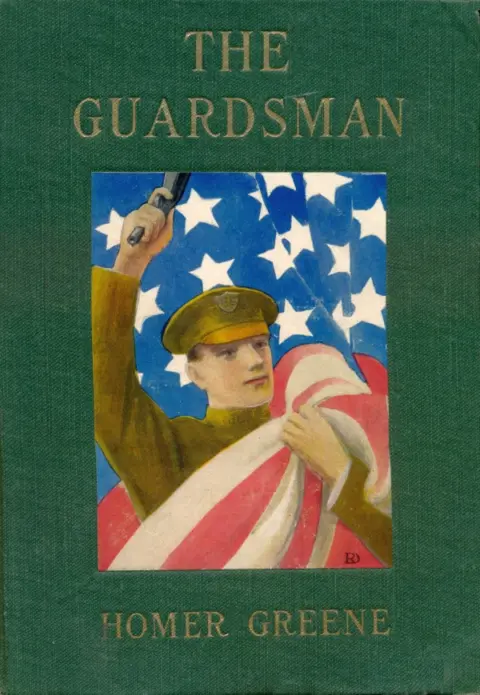
Homer Greene
Homer Greene
BEHIND THE BOOK
This eBook is for the use of anyone anywhere in the United States and most other parts of the world at no cost and with almost no restrictions whatsoever. You may copy it, give it away or re-use it under the terms of the Project Gutenberg License included with this eBook or online at www.gutenberg.org. If you are not located in the United States, you will have to check the laws of the country where you are located before using this eBook. Read the source licence.
The original source file, including credits and licence, is retained by this library. Request an original-format copy at no charge. Please include the book title and Project Gutenberg identifier #25188.
KEEP YOUR CURIOSITY GOING
Coulson Kernahan

Maurice Baring
Frances Wright
Cécile Tormay

Frederic Jesup Stimson

W. H. P. (William Henry Pope) Jarvis