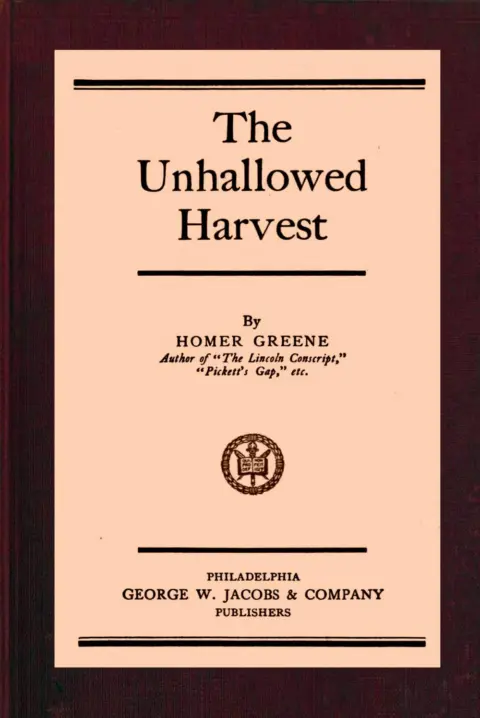
The unhallowed harvest
Homer Greene
THE CLASSIC COLLECTION · 1917
"The Flag" by Homer Greene is a novel written in the early 20th century. The story revolves around Penfield Butler, a fourteen-year-old boy living in the village of Chestnut Hill, where rivalries between local youth lead to playful yet intense conflicts. The narrative opens against a backdrop of snowy winter, highlighting Pen's interactions with family and friends as well as his involvement in a school initiative to raise money for an American flag. At the start of the book, we are introduced to Pen and his family, including his strict yet loving Aunt Millicent and his grandfather, Colonel Butler. The tension between the Hilltops and the Riverbeds, two boyhood factions, is evident as excitement grows for a more significant "battle" involving snowball fights. As the story unfolds, Pen's determination to see off his grandfather on a train is interrupted by an accident during coasting, which inadvertently leads to rivalry and competition for the flag being the centerpiece of their conflicts. The opening chapters set the stage for a tale of youthful conflict, camaraderie, and the exploration of patriotism, setting up deeper themes of honor and self-reflection.
Introduction adapted from the source catalogue; source summaries may be automatically generated.
Free to read · English · 57,191 words · No account needed
MAKE TIME FOR A GOOD BOOK
On by default. Untick to stop anonymous reading totals. Each page counts after 10 seconds in view. How this works.
Anonymous counting is on unless you have switched it off.
The colonel resumed his seat amid a roar of applause, and when it had subsided Miss Grey arose to introduce the respondent.
"This beautiful flag," she said, "will now be accepted, on behalf of
the school, in an address by one of our pupils: Master Alexander
Sands."
Aleck arose and made his way to the platform. The Riverbeds applauded him vigorously, and the guests mildly, as he went. He started out bravely enough on his speech.
"Colonel Butler, teachers and guests: It gives me pleasure, on behalf of the Chestnut Hill public school, to accept this beautiful flag--"
He made a sweeping gesture toward the right-hand corner of the platform, as he had done at rehearsals, only to discover that the flag had, at the last moment, been shifted to the left-hand corner, and he had, perforce, to turn and repeat his gesture in that direction. There was nothing particularly disconcerting about this, but it broke the continuity of his effort, it interfered with his memory, he halted, colored, and cudgeled his brains to find what came next. Back, in the rear of the room, where the Hilltops were gathered, there was an audible snicker; but Aleck was too busy to hear it, and Miss Grey, prepared for just such an emergency as this, glanced at a manuscript she had in her hand, and prompted him:
"So graciously given to us--"
Aleck caught the words and went on:
"--so graciously given to us by our honored townsman and patriotic citizen, Colonel Richard Butler."
Another pause. Again Miss Grey came to the rescue.
"No words of mine--" she said.
"No words of mine," repeated Aleck.
"Sure, they're no words of yours," said some one in a stage-whisper,
far down in the audience.
Suspicion pointed to Elmer Cuddeback, but he stood there against the wall, with such an innocent, sober look on his round face, that people thought they must be mistaken. The words had not failed to reach to the platform, however, and Miss Grey, more troubled than before, again had recourse to her manuscript for the benefit of Aleck, who was floundering more deeply than ever in the bogs of memory.
"--can properly express--"
"--can properly express--"
Another pause. Again the voice back by the wall:
"Express broke down; take local."
The situation was growing desperate. Miss Grey was almost at her wit's end. Then a bright idea struck her. She thrust the manuscript into Aleck's hand.
"Oh, Aleck," she exclaimed, "take it and read it!"
He grasped it like the proverbial drowning man, turned it upside down and right side up, but failed to find the place where he had left off.
Your reading position is saved on this browser. Take it to another device with a library code. Reading pages adapt to text, rather than matching a printed edition.
Homer Greene
Homer Greene
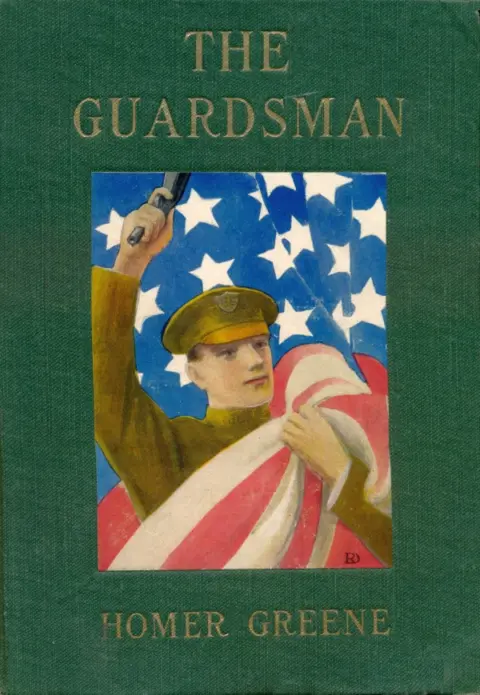
Homer Greene
Homer Greene
BEHIND THE BOOK
This eBook is for the use of anyone anywhere in the United States and most other parts of the world at no cost and with almost no restrictions whatsoever. You may copy it, give it away or re-use it under the terms of the Project Gutenberg License included with this eBook or online at www.gutenberg.org. If you are not located in the United States, you will have to check the laws of the country where you are located before using this eBook. Read the source licence.
The original source file, including credits and licence, is retained by this library. Request an original-format copy at no charge. Please include the book title and Project Gutenberg identifier #25188.
KEEP YOUR CURIOSITY GOING
Coulson Kernahan

Maurice Baring
Frances Wright
Cécile Tormay

Frederic Jesup Stimson

W. H. P. (William Henry Pope) Jarvis