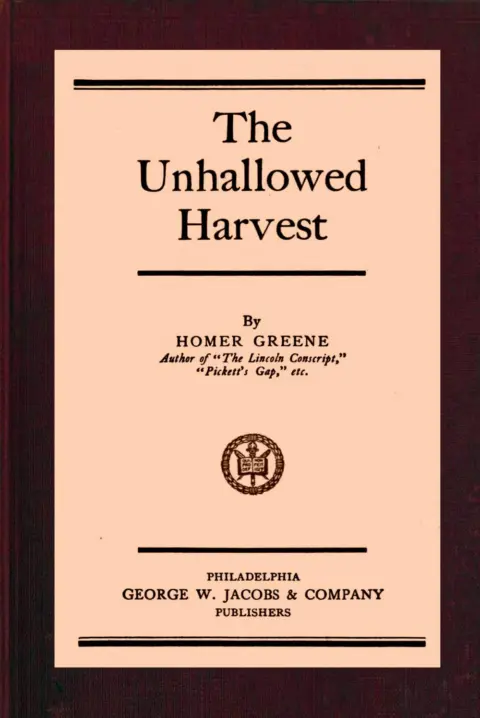
The unhallowed harvest
Homer Greene
THE CLASSIC COLLECTION · 1917
"The Flag" by Homer Greene is a novel written in the early 20th century. The story revolves around Penfield Butler, a fourteen-year-old boy living in the village of Chestnut Hill, where rivalries between local youth lead to playful yet intense conflicts. The narrative opens against a backdrop of snowy winter, highlighting Pen's interactions with family and friends as well as his involvement in a school initiative to raise money for an American flag. At the start of the book, we are introduced to Pen and his family, including his strict yet loving Aunt Millicent and his grandfather, Colonel Butler. The tension between the Hilltops and the Riverbeds, two boyhood factions, is evident as excitement grows for a more significant "battle" involving snowball fights. As the story unfolds, Pen's determination to see off his grandfather on a train is interrupted by an accident during coasting, which inadvertently leads to rivalry and competition for the flag being the centerpiece of their conflicts. The opening chapters set the stage for a tale of youthful conflict, camaraderie, and the exploration of patriotism, setting up deeper themes of honor and self-reflection.
Introduction adapted from the source catalogue; source summaries may be automatically generated.
Free to read · English · 57,191 words · No account needed
MAKE TIME FOR A GOOD BOOK
On by default. Untick to stop anonymous reading totals. Each page counts after 10 seconds in view. How this works.
Anonymous counting is on unless you have switched it off.
"Penfield," he said, "a gentleman should never permit anything to interfere with the keeping of his engagements. If the matter in hand is of sufficient importance to call for an engagement, it is of sufficient importance to keep the engagement so made. It is an elementary principle of good conduct that a gentleman should always keep his word. Otherwise the relations of men with each other would become chaotic."
"Yes, sir," replied Pen.
Colonel Butler removed his glasses and again applied himself to the disposal of his food which had been cut into convenient portions by his devoted daughter.
But his mind soon recurred to the subject of the flag.
"A--Penfield," he inquired, "do you chance to know whether any person
has been chosen to make a formal response to my speech of
presentation?"
Pen felt that the conversation was approaching an embarrassing stage, but there was no hesitancy in his manner as he replied:
"Yes, sir. The boy that got your offer, Aleck Sands, will make the
response."
"H'm! I was hoping, expecting in fact, that you, yourself, would be chosen to perform that pleasing duty. Had you been, we could have prepared our several speeches with a view to their proper relation to each other. It occurred to me that your teacher, Miss Grey, would have this fact in mind. Do you happen to know of any reason why she should not have appointed you?"
For the first time in the course of the conversation Pen hesitated and
stammered.
"Why, I--she--she did appoint me."
"Haven't you just told me, sir, that--"
"But, grandfather, I declined."
Aunt Millicent dropped her hands into her lap in astonishment.
"Pen Butler!" she exclaimed, "why haven't you told me a word of this
before?"
"Because, Aunt Milly, it wasn't a very agreeable incident, and I didn't want to bother you telling about it."
Colonel Butler had, in the meantime, again put on his glasses in order that he might look more searchingly at his grandson.
"Permit me to inquire," he asked, "why you should have declined so
distinct an honor?"
Then Pen blurted out his whole grievance.
"Because Aleck Sands didn't do the fair thing. He got you to give the flag through him instead of through me, by a mean trick. He gets the credit of getting the flag; now let him have the honor of accepting it. I won't play second fiddle to such a fellow as he is, and that's all there is to it."
He pushed his chair back from the table and sat, with flaming cheeks and defiant eyes, as if ready to meet all comers.
Aunt Millicent, more astonished than ever, exclaimed:
"Why, Pen Butler, I'm shocked!"
Your reading position is saved on this browser. Take it to another device with a library code. Reading pages adapt to text, rather than matching a printed edition.
Homer Greene
Homer Greene
Homer Greene
Homer Greene
BEHIND THE BOOK
This eBook is for the use of anyone anywhere in the United States and most other parts of the world at no cost and with almost no restrictions whatsoever. You may copy it, give it away or re-use it under the terms of the Project Gutenberg License included with this eBook or online at www.gutenberg.org. If you are not located in the United States, you will have to check the laws of the country where you are located before using this eBook. Read the source licence.
The original source file, including credits and licence, is retained by this library. Request an original-format copy at no charge. Please include the book title and Project Gutenberg identifier #25188.
KEEP YOUR CURIOSITY GOING
Coulson Kernahan

Maurice Baring
Frances Wright
Cécile Tormay

Frederic Jesup Stimson

W. H. P. (William Henry Pope) Jarvis