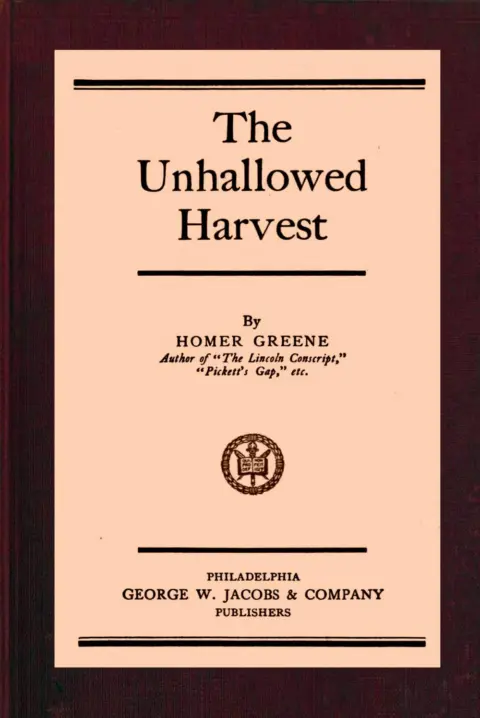
The unhallowed harvest
Homer Greene
THE CLASSIC COLLECTION · 1917
"The Flag" by Homer Greene is a novel written in the early 20th century. The story revolves around Penfield Butler, a fourteen-year-old boy living in the village of Chestnut Hill, where rivalries between local youth lead to playful yet intense conflicts. The narrative opens against a backdrop of snowy winter, highlighting Pen's interactions with family and friends as well as his involvement in a school initiative to raise money for an American flag. At the start of the book, we are introduced to Pen and his family, including his strict yet loving Aunt Millicent and his grandfather, Colonel Butler. The tension between the Hilltops and the Riverbeds, two boyhood factions, is evident as excitement grows for a more significant "battle" involving snowball fights. As the story unfolds, Pen's determination to see off his grandfather on a train is interrupted by an accident during coasting, which inadvertently leads to rivalry and competition for the flag being the centerpiece of their conflicts. The opening chapters set the stage for a tale of youthful conflict, camaraderie, and the exploration of patriotism, setting up deeper themes of honor and self-reflection.
Introduction adapted from the source catalogue; source summaries may be automatically generated.
Free to read · English · 57,191 words · No account needed
MAKE TIME FOR A GOOD BOOK
On by default. Untick to stop anonymous reading totals. Each page counts after 10 seconds in view. How this works.
Anonymous counting is on unless you have switched it off.
But there were no complaints. The men were on the firing line, ready to obey orders, whatever they might be; they asked only one thing more, and that was to fight. But, in these days, there was a lull in the actual fighting. The "big drive" had not yet been launched. Aside from a skirmish now and then, a fierce bombardment for a few hours, an attempt, on one side or the other, to rush a trench, there was little aggressive warfare in this neighborhood, and few casualties; nor was there any material variance in the front lines of trenches on either side. There were six days of this kind of duty and then the men of Pen's company were relieved and sent to the rear for a week's rest, to act as reserves, and to be called during that time only in case of an emergency. But the following week saw them again at the front; not in the same trench where they had first served, but in an advanced position farther to the south. The trenches here were not so roomy nor so dry as had been those of the first assignment. There was much mud, slippery and deep, to be contended with, and the walls at the sides were continually caving in. The duties of the men, however, were not materially different from those with which they were already familiar. Clashes had been more frequent here, and the dead bodies of soldiers, crumpled up in the trench or lying, unrescued, on the scarred and fire-swept surface of "no man's land" were not an unusual sight. But the "rookies" were becoming hardened now to many of the horrors of war.
It was while they were in this trench that Pen had his "baptism of fire." Late one afternoon the German artillery began shelling fiercely the first line of Allied trenches. Aleck and Pen were both on sentry duty. Just beyond them Lieutenant Davis stood at an advanced lookout post intent on studying the outside situation by means of his periscope. At irregular intervals machine guns, deftly hidden from the sight of the enemy, poked their menacing mouths toward the Boche lines. Now and then, finding its mark at some point in the course of the winding trench, an enemy shell would explode throwing clouds of dust and debris into the air, wrecking the earthworks where it fell, taking its toll of human lives and limbs. Twice Pen was thrown off his feet by the shock of near-by explosions, but he escaped injury, as did also Aleck. It was apparent that the Germans were either making a feint for the purpose of attacking at some unexpected point, or else that they were preparing for a charge on the trenches which they were bombarding. It developed that the latter theory was the correct one, for, after a while, they directed their fire to the rear of the first line trenches, and set up a still more furious bombardment. This, as every one knew, was for the purpose of preventing the British from bringing up reinforcements, and to give their own troops the opportunity to charge into the Allied front. The charge was not long delayed. A gray wave poured over the parapet of the German first line trench, rolled through the prepared openings in their own barbed-wire entanglements, and advanced, alternately running and creeping, toward the Allied line. But when the Germans were once in the open a terrible thing happened to them. The machine guns from all along the British trenches met them with a rain of bullets that mowed them down as grain falls to the blades of the farmer's reaper. The rifles of the men in khaki, resting on the benches of the parapet, spit constant and deadly fire at them. The artillery to the rear, in constant telephone touch with the first line, quickly found the range and dropped shells into the charging mass with terrible effect. A second body of gray-clad soldiers with fixed bayonets swarmed out of the German trenches and came to the help of their hard-beset comrades, and met a similar fate. Then a third platoon came on, and a fourth. The resources of the enemy in men seemed endless, their persistence remarkable, their recklessness in the face of sure death almost unbelievable. The noise was terrific; the constant rattle of the machine guns, the spitting of rifles, the booming of the artillery, the whining and crashing of shells, the yells of the charging troops, the shrieks of the wounded. In the British trenches the men were assembled, ready to pour out at the whistle and repel the assault on open ground; but it was not necessary for them to do so. The German ranks, unable to withstand the fire that devoured them as they met it, a fire that it was humanly impossible for any troops to withstand, turned back and sought the shelter of their trenches, leaving their dead and wounded piled and sprawled by the hundreds on the ground they had failed to cross.
Your reading position is saved on this browser. Take it to another device with a library code. Reading pages adapt to text, rather than matching a printed edition.
Homer Greene
Homer Greene
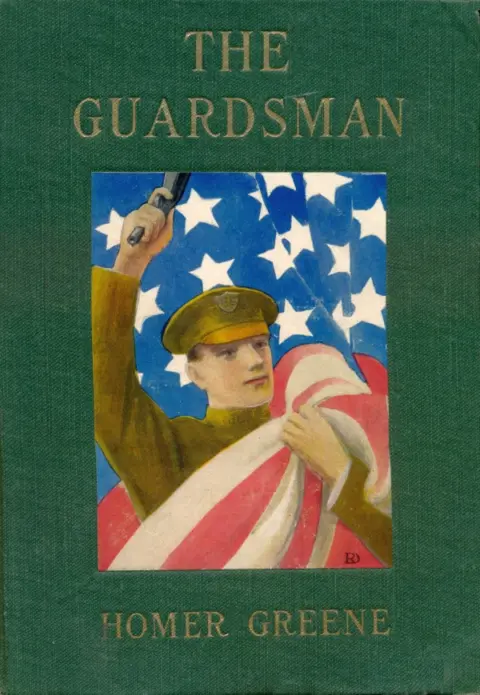
Homer Greene
Homer Greene
BEHIND THE BOOK
This eBook is for the use of anyone anywhere in the United States and most other parts of the world at no cost and with almost no restrictions whatsoever. You may copy it, give it away or re-use it under the terms of the Project Gutenberg License included with this eBook or online at www.gutenberg.org. If you are not located in the United States, you will have to check the laws of the country where you are located before using this eBook. Read the source licence.
The original source file, including credits and licence, is retained by this library. Request an original-format copy at no charge. Please include the book title and Project Gutenberg identifier #25188.
KEEP YOUR CURIOSITY GOING
Coulson Kernahan

Maurice Baring
Frances Wright
Cécile Tormay

Frederic Jesup Stimson

W. H. P. (William Henry Pope) Jarvis