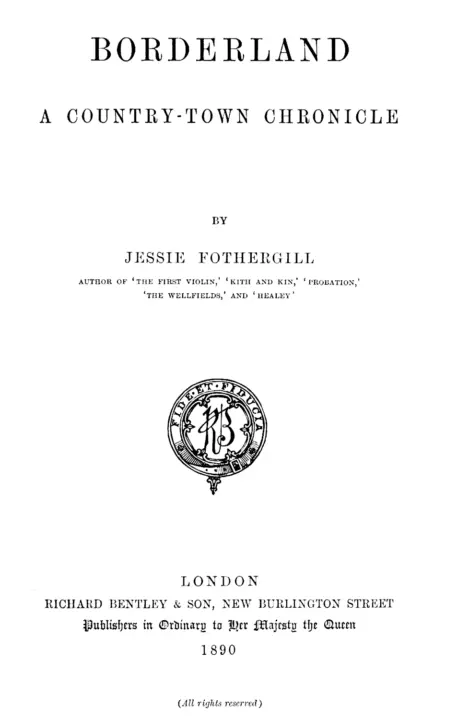
Borderland
Jessie Fothergill
THE CLASSIC COLLECTION · 1895
"The First Violin" by Jessie Fothergill is a novel written in the late 19th century. The story begins with a young woman named May Wedderburn, who grapples with personal challenges and a sense of loneliness despite being surrounded by family. The narrative introduces tensions stemming from her interactions with Miss Hallam, their enigmatic neighbor, and Sir Peter Le Marchant, a man whose intentions toward May cast a shadow over her emerging identity. The opening of the book sets the stage for May’s internal struggles. We witness her contemplative moments as she wrestles with grief and social isolation, despite the picturesque backdrop of her rural home. Following her conversation with Miss Hallam, who unexpectedly proposes tea, May is drawn into a world of complex relationships where societal expectations and her own desires collide. We also meet Sir Peter, whose unwanted affections threaten to compromise her sense of self, creating a sense of foreboding that pervades the opening chapters. As May's life unfolds, the interplay between her aspirations, familial connections, and looming uncertainties invites readers to reflect on themes of autonomy, identity, and social constraints.
Introduction adapted from the source catalogue; source summaries may be automatically generated.
Free to read · English · 142,717 words · No account needed
MAKE TIME FOR A GOOD BOOK
On by default. Untick to stop anonymous reading totals. Each page counts after 10 seconds in view. How this works.
Anonymous counting is on unless you have switched it off.
"I do not understand," said he, putting his hat down, and leaning one elbow upon the piano, while his deep eyes fixed themselves upon my face, and, as usual, began to compel my secrets from me.
"I am going home," said I.
A quick look of feeling--whether astonishment, regret, or dismay, I should not like to have said--flashed across his face.
"Have you had bad news?"
"Yes, very. Miss Hallam returns to England next week."
"But why do you go? Why not remain here?"
"Gladly, if I had any money," I said, with a dry smile. "But I have
none, and can not get any."
"You will return to England now? Do you know what you are giving up?"
"Obligation has no choice," said I, gracefully. "I would give anything if I could stay here, and not go home again." And with that I burst into tears. I covered my face with my hands, and all the pent-up grief and pain of the coming parting streamed from my eyes. I wept uncontrollably.
He did not interrupt my tears for some time. When he did speak, it was
in a very gentle voice.
"Miss Wedderburn, will you try to compose yourself, and listen to
something I have to say?"
I looked up. I saw his eyes fixed seriously and kindly upon me with an expression quite apart from their usual indifferent coolness--with the look of one friend to another--with such a look as I had seen and have since seen exchanged between Courvoisier and his friend Helfen.
"See," said he, "I take an interest in you, Fräulein May. Why should I hesitate to say so? You are young--you do not know the extent of your own strength, or of your own weakness. I do. I will not flatter--it is not my way--as I think you know."
I smiled. I remembered the plentiful blame and the scant praise which it had often fallen to my lot to receive from him.
"I am a strict, sarcastic, disagreeable old pedagogue, as you and so many of my other fair pupils consider," he went on, and I looked up in amaze. I knew that so many of his "fair pupils" considered him exactly the reverse.
"It is my business to know whether a voice is good for anything or not. Now yours, with training, will be good for a great deal. Have you the means, or the chance, or the possibility of getting that training in England?"
"No."
"I should like to help you, partly from the regard I have for you, partly for my own sake, because I think you would do me credit."
Your reading position is saved on this browser. Take it to another device with a library code. Reading pages adapt to text, rather than matching a printed edition.
Jessie Fothergill
Jessie Fothergill
Jessie Fothergill
Jessie Fothergill
BEHIND THE BOOK
This eBook is for the use of anyone anywhere in the United States and most other parts of the world at no cost and with almost no restrictions whatsoever. You may copy it, give it away or re-use it under the terms of the Project Gutenberg License included with this eBook or online at www.gutenberg.org. If you are not located in the United States, you will have to check the laws of the country where you are located before using this eBook. Read the source licence.
The original source file, including credits and licence, is retained by this library. Request an original-format copy at no charge. Please include the book title and Project Gutenberg identifier #29219.
KEEP YOUR CURIOSITY GOING
Coulson Kernahan

Maurice Baring
Frances Wright
Cécile Tormay

Frederic Jesup Stimson

W. H. P. (William Henry Pope) Jarvis