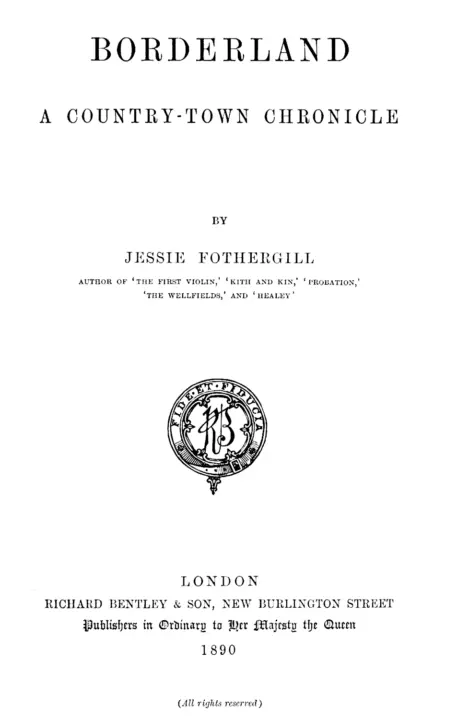
Borderland
Jessie Fothergill
THE CLASSIC COLLECTION · 1895
"The First Violin" by Jessie Fothergill is a novel written in the late 19th century. The story begins with a young woman named May Wedderburn, who grapples with personal challenges and a sense of loneliness despite being surrounded by family. The narrative introduces tensions stemming from her interactions with Miss Hallam, their enigmatic neighbor, and Sir Peter Le Marchant, a man whose intentions toward May cast a shadow over her emerging identity. The opening of the book sets the stage for May’s internal struggles. We witness her contemplative moments as she wrestles with grief and social isolation, despite the picturesque backdrop of her rural home. Following her conversation with Miss Hallam, who unexpectedly proposes tea, May is drawn into a world of complex relationships where societal expectations and her own desires collide. We also meet Sir Peter, whose unwanted affections threaten to compromise her sense of self, creating a sense of foreboding that pervades the opening chapters. As May's life unfolds, the interplay between her aspirations, familial connections, and looming uncertainties invites readers to reflect on themes of autonomy, identity, and social constraints.
Introduction adapted from the source catalogue; source summaries may be automatically generated.
Free to read · English · 142,717 words · No account needed
MAKE TIME FOR A GOOD BOOK
On by default. Untick to stop anonymous reading totals. Each page counts after 10 seconds in view. How this works.
Anonymous counting is on unless you have switched it off.
He submitted--nay, more, he put his arms about my neck and laid his face upon my shoulder, and presently, as if he had choked down some silent emotion, looked up at me with large, imploring, sad eyes, and asked:
"Have you seen my father?"
"Sigmund, I saw him the day before yesterday."
"You saw him--you spoke to him, perhaps?"
"Yes. I spoke long with him."
"What did he look like?"
"As he always does--brave, and true, and noble."
"Nicht wahr?" said the boy, with flashing eyes. "I know how he looks, just. I am waiting till I am grown up, that I may go to him again."
"Do you like me, Sigmund?"
"Yes; very much."
"Do you think you could love me? Would you trust me to love those you
love?"
"Do you mean him?" he asked point-blank, and looked at me somewhat
startled.
"Yes."
"I--don't--know."
"I mean, to take care of him, and try to make him happy till you come to him again, and then we will all be together."
He looked doubtful still.
"What I mean, Sigmund, is that your father and I are going to be married; but we shall never be quite happy until you are with us."
He stood still, taking it in, and I waited in much anxiety. I was certain that if I had time and opportunity I could win him; but I feared the result of this sudden announcement and separation. He might only see that his father--his supreme idol--could turn for comfort to another, while he would not know how I loved him and longed to make his grave young life happy for him. I put my arm round his shoulder, and kneeling down beside him, said:
"You must say you are glad, Sigmund, or you will make me very unhappy. I want you to love me as well as him. Look at me and tell me you will trust me till we are all together, for I am sure we shall be together some day."
He still hesitated some little time, but at last said, with the sedateness peculiar to him, as of one who overcame a struggle and made a sacrifice:
"If he has decided it so it must be right, you know; but--but--you won't let him forget me, will you?"
The child's nature overcame that which had been, as it were, supplanted and grafted upon it. The lip quivered, the dark eyes filled with tears. Poor little lonely child! desolate and sad in the midst of all the grandeur! My heart yearned to him.
"Forget you, Sigmund? Your father never forgets, he can not!"
"I wish I was grown up," was all he said.
Your reading position is saved on this browser. Take it to another device with a library code. Reading pages adapt to text, rather than matching a printed edition.
Jessie Fothergill
Jessie Fothergill
Jessie Fothergill
Jessie Fothergill
BEHIND THE BOOK
This eBook is for the use of anyone anywhere in the United States and most other parts of the world at no cost and with almost no restrictions whatsoever. You may copy it, give it away or re-use it under the terms of the Project Gutenberg License included with this eBook or online at www.gutenberg.org. If you are not located in the United States, you will have to check the laws of the country where you are located before using this eBook. Read the source licence.
The original source file, including credits and licence, is retained by this library. Request an original-format copy at no charge. Please include the book title and Project Gutenberg identifier #29219.
KEEP YOUR CURIOSITY GOING
Coulson Kernahan

Maurice Baring
Frances Wright
Cécile Tormay

Frederic Jesup Stimson

W. H. P. (William Henry Pope) Jarvis