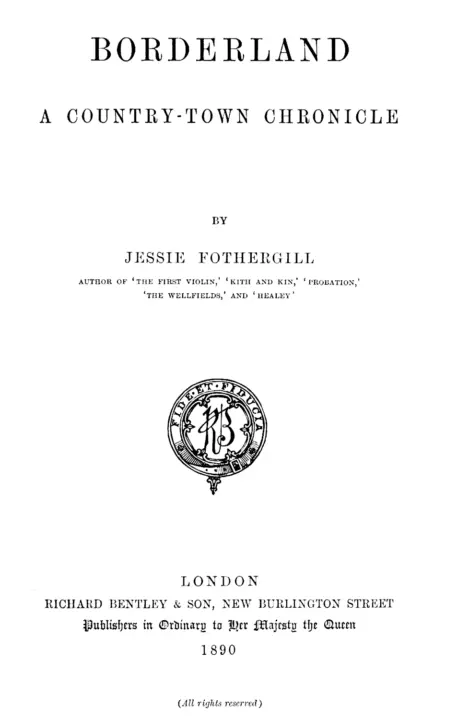
Borderland
Jessie Fothergill
THE CLASSIC COLLECTION · 1895
"The First Violin" by Jessie Fothergill is a novel written in the late 19th century. The story begins with a young woman named May Wedderburn, who grapples with personal challenges and a sense of loneliness despite being surrounded by family. The narrative introduces tensions stemming from her interactions with Miss Hallam, their enigmatic neighbor, and Sir Peter Le Marchant, a man whose intentions toward May cast a shadow over her emerging identity. The opening of the book sets the stage for May’s internal struggles. We witness her contemplative moments as she wrestles with grief and social isolation, despite the picturesque backdrop of her rural home. Following her conversation with Miss Hallam, who unexpectedly proposes tea, May is drawn into a world of complex relationships where societal expectations and her own desires collide. We also meet Sir Peter, whose unwanted affections threaten to compromise her sense of self, creating a sense of foreboding that pervades the opening chapters. As May's life unfolds, the interplay between her aspirations, familial connections, and looming uncertainties invites readers to reflect on themes of autonomy, identity, and social constraints.
Introduction adapted from the source catalogue; source summaries may be automatically generated.
Free to read · English · 142,717 words · No account needed
MAKE TIME FOR A GOOD BOOK
On by default. Untick to stop anonymous reading totals. Each page counts after 10 seconds in view. How this works.
Anonymous counting is on unless you have switched it off.
"Everything, thank you, Frau Lutzler," said I. "But come in! I want to speak to you. I am afraid I have given you no end of trouble."
"Ach, ich bitte sie, Fräulein! Don't mention the trouble. We have
managed to keep you alive."
How they all did rejoice in having won a victory over that gray-winged angel, Death! I thought to myself, with a curious sensation of wonder.
"You are very kind," I said, "and I want you to tell me something, Frau Lutzler: how long have I been ill?"
"Fourteen days, Fräulein; little as you may think it."
"Indeed! I have heard nothing about any one in that time. Who has been made musik-direktor in place of Herr von Francius?"
Frau Lutzler folded her arms and composed herself to tell me a history.
"Ja, Fräulein, the post would have been offered to Herr Courvoisier, only, you see, he has turned out a good-for-nothing. But perhaps you heard about that?"
"Oh, yes! I know all about it," said I, hastily, as I passed my
handkerchief over my mouth to hide the spasm of pain which contracted
it.
"Of course, considering all that, the Direktion could not offer it to him, so they proposed it to Herr Helfen--you know Herr Helfen, Fräulein, nicht?"
I nodded.
"A good young man! a worthy young man, and so popular with his companions! Aber denken sie nur! The authorities might have been offering him an insult instead of a good post. He refused it then and there; would not stop to consider about it--in fact, he was quite angry about it. The gentleman who was chosen at last was a stranger, from Hanover."
"Herr Helfen refused it--why, do you know?"
"They say, because he was so fond of Herr Courvoisier, and would not be set above him. It may be so. I know for a certainty that, so far from taking part against Herr Courvoisier, he would not even believe the story against him, though he could not deny it, and did not try to deny it. Aber, Fräulein--what hearts men must have! To have lived three years, and let the world think him an honest man, when all the time he had that on his conscience! Schrecklich!"
Adelaide and Courvoisier, it seemed, might almost be pelted with the
same stones.
"His wife, they say, died of grief at the disgrace--"
"Yes," said I, wincing. I could not bear this any longer, nor to discuss Courvoisier with Frau Lutzler, and the words "his wife," uttered in that speculatively gossiping tone, repelled me. She turned the subject to Helfen again.
Your reading position is saved on this browser. Take it to another device with a library code. Reading pages adapt to text, rather than matching a printed edition.
Jessie Fothergill
Jessie Fothergill
Jessie Fothergill
Jessie Fothergill
BEHIND THE BOOK
This eBook is for the use of anyone anywhere in the United States and most other parts of the world at no cost and with almost no restrictions whatsoever. You may copy it, give it away or re-use it under the terms of the Project Gutenberg License included with this eBook or online at www.gutenberg.org. If you are not located in the United States, you will have to check the laws of the country where you are located before using this eBook. Read the source licence.
The original source file, including credits and licence, is retained by this library. Request an original-format copy at no charge. Please include the book title and Project Gutenberg identifier #29219.
KEEP YOUR CURIOSITY GOING
Coulson Kernahan

Maurice Baring
Frances Wright
Cécile Tormay

Frederic Jesup Stimson

W. H. P. (William Henry Pope) Jarvis