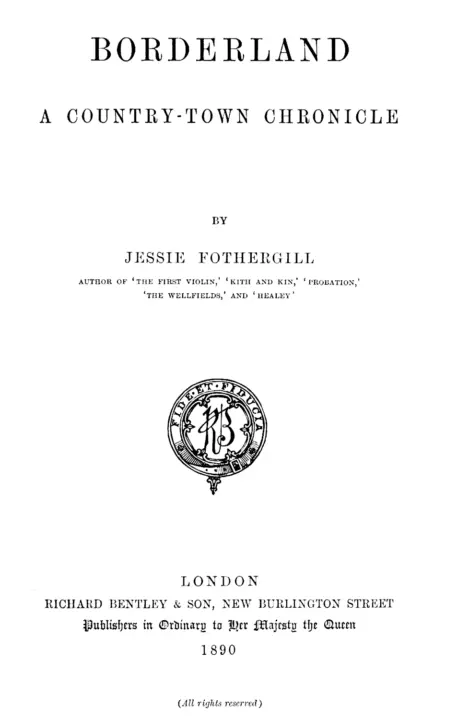
Borderland
Jessie Fothergill
THE CLASSIC COLLECTION · 1895
"The First Violin" by Jessie Fothergill is a novel written in the late 19th century. The story begins with a young woman named May Wedderburn, who grapples with personal challenges and a sense of loneliness despite being surrounded by family. The narrative introduces tensions stemming from her interactions with Miss Hallam, their enigmatic neighbor, and Sir Peter Le Marchant, a man whose intentions toward May cast a shadow over her emerging identity. The opening of the book sets the stage for May’s internal struggles. We witness her contemplative moments as she wrestles with grief and social isolation, despite the picturesque backdrop of her rural home. Following her conversation with Miss Hallam, who unexpectedly proposes tea, May is drawn into a world of complex relationships where societal expectations and her own desires collide. We also meet Sir Peter, whose unwanted affections threaten to compromise her sense of self, creating a sense of foreboding that pervades the opening chapters. As May's life unfolds, the interplay between her aspirations, familial connections, and looming uncertainties invites readers to reflect on themes of autonomy, identity, and social constraints.
Introduction adapted from the source catalogue; source summaries may be automatically generated.
Free to read · English · 142,717 words · No account needed
MAKE TIME FOR A GOOD BOOK
On by default. Untick to stop anonymous reading totals. Each page counts after 10 seconds in view. How this works.
Anonymous counting is on unless you have switched it off.
"Naturally," I said, with a somewhat unsteady laugh. A rush of my ruling feeling--propriety and decent reserve--tied my tongue, and I could not say, "Not all--not always."
He, however, snapped, as it were, at my remark or admission, and chose to take it as if it were in the deepest earnest; for he said, quickly, decisively, and, as I thought, with a kind of exultation:
"Ah, then I will be disagreeable to you."
This remark, and the tone in which it was uttered, came upon me with a shock which I can not express. He would be disagreeable to me because I hated those who were disagreeable to me, ergo, he wished me to hate him. But why? What was the meaning of the whole extraordinary proceeding?
"Why?" I asked, mechanically, and asked nothing more.
"Because then you will hate me, unless you have the good sense to do so
already."
"Why? What effect will my hatred have upon you?"
"None. Not a jot. Gar keine. But I wish you to hate me, nevertheless."
"So you have begun to be disagreeable to me by pulling me out of the water, lending me your coat, and giving me your arm all along this hard, lonely road," said I, composedly.
He laughed.
"That was before I knew of your peculiarity. From to-morrow morning on I shall begin. I will make you hate me. I shall be glad if you hate me."
I said nothing. My head felt bewildered; my understanding benumbed. I was conscious that I was very weary--conscious that I should like to cry, so bitter was my disappointment.
As we came within the town, I said:
"I am very sorry, Herr Courvoisier, to have given you so much trouble."
"That means that I am to put you into a cab and relieve you of my
company."
"It does not," I ejaculated, passionately, jerking my hand from his arm. "How can you say so? How dare you say so?"
"You might meet some of your friends, you know."
"And I tell you I have no friends except Herr von Francius, and I am not accountable to him for my actions."
"We shall soon be at your house now."
"Herr Courvoisier, have you forgiven me?"
"Forgiven you what?"
"My rudeness to you once."
"Ah, mein Fräulein," said he, shrugging his shoulders a little and smiling slightly, "you are under a delusion about that circumstance. How can I forgive that which I never resented?"
This was putting the matter in a new, and, for me, an humbling light.
"Never resented!" I murmured, confusedly.
Your reading position is saved on this browser. Take it to another device with a library code. Reading pages adapt to text, rather than matching a printed edition.
Jessie Fothergill
Jessie Fothergill
Jessie Fothergill
Jessie Fothergill
BEHIND THE BOOK
This eBook is for the use of anyone anywhere in the United States and most other parts of the world at no cost and with almost no restrictions whatsoever. You may copy it, give it away or re-use it under the terms of the Project Gutenberg License included with this eBook or online at www.gutenberg.org. If you are not located in the United States, you will have to check the laws of the country where you are located before using this eBook. Read the source licence.
The original source file, including credits and licence, is retained by this library. Request an original-format copy at no charge. Please include the book title and Project Gutenberg identifier #29219.
KEEP YOUR CURIOSITY GOING
Coulson Kernahan

Maurice Baring
Frances Wright
Cécile Tormay

Frederic Jesup Stimson

W. H. P. (William Henry Pope) Jarvis