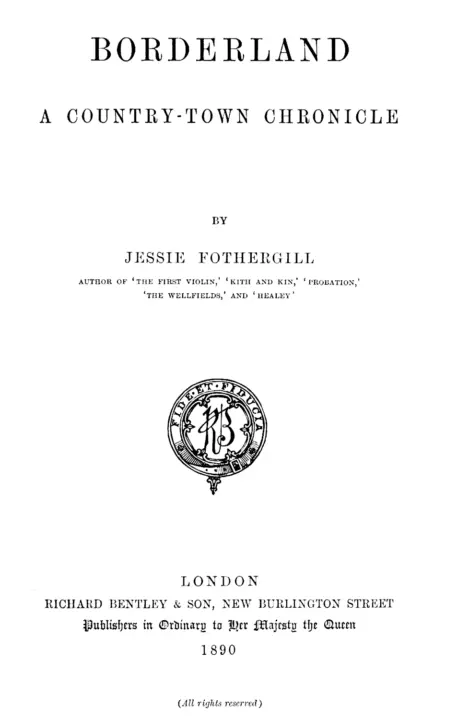
Borderland
Jessie Fothergill
THE CLASSIC COLLECTION · 1895
"The First Violin" by Jessie Fothergill is a novel written in the late 19th century. The story begins with a young woman named May Wedderburn, who grapples with personal challenges and a sense of loneliness despite being surrounded by family. The narrative introduces tensions stemming from her interactions with Miss Hallam, their enigmatic neighbor, and Sir Peter Le Marchant, a man whose intentions toward May cast a shadow over her emerging identity. The opening of the book sets the stage for May’s internal struggles. We witness her contemplative moments as she wrestles with grief and social isolation, despite the picturesque backdrop of her rural home. Following her conversation with Miss Hallam, who unexpectedly proposes tea, May is drawn into a world of complex relationships where societal expectations and her own desires collide. We also meet Sir Peter, whose unwanted affections threaten to compromise her sense of self, creating a sense of foreboding that pervades the opening chapters. As May's life unfolds, the interplay between her aspirations, familial connections, and looming uncertainties invites readers to reflect on themes of autonomy, identity, and social constraints.
Introduction adapted from the source catalogue; source summaries may be automatically generated.
Free to read · English · 142,717 words · No account needed
MAKE TIME FOR A GOOD BOOK
On by default. Untick to stop anonymous reading totals. Each page counts after 10 seconds in view. How this works.
Anonymous counting is on unless you have switched it off.
"I'm certain of one thing: von Francius will go on slapping the public's face. I won't say how it will end; but it would not surprise me in the least to see the public at his feet, as it is now at those of--"
"Humph!" said Karl, reflectively.
He did not stay much longer, but having finished his cigar, rose. He seemed to feel very apologetic, and out of the fullness of his heart his mouth spake.
"I really wouldn't have intruded if I had known--"
"Known what?" inquired Eugen, with well-assumed surprise.
"I thought you were just by yourselves, you know, and--"
"So we are; but we can do with other society. Friedel here gets very tedious sometimes--in fact, langweilig. Come again, nicht wahr?"
"If I sha'n't be in your way," said Karl, looking round the room with
somewhat wistful eyes.
We assured him to the contrary, and he promised, with unnecessary
emphasis, to come again.
"He will return; I know he will!" said Eugen, after he had gone.
The next time that Herr Linders arrived, which was ere many days had passed, he looked excited and important; and after the first greetings were over, he undid a great number of papers which wrapped and infolded a parcel of considerable dimensions, and displayed to our enraptured view of a white woolly animal of stupendous dimensions, fastened upon a green stand, which stand, when pressed, caused the creature to give forth a howl like unto no lowing of oxen nor bleating of sheep ever heard on earth. This inviting-looking creature he held forth toward Sigmund, who stared at it.
"Perhaps he's got one already?" said Karl, seeing that the child did not display any violent enthusiasm about the treasure.
"Oh, no!" said Eugen, promptly.
"Perhaps he doesn't know what it is," I suggested, rather unkindly, scarcely able to keep my countenance at the idea of that baby playing with such a toy.
"Perhaps not," said Karl, more cheerfully, kneeling down by my side--Sigmund sat on my knee--and squeezing the stand, so that the woolly animal howled. "Sieh! Sigmund! Look at the pretty lamb!"
"Oh, come, Karl! Are you a lamb? Call it an eagle at once," said I,
skeptically.
"It is a lamb, ain't it?" said he, turning it over. "They called it a
lamb at the shop."
"A very queer lamb; not a German breed, anyhow."
"Now I think of it, my little sister has one, but she calls it a rabbit,
I believe."
"Very likely. You might call that anything, and no one could contradict
you."
"Well, der Kleine doesn't know the difference; it's a toy," said Karl,
desperately.
Your reading position is saved on this browser. Take it to another device with a library code. Reading pages adapt to text, rather than matching a printed edition.
Jessie Fothergill
Jessie Fothergill
Jessie Fothergill
Jessie Fothergill
BEHIND THE BOOK
This eBook is for the use of anyone anywhere in the United States and most other parts of the world at no cost and with almost no restrictions whatsoever. You may copy it, give it away or re-use it under the terms of the Project Gutenberg License included with this eBook or online at www.gutenberg.org. If you are not located in the United States, you will have to check the laws of the country where you are located before using this eBook. Read the source licence.
The original source file, including credits and licence, is retained by this library. Request an original-format copy at no charge. Please include the book title and Project Gutenberg identifier #29219.
KEEP YOUR CURIOSITY GOING
Coulson Kernahan

Maurice Baring
Frances Wright
Cécile Tormay

Frederic Jesup Stimson

W. H. P. (William Henry Pope) Jarvis