
Letters to a Friend, Written to Mrs. Ezra S. Carr, 1866-1879
John Muir
THE CLASSIC COLLECTION · 1900
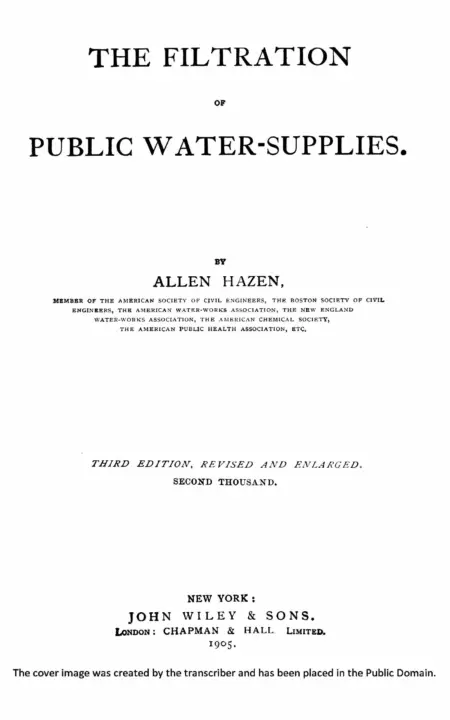
"The Filtration of Public Water-Supplies" by Allen Hazen is a scientific publication written in the early 20th century. The book discusses the critical importance of filtration systems used to purify water supplies, specifically focusing on practices in the United States compared to those in densely populated European countries. It aims to stimulate interest in improving water quality and outlines established methods and necessary conditions for effective water filtration. At the start of the book, Hazen highlights the historical development of water filtration, acknowledging earlier efforts in the United States and contrasting them with successful European practices. He underscores the detrimental effects of using unfiltered water, referencing grave public health issues like cholera outbreaks. The introduction sets the stage for discussing the fundamental principles of filtration, the evolution of methods, and emphasizes the role of proper filtration systems in ensuring the health of urban populations. This opening portion establishes a foundation for a detailed examination of filtration technologies and their significance in public health and engineering, promising a comprehensive resource for those interested in environmental science and engineering practices.
Introduction adapted from the source catalogue; source summaries may be automatically generated.
Free to read · English · 99,444 words · No account needed
MAKE TIME FOR A GOOD BOOK
On by default. Untick to stop anonymous reading totals. Each page counts after 10 seconds in view. How this works.
Anonymous counting is on unless you have switched it off.
------------+-----------+-----------+----------------------------- | |Approximate| Population in Place. | County. | Distance +--------+-------+------------ | | above | 1880. | 1890. | 1900. | | Intake, | | | | | Miles. | | |(Estimated.) ------------+-----------+-----------+--------+-------+------------ Troy |Rensselaer | 4 | 56,747 | 60,956| 65,470 Watervliet |Albany | 4 | 8,820 | 12,967| 19,040 Green Island|Rensselaer | 5 | 4,160 | 4,463| 4,788 Cohoes |Albany | 8 | 19,416 | 22,509| 26,450 Lansingburg |Rensselaer | 8 | 7,432 | 10,550| 14,980 Waterford |Saratoga | 9 | (1,822)| 1,822| (1,822) Schenectady |Schenectady| 28 | 13,655 | 19,002| 26,450 Hoosic Falls|Rensselaer | 44 | 4,530 | 7,014| 10,860 Amsterdam |Montgomery | 44 | 9,466 | 17,336| 31,730 Glens Falls |Warren | 49 | 4,900 | 9,509| 18,450 Saratoga |Saratoga | 51 | 8,421 | 11,975| 17,010 Springs | | | | | Johnstown |Fulton | 56 | 5,013 | 7,768| 12,040 Gloversville|Fulton | 58 | 7,133 | 13,864| 26,930 North Adams,| | | | | Mass. |Berkshire | 68 | 10,191 | 16,074| 25,340 Adams, Mass.|Berkshire | 75 | 5,591 | 9,213| 15,181 Little Falls|Herkimer | 82 | 6,910 | 8,783| 11,160 Utica |Oneida | 107 | 33,914 | 44,007| 57,090 Rome |Oneida | 127 | 12,194 | 14,991| 18,430 32 villages | | | 52,523 | 61,869| 76,194 ------------+-----------+-----------+--------+-------+------------ Total, not including rural | | | population |272,838 |354,672| 479,415 Per square mile | 33 | 43| 59 ------------------------------------+--------+-------+------------
Without entering into a detailed discussion, it may be said that the amount of sewage, with reference to the size of the river and the volume of flow, is a fraction less than that at Lawrence, Mass., where a filter-plant has also been constructed, but the pollution is much greater than that of most American rivers from which municipal water-supplies are taken.
The filtration-plant completed in 1899 takes the water from a point about two miles above the old intake. Pumps lift the water to the sedimentation-basin, from which it flows to the filters and thence through a conduit to the pumping-station previously used.
=Intake.=—The intake consists of a simple concrete structure in the form of a box, having an open top covered with rails 6 inches apart, and connected below, through a 36-inch pipe, with a well in the pumping-station. Before going to the pumps the water passes through a screen with bars 2 inches apart, so arranged as to be raked readily. The rails over the intake and this screen are intended to stop matters which might obstruct the passageways of the pumps, but no attempt is made to stop fish, leaves, or other floating matters which may be in the water. The arrangement, in this respect, is like that of the filter at Lawrence, Mass., where the raw water is not subjected to close screening. There is room, however, to place finer screens in the pump-well, should they be found desirable.
=Pumping-station.=—The centrifugal pumps have a guaranteed capacity of 16,000,000 gallons per 24 hours against a lift of 18 feet, or 12,000,000 gallons per 24 hours against a lift of 24 feet. The ordinary pumping at low water is against the higher lift, and under these conditions either pump can supply the ordinary consumption, the other pump being held in reserve.
The pumping-station building, to a point above the highest flood-level, is of massive concrete construction, without openings. Nearly all the machinery is necessarily below this level, and in high water the sluice-gates are closed, and the machinery is thus protected from flooding. The superstructure is of pressed brick, with granite trimmings.
Your reading position is saved on this browser. Take it to another device with a library code. Reading pages adapt to text, rather than matching a printed edition.
BEHIND THE BOOK
This eBook is for the use of anyone anywhere in the United States and most other parts of the world at no cost and with almost no restrictions whatsoever. You may copy it, give it away or re-use it under the terms of the Project Gutenberg License included with this eBook or online at www.gutenberg.org. If you are not located in the United States, you will have to check the laws of the country where you are located before using this eBook. Read the source licence.
The original source file, including credits and licence, is retained by this library. Request an original-format copy at no charge. Please include the book title and Project Gutenberg identifier #69025.
KEEP YOUR CURIOSITY GOING
John Muir

Asa Gray
Asa Gray

Florence Nightingale
Elizabeth Robins Pennell
Denison Olmsted