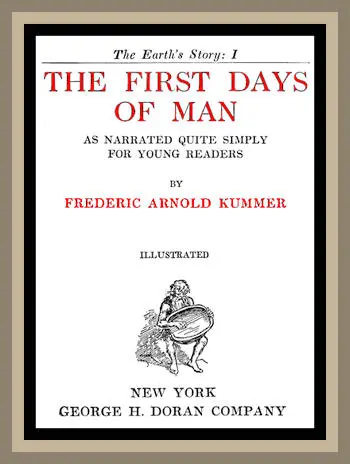
The First Days of Man, as Narrated Quite Simply for Young Readers
Frederic Arnold Kummer
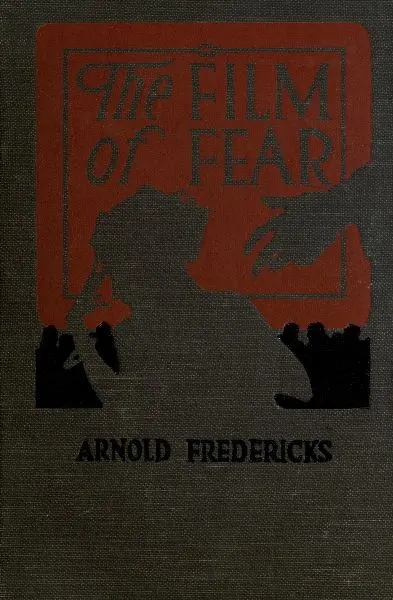
THE CLASSIC COLLECTION · 1917
"The Film of Fear" by Arnold Fredericks is a fictional work written in the early 20th century. The story revolves around actress Ruth Morton, who finds herself a target of threatening notes that promise to ruin her beauty. The plot unfolds in a glamorous yet menacing Hollywood backdrop, filled with intrigue and the dangers of envy in the competitive world of film. The opening of the novel introduces Ruth Morton, a rising motion picture star whose daily routine includes sifting through a barrage of fan mail. However, her seemingly glamorous life takes a dark turn when she receives a chilling letter sealed with a sinister death's head emblem, declaring that her beauty will be destroyed within thirty days. As Ruth grapples with the threat and its implications, her concerned mother enlists the help of Richard Duvall, an adept investigator, to uncover the source of the threats. This sets the stage for a gripping exploration of jealousy, fame, and the lengths people will go to sabotage others.
Introduction adapted from the source catalogue; source summaries may be automatically generated.
Free to read · English · 61,063 words · No account needed
MAKE TIME FOR A GOOD BOOK
On by default. Untick to stop anonymous reading totals. Each page counts after 10 seconds in view. How this works.
Anonymous counting is on unless you have switched it off.
"A dozen people. Half a hundred, I guess. You see, Mr. Moore's office is a big room, just beyond here." He rose, and led the detective through a short corridor. "Here it is," he went on, throwing open the door. "This is where Mr. Moore receives his callers. It is his reception room, and no private papers are kept here. Those are all in the smaller office adjoining. This room is open at any time. After Mr. Moore leaves in the evening, and he often leaves early, anyone might come in here. And when the offices are closed, at night, I suppose any employee of the company might look in, if he cared to do so, without anyone objecting. You see, this is a sort of public room. The inner office is always kept locked, but there has never seemed to be any good reason for locking this one."
"Still, although you cannot tell who has taken the picture, it seems clear enough that it must have been removed by some one employed in the studio."
"Even that is by no means certain. So many people come here every day. All sorts of visitors, writers, actors, and the like. After business hours I don't doubt any number of persons enter this room, to look at the pictures of our great successes that hang on its walls. And then there are the caretakers, the scrub-women, and their friends. I find that they, many of them, bring in outsiders, after working hours, to look at the studio, and the famous offices. Of course it should not be, and it will not be, in the future, but up to now we have rather welcomed people from outside. It seemed good advertising."
Duvall followed his companion back to his office.
"Then this clue, like all the others in this singular case," he remarked, "seems to end in a blind alley."
"It seems so," assented Mr. Baker, gloomily. "What was your plan about the new film we're going to show to-night?"
Duvall was about to speak, but before he could do so, they heard a slight commotion in the hall outside. Then someone rapped violently on the door.
Both he and Baker sprang to their feet.
"Come in," the latter cried.
The door was flung open, and Mr. Edwards, the director, who was making the picture upon which Ruth Morton was working, strode hastily into the room. "Mr. Baker!" he exclaimed, then paused upon seeing Duvall.
"What is it?" Baker replied.
"Will you look here a minute, please?"
Baker went up to him, his face showing the greatest uneasiness.
"What's the matter?" he asked. "Anything wrong?"
Your reading position is saved on this browser. Take it to another device with a library code. Reading pages adapt to text, rather than matching a printed edition.
Frederic Arnold Kummer
Frederic Arnold Kummer
BEHIND THE BOOK
This eBook is for the use of anyone anywhere in the United States and most other parts of the world at no cost and with almost no restrictions whatsoever. You may copy it, give it away or re-use it under the terms of the Project Gutenberg License included with this eBook or online at www.gutenberg.org. If you are not located in the United States, you will have to check the laws of the country where you are located before using this eBook. Read the source licence.
The original source file, including credits and licence, is retained by this library. Request an original-format copy at no charge. Please include the book title and Project Gutenberg identifier #29498.
KEEP YOUR CURIOSITY GOING
Coulson Kernahan

Maurice Baring
Frances Wright
Cécile Tormay

Frederic Jesup Stimson

W. H. P. (William Henry Pope) Jarvis