THE CLASSIC COLLECTION✦An outlaw’s diary: the CommuneCLASSIC FREE BOOKS
An outlaw’s diary: the Commune
Cécile Tormay
THE CLASSIC COLLECTION · 1917
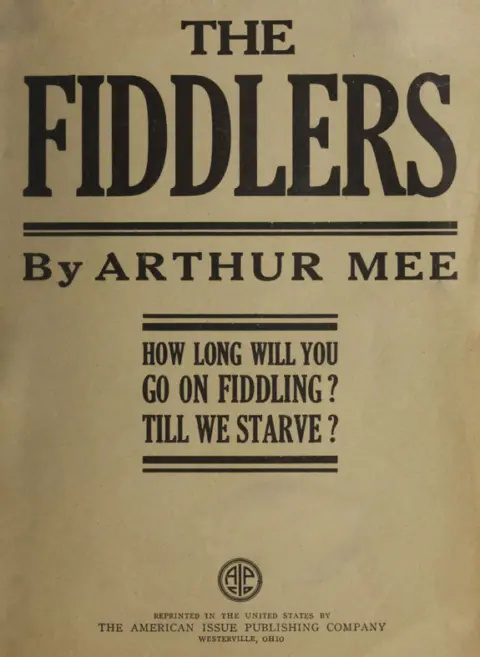
"The Fiddlers; Drink in the Witness Box" by Arthur Mee is a critical examination of the impact of alcohol on society and the war effort, written in the early 20th century, notably during World War I. This work appears to convey strong anti-alcohol sentiments, arguing that the drink trade undermines the country's strength during wartime and contributes to social and economic woes. Mee highlights the detrimental effects of alcohol on both the general population and soldiers, suggesting it is a significant enemy alongside the forces of Germany. The opening of the text establishes a passionate tone as Mee presents a compelling argument against the drink trade, asserting that it prolongs the war and exacerbates dire food shortages. He cites various statistics and examples of the massive quantities of food destroyed for beverage production, claiming that this waste directly threatens national security. Through a series of anecdotes and reports, he builds a case that emphasizes the ruin caused by alcohol at home—neglect, poverty, and broken families—contrasting sharply with the sacrifices of soldiers fighting abroad. The piece serves both as a historical piece and a call to action for societal reform regarding alcohol consumption.
Introduction adapted from the source catalogue; source summaries may be automatically generated.
Free to read · English · 21,745 words · No account needed
MAKE TIME FOR A GOOD BOOK
On by default. Untick to stop anonymous reading totals. Each page counts after 10 seconds in view. How this works.
Anonymous counting is on unless you have switched it off.
“Men I have known for years to be regular promenading tanks have given it up, and are starting a decent life again. The Police Court is empty. England should try it. It would be, after the first heavy initial loss, the best thing that ever struck the nation. I cursed these temperance guys as hard as any, but all the same it cannot blind you from the truth.”
Your Share in the Food Crisis
The Food and Money Wasted on Drink in Our Great Towns
ESTIMATED FROM AUGUST 1914 TO APRIL 1917 INCLUSIVE by GEORGE B. WILSON, B.A., Compiler of the National Drink Bill
───────────────────────┬─────────────┬─────────────┬────────────── │ Drink Bill │ Grain Lost │Sugar in Beer ───────────────────────┼─────────────┼─────────────┼────────────── │ │ Tons │ lb. United Kingdom │ £510,000,000│ 4,400,000│ 762,000,000 London │ £83,000,000│ 693,000│ 120,000,000 Edinburgh │ £3,200,000│ 31,000│ 5,300,000 Dublin │ £2,600,000│ 29,000│ 5,000,000 Glasgow │ £10,500,000│ 101,000│ 17,400,000 Manchester and Salford │ £11,000,000│ 92,000│ 15,900,000 Birmingham │ £9,900,000│ 82,000│ 14,200,000 Liverpool │ £8,800,000│ 73,000│ 12,600,000 Sheffield │ £5,400,000│ 45,000│ 7,800,000 Leeds │ £5,300,000│ 44,000│ 7,600,000 Bristol │ £4,200,000│ 35,000│ 6,000,000 West Ham │ £3,400,000│ 28,000│ 4,900,000 Bradford │ £3,300,000│ 28,000│ 4,800,000 Hull │ £3,300,000│ 27,000│ 4,700,000 Newcastle │ £3,100,000│ 26,000│ 4,500,000 Nottingham │ £3,100,000│ 26,000│ 4,500,000 Portsmouth │ £2,800,000│ 23,000│ 4,400,000 Stoke │ £2,800,000│ 23,000│ 4,000,000 Leicester │ £2,700,000│ 22,000│ 3,800,000 Cardiff │ £2,100,000│ 18,000│ 3,100,000 Bolton │ £2,100,000│ 18,000│ 3,000,000 Croydon │ £2,100,000│ 17,000│ 3,000,000 Sunderland │ £1,700,000│ 14,000│ 2,500,000 Oldham │ £1,700,000│ 14,000│ 2,500,000 Birkenhead │ £1,600,000│ 13,000│ 2,200,000 Blackburn │ £1,500,000│ 13,000│ 2,200,000 Brighton │ £1,500,000│ 13,000│ 2,200,000 Plymouth │ £1,500,000│ 12,000│ 2,100,000 Derby │ £1,400,000│ 12,000│ 2,100,000 Middlesbrough │ £1,400,000│ 12,000│ 2,100,000 Stockport │ £1,400,000│ 12,000│ 2,100,000 Norwich │ £1,400,000│ 12,000│ 2,100,000 Southampton │ £1,400,000│ 12,000│ 2,000,000 Swansea │ £1,400,000│ 12,000│ 2,000,000 Gateshead │ £1,400,000│ 11,000│ 2,000,000 Preston │ £1,400,000│ 11,000│ 1,900,000 Coventry │ £1,300,000│ 11,000│ 1,900,000 Huddersfield │ £1,300,000│ 10,000│ 1,800,000 Halifax │ £1,200,000│ 10,000│ 1,700,000 ───────────────────────┴─────────────┴─────────────┴──────────────
There is one week’s bread in 18 pints of beer There is one week’s sugar in 16 pints of beer
The man who drinks 3 pints a day drinks another man’s rations.
How the Brewer Gets Our Food
It is easy to talk of a mine-sweeper. I wish the whole nation could understand what these men are doing. They are feeding the whole population, battling with the elements as well as with the enemy, battling with dangers overhead and dangers under the sea. The mine-sweeper is like the soldier daily over the parapet—he carries his life in his hand.
First Lord of the Admiralty.
A London caterer ordered a quantity of sugar from the Philippines. The mine-sweepers cleared the way for it and it reached the docks. The caterer sent for it, and was informed that it could only be delivered if it was for a brewer.
A provincial caterer ordered sugar and paid for it, but was told by the Food Controller that it could only be released if it was sold to a brewer.
A working man was discussing rations with his minister in the street. “It is very hard,” he said, “to keep to your rations when you have five strapping lads, but we are going to try it.” Then a drunken man lurched past. The workman pulled himself together, and said, in great passion: “I tell you what it is, sir, I am not going to let my boys starve as long as there is food to make beer for men like that.”
Your reading position is saved on this browser. Take it to another device with a library code. Reading pages adapt to text, rather than matching a printed edition.
BEHIND THE BOOK
This eBook is for the use of anyone anywhere in the United States and most other parts of the world at no cost and with almost no restrictions whatsoever. You may copy it, give it away or re-use it under the terms of the Project Gutenberg License included with this eBook or online at www.gutenberg.org. If you are not located in the United States, you will have to check the laws of the country where you are located before using this eBook. Read the source licence.
The original source file, including credits and licence, is retained by this library. Request an original-format copy at no charge. Please include the book title and Project Gutenberg identifier #53733.
KEEP YOUR CURIOSITY GOING
Cécile Tormay

Moritz Busch
John L. Ransom
Frances Wright
Cécile Tormay

Mabel Potter Daggett