THE CLASSIC COLLECTION✦An outlaw’s diary: the CommuneCLASSIC FREE BOOKS
An outlaw’s diary: the Commune
Cécile Tormay
THE CLASSIC COLLECTION · 1917
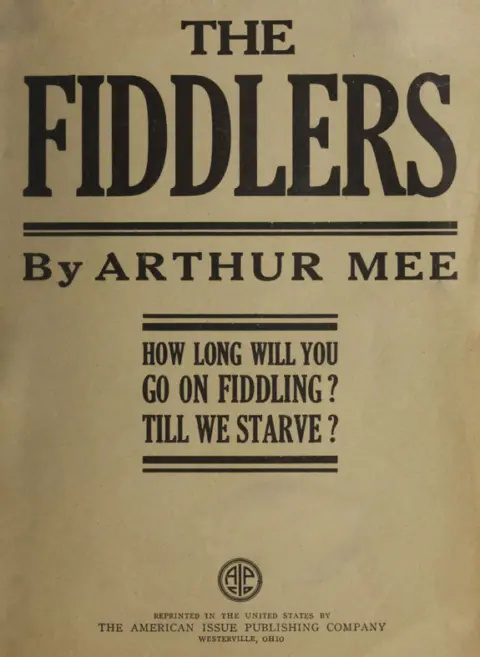
"The Fiddlers; Drink in the Witness Box" by Arthur Mee is a critical examination of the impact of alcohol on society and the war effort, written in the early 20th century, notably during World War I. This work appears to convey strong anti-alcohol sentiments, arguing that the drink trade undermines the country's strength during wartime and contributes to social and economic woes. Mee highlights the detrimental effects of alcohol on both the general population and soldiers, suggesting it is a significant enemy alongside the forces of Germany. The opening of the text establishes a passionate tone as Mee presents a compelling argument against the drink trade, asserting that it prolongs the war and exacerbates dire food shortages. He cites various statistics and examples of the massive quantities of food destroyed for beverage production, claiming that this waste directly threatens national security. Through a series of anecdotes and reports, he builds a case that emphasizes the ruin caused by alcohol at home—neglect, poverty, and broken families—contrasting sharply with the sacrifices of soldiers fighting abroad. The piece serves both as a historical piece and a call to action for societal reform regarding alcohol consumption.
Introduction adapted from the source catalogue; source summaries may be automatically generated.
Free to read · English · 21,745 words · No account needed
MAKE TIME FOR A GOOD BOOK
On by default. Untick to stop anonymous reading totals. Each page counts after 10 seconds in view. How this works.
Anonymous counting is on unless you have switched it off.
A wounded soldier, mentioned in despatches, was charged with causing the death of a soldier with whom he had been drinking. Reeling under a heavy blow, the injured man was helped to bed, but when the bugle sounded in the morning he was dead.
Facts in “Daily Mail,” December 21, 1915
A soldier, aged 29, with a gunshot wound in his arm, died from alcohol at Oxford. One Sunday night he and two other wounded soldiers consumed four bottles of rum brought into the hospital.
Records of Oxford Coroner, January 10, 1916
Three soldiers in hospital uniform were found lying helplessly drunk on the tramlines of Sheffield. Two were back from the Dardanelles.
Facts in “Sheffield Star,” March 2, 1916
Seamen on a ship bringing wounded to England from Boulogne were so drunk that they interfered with the stretcher bearers, and one fell across a wounded soldier lying on deck.
Police Records of Southampton, May 14, 1915
There was a paralysed and helpless man who was found hopelessly drunk in hospital after his friends had visited him.
Statement by Lieut.-Col. Sir Alfred Pearce Gould
An officer who has trained hundreds of men for the ambulance corps declared that a large percentage of wounded are in a very nervous condition, in which alcohol means collapse and almost certain death.
Quoted in “Daily Mail”
Lying helpless at a London station, moaning on the ground in drunken delirium, was a lad in hospital blue who had, in truth, been wounded by his friends. Drink was taking him again through the worst of his experiences, and his mental pain was pitiable to see.
Facts in the “Globe,” January, 1917
Two drunken soldiers from Gallipoli made what a doctor described as the most savage attack he ever saw on a civilian. They held a young man’s head against a wall and pounded him unmercifully.
Facts in “Daily News,” August 19, 1916
A party of soldiers were seriously injured in a struggle to arrest a drunken private at Pontefract. The publican called on the men in his taproom to rescue the private, but the sergeants drove them off.
Facts in “Daily News,” October 5, 1914
A sergeant of a Welsh regiment, invited to drink by friends in Waterloo Road, was picked up as he lay senseless, his pulse beating feebly, his eyes wide open, and his body starving with cold.
Facts in “Daily News,” February 14, 1916
A drunken man rushed from a publichouse and kicked a soldier unconscious. The military police, chasing the man, were stoned. Four soldiers were injured, one having his head cut open, and the military were ordered to clear the place with fixed bayonets.
Facts in “Daily News,” August 11, 1915
Your reading position is saved on this browser. Take it to another device with a library code. Reading pages adapt to text, rather than matching a printed edition.
BEHIND THE BOOK
This eBook is for the use of anyone anywhere in the United States and most other parts of the world at no cost and with almost no restrictions whatsoever. You may copy it, give it away or re-use it under the terms of the Project Gutenberg License included with this eBook or online at www.gutenberg.org. If you are not located in the United States, you will have to check the laws of the country where you are located before using this eBook. Read the source licence.
The original source file, including credits and licence, is retained by this library. Request an original-format copy at no charge. Please include the book title and Project Gutenberg identifier #53733.
KEEP YOUR CURIOSITY GOING
Cécile Tormay

Moritz Busch
John L. Ransom
Frances Wright
Cécile Tormay

Mabel Potter Daggett