THE CLASSIC COLLECTION✦An outlaw’s diary: the CommuneCLASSIC FREE BOOKS
An outlaw’s diary: the Commune
Cécile Tormay
THE CLASSIC COLLECTION · 1917
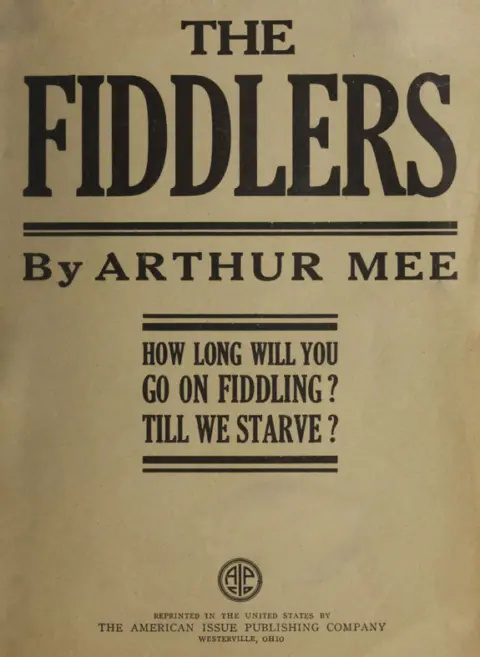
"The Fiddlers; Drink in the Witness Box" by Arthur Mee is a critical examination of the impact of alcohol on society and the war effort, written in the early 20th century, notably during World War I. This work appears to convey strong anti-alcohol sentiments, arguing that the drink trade undermines the country's strength during wartime and contributes to social and economic woes. Mee highlights the detrimental effects of alcohol on both the general population and soldiers, suggesting it is a significant enemy alongside the forces of Germany. The opening of the text establishes a passionate tone as Mee presents a compelling argument against the drink trade, asserting that it prolongs the war and exacerbates dire food shortages. He cites various statistics and examples of the massive quantities of food destroyed for beverage production, claiming that this waste directly threatens national security. Through a series of anecdotes and reports, he builds a case that emphasizes the ruin caused by alcohol at home—neglect, poverty, and broken families—contrasting sharply with the sacrifices of soldiers fighting abroad. The piece serves both as a historical piece and a call to action for societal reform regarding alcohol consumption.
Introduction adapted from the source catalogue; source summaries may be automatically generated.
Free to read · English · 21,745 words · No account needed
MAKE TIME FOR A GOOD BOOK
On by default. Untick to stop anonymous reading totals. Each page counts after 10 seconds in view. How this works.
Anonymous counting is on unless you have switched it off.
“I have never been a teetotaler, and have rather opposed the radical temperance agitation, but am now changing my views as I see our success over here hampered and our progress towards victory retarded so obviously by drink.”
Letter from a Lieut.-Colonel at the Front, seen by the Author
The captain of a British merchant ship, drunk on the bridge, ordered his chief gunner to fire 50 rounds of shell at nothing. The gunner fired four rounds to appease him. Going through the Mediterranean, the drunken captain ordered his gunner to fire at a British hospital ship, and the incident led to a struggle for life, which ended in the captain’s being put in irons, tried, and sentenced to five years’ penal servitude.
Record of Devon Assizes, Exeter, February 2, 1917
An officer was left in charge of a British ship. Mad with drink, he went among the men and shot one dead. He is now in an asylum.
Case reported to the Admiralty
The crew of a Dutch ship arriving in the Tyne was placed under a naval guard after a drunken riot in which three were killed.
Facts in “Daily News,” September 14, 1915
The captain of a Norwegian barque mysteriously disappeared, and the vessel arrived in port from the North Sea. The mate, who had been drinking heavily, was seen, with a hammer in his hand, with the captain in a corner, bleeding from wounds about the head.
Facts in “Daily News,” April 8, 1916
A seaman ashore in Glasgow, “wild with drink and passion,” was terribly wounded in a quarrel in a public-house, and died the same night. A youth of 19 was sentenced to five years’ penal servitude.
Records of Edinburgh High Court, Dec. 1916
A barge-loader at West India Docks died from alcohol, and three other men were removed in an ambulance after drinking rum.
Facts in “Daily Chronicle,” May 9, 1916
Orders were given on a steamer for the boats to be swung out in readiness for submarines. The first and second officer, having been drinking, could not do their duty.
Records of Liverpool Marine Board, April 13, 1917
The jury returned a verdict of murder against a youth of 19 who, after drinking one night, went on to his ship and killed the second officer.
Records of Hull Coroner, April 24, 1917
A drunken captain in command of a drifter landed with an armed party on the Isle of Man. He posted the men on the quay, and gave them orders to allow no one to pass. Declaring he would shoot every person who came within reach, he fired twice, and threatened to kill two police officers.
Facts in “Times,” October 6, 1916
Your reading position is saved on this browser. Take it to another device with a library code. Reading pages adapt to text, rather than matching a printed edition.
BEHIND THE BOOK
This eBook is for the use of anyone anywhere in the United States and most other parts of the world at no cost and with almost no restrictions whatsoever. You may copy it, give it away or re-use it under the terms of the Project Gutenberg License included with this eBook or online at www.gutenberg.org. If you are not located in the United States, you will have to check the laws of the country where you are located before using this eBook. Read the source licence.
The original source file, including credits and licence, is retained by this library. Request an original-format copy at no charge. Please include the book title and Project Gutenberg identifier #53733.
KEEP YOUR CURIOSITY GOING
Cécile Tormay

Moritz Busch
John L. Ransom
Frances Wright
Cécile Tormay

Mabel Potter Daggett