THE CLASSIC COLLECTION✦An outlaw’s diary: the CommuneCLASSIC FREE BOOKS
An outlaw’s diary: the Commune
Cécile Tormay
THE CLASSIC COLLECTION · 1917
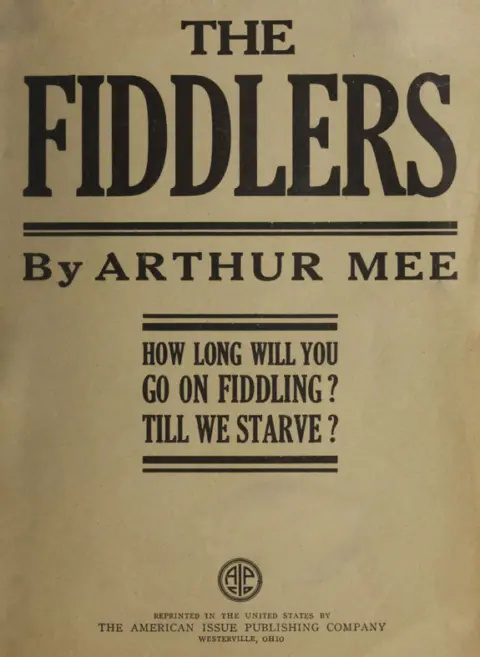
"The Fiddlers; Drink in the Witness Box" by Arthur Mee is a critical examination of the impact of alcohol on society and the war effort, written in the early 20th century, notably during World War I. This work appears to convey strong anti-alcohol sentiments, arguing that the drink trade undermines the country's strength during wartime and contributes to social and economic woes. Mee highlights the detrimental effects of alcohol on both the general population and soldiers, suggesting it is a significant enemy alongside the forces of Germany. The opening of the text establishes a passionate tone as Mee presents a compelling argument against the drink trade, asserting that it prolongs the war and exacerbates dire food shortages. He cites various statistics and examples of the massive quantities of food destroyed for beverage production, claiming that this waste directly threatens national security. Through a series of anecdotes and reports, he builds a case that emphasizes the ruin caused by alcohol at home—neglect, poverty, and broken families—contrasting sharply with the sacrifices of soldiers fighting abroad. The piece serves both as a historical piece and a call to action for societal reform regarding alcohol consumption.
Introduction adapted from the source catalogue; source summaries may be automatically generated.
Free to read · English · 21,745 words · No account needed
MAKE TIME FOR A GOOD BOOK
On by default. Untick to stop anonymous reading totals. Each page counts after 10 seconds in view. How this works.
Anonymous counting is on unless you have switched it off.
=whether the ships that have brought in food for destruction by the drink trade could not have brought in a large proportion of the 3,500,000 tons of wheat now waiting for ships in Australia and the 2,000,000 tons waiting in Canada?=
The Roll of the Dead
No more pitiful record of the war is there than that unnumbered roll of men lured from our armies by this liquor trade, and cast into dishonoured graves. We can take only a few of them.
A number of soldiers at Ormskirk came into camp drunk on Christmas night. A request for quiet led to a fight, and one of the men was struck two blows and was dead the next morning.
Facts in “Daily Mail,” December 28, 1915
A Liverpool soldier, drinking continuously, had overstayed his leave, and in a quarrel about this he stabbed his brother dead.
Facts in “Liverpool Courier,” April 20, 1917
A soldier invalided from France, having recovered from his wounds, gave way to drink, assaulted an officer, and hanged himself in his prison cell.
Facts in “Daily News,” April 11, 1916
A young lieutenant shot himself in an hotel near Trafalgar Square, and among the documents read at the inquest was a letter striking him off his battalion for drinking and gross carelessness.
Facts in “Daily Chronicle,” October 27, 1916
A captain in the Army ruined by drink, with a fine record of military service, started drinking on his way to a shooting range in London, and in a struggle he shot a detective dead.
Facts in “Daily News,” September 20, 1915
In the Scottish Express, between Doncaster and Selby, a drunken corporal of the Coldstream Guards was showing his rifle to a friend when it went off, the bullet killing a munitions works director in the next compartment, and narrowly escaping a lady in the compartment beyond. The corporal had in his pocket a bottle of whisky, which was freely handed round.
Facts in “Daily News,” December 3, 1915
A soldier who had been drinking heavily was placed in the guard
room, and died after a night of groaning, evidently as the result of
a fall.
Records of Greenwich Coroner, January 1, 1915
A young soldier arriving from India on Christmas morning was
arrested three days later, after a drunken fight in which a man was
killed.
Westminster Police Records, December 28, 1914
A soldier spent a day’s leave in Manchester, ate and drank very heavily, and was found dead the next morning from choking.
Records of Manchester Coroner, December 28, 1914
A soldier home on leave was found drunk with his wife. They had been throwing pots at one another, and on Christmas morning the woman was found dead with a wound in her head.
Records of Oldham Coroner, December 24, 1914
Your reading position is saved on this browser. Take it to another device with a library code. Reading pages adapt to text, rather than matching a printed edition.
BEHIND THE BOOK
This eBook is for the use of anyone anywhere in the United States and most other parts of the world at no cost and with almost no restrictions whatsoever. You may copy it, give it away or re-use it under the terms of the Project Gutenberg License included with this eBook or online at www.gutenberg.org. If you are not located in the United States, you will have to check the laws of the country where you are located before using this eBook. Read the source licence.
The original source file, including credits and licence, is retained by this library. Request an original-format copy at no charge. Please include the book title and Project Gutenberg identifier #53733.
KEEP YOUR CURIOSITY GOING
Cécile Tormay

Moritz Busch
John L. Ransom
Frances Wright
Cécile Tormay

Mabel Potter Daggett