THE CLASSIC COLLECTION✦An outlaw’s diary: the CommuneCLASSIC FREE BOOKS
An outlaw’s diary: the Commune
Cécile Tormay
THE CLASSIC COLLECTION · 1917
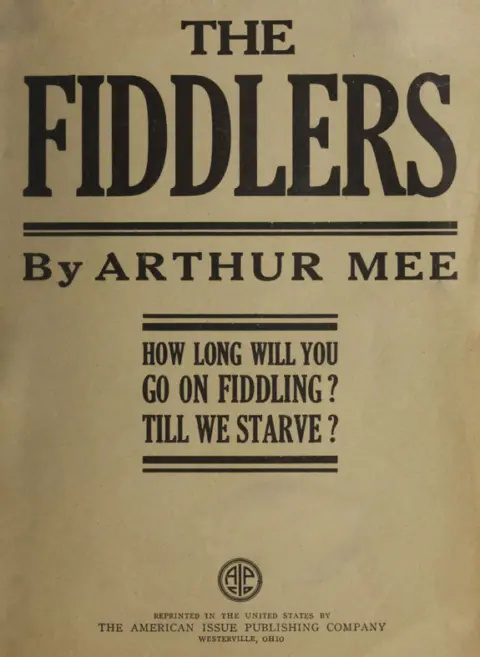
"The Fiddlers; Drink in the Witness Box" by Arthur Mee is a critical examination of the impact of alcohol on society and the war effort, written in the early 20th century, notably during World War I. This work appears to convey strong anti-alcohol sentiments, arguing that the drink trade undermines the country's strength during wartime and contributes to social and economic woes. Mee highlights the detrimental effects of alcohol on both the general population and soldiers, suggesting it is a significant enemy alongside the forces of Germany. The opening of the text establishes a passionate tone as Mee presents a compelling argument against the drink trade, asserting that it prolongs the war and exacerbates dire food shortages. He cites various statistics and examples of the massive quantities of food destroyed for beverage production, claiming that this waste directly threatens national security. Through a series of anecdotes and reports, he builds a case that emphasizes the ruin caused by alcohol at home—neglect, poverty, and broken families—contrasting sharply with the sacrifices of soldiers fighting abroad. The piece serves both as a historical piece and a call to action for societal reform regarding alcohol consumption.
Introduction adapted from the source catalogue; source summaries may be automatically generated.
Free to read · English · 21,745 words · No account needed
MAKE TIME FOR A GOOD BOOK
On by default. Untick to stop anonymous reading totals. Each page counts after 10 seconds in view. How this works.
Anonymous counting is on unless you have switched it off.
A soldier’s wife in Sunderland drew £12 arrears of Army pay, and she and her mother began to drink it away. She drew her pay on Friday, was carried home drunk on Saturday, gave birth to twins on Sunday morning, and died on Sunday night. The twins died a week or two after, and a week or two after that the soldier came home from the trenches to find his family in the grave.
Facts in Sunderland papers, 1917
Two women went drinking in Chester on a Sunday night, a soldier’s mother and a soldier’s wife. They had five whiskies each, and fell drunk in the street. One slept all night on a sofa, and the other lay on the floor, shouting and swearing. Her husband propped her up with a mat, and for hours she lay shrieking. In the morning she was dead. The publican was fined £5.
Facts in “Chester Chronicle,” February 17, 1917
The wife of a Yorkshire soldier was drowned while drunk at Sheffield. She started drinking with another soldier’s wife disappeared with a drunken man, and her death was a mystery.
Facts in “Sheffield Independent,” April 26, 1916
At an inquest on the bodies of a soldier’s twin children, both dead from chronic wasting, it was stated that the mother had 34s. a week, and both she and her husband drank. The mother had had four children in fifteen months, and all were dead.
Records of Battersea Coroner, October 1915
In one street in London where there were one day four convictions for drunkenness, a woman carried a sick baby into a public house. As she stood at the bar the little baby died, but the mother went on drinking, with the dead child in her arms.
Records of Charity Organisation Society
The wife of a highly-esteemed sergeant-major fighting in France was found lying drunk. Her four children, shockingly neglected, were put in a home, but she took them out, went on drinking, and received soldiers at her house. In a few weeks her husband heard in the trenches that his wife had died from drinking.
Records of West Surrey Coroner, March 1917
A soldier left three children at home. He had been earning £1 a week, but his wife received 32s. 6d. a week. She drank it away, neglected the children, and died in an asylum while her husband was in France.
Records of Claybury Asylum
The little child of a soldier in France died in Guy’s Hospital from burns. The mother said she could not buy a fireguard. While she was absent the baby was burned, and the mother, returning in a drunken state carrying a can of beer, said, “A good job!”
Your reading position is saved on this browser. Take it to another device with a library code. Reading pages adapt to text, rather than matching a printed edition.
BEHIND THE BOOK
This eBook is for the use of anyone anywhere in the United States and most other parts of the world at no cost and with almost no restrictions whatsoever. You may copy it, give it away or re-use it under the terms of the Project Gutenberg License included with this eBook or online at www.gutenberg.org. If you are not located in the United States, you will have to check the laws of the country where you are located before using this eBook. Read the source licence.
The original source file, including credits and licence, is retained by this library. Request an original-format copy at no charge. Please include the book title and Project Gutenberg identifier #53733.
KEEP YOUR CURIOSITY GOING
Cécile Tormay

Moritz Busch
John L. Ransom
Frances Wright
Cécile Tormay

Mabel Potter Daggett