THE CLASSIC COLLECTION✦An outlaw’s diary: the CommuneCLASSIC FREE BOOKS
An outlaw’s diary: the Commune
Cécile Tormay
THE CLASSIC COLLECTION · 1917
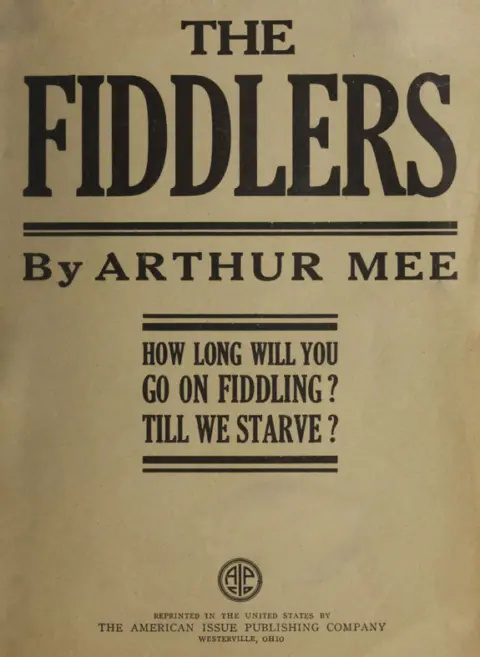
"The Fiddlers; Drink in the Witness Box" by Arthur Mee is a critical examination of the impact of alcohol on society and the war effort, written in the early 20th century, notably during World War I. This work appears to convey strong anti-alcohol sentiments, arguing that the drink trade undermines the country's strength during wartime and contributes to social and economic woes. Mee highlights the detrimental effects of alcohol on both the general population and soldiers, suggesting it is a significant enemy alongside the forces of Germany. The opening of the text establishes a passionate tone as Mee presents a compelling argument against the drink trade, asserting that it prolongs the war and exacerbates dire food shortages. He cites various statistics and examples of the massive quantities of food destroyed for beverage production, claiming that this waste directly threatens national security. Through a series of anecdotes and reports, he builds a case that emphasizes the ruin caused by alcohol at home—neglect, poverty, and broken families—contrasting sharply with the sacrifices of soldiers fighting abroad. The piece serves both as a historical piece and a call to action for societal reform regarding alcohol consumption.
Introduction adapted from the source catalogue; source summaries may be automatically generated.
Free to read · English · 21,745 words · No account needed
MAKE TIME FOR A GOOD BOOK
On by default. Untick to stop anonymous reading totals. Each page counts after 10 seconds in view. How this works.
Anonymous counting is on unless you have switched it off.
Facts in “Sunday Herald,” June 1916
A seaman gunner, who had been torpedoed and had fought in the trenches, arrived home to find his wife, in his own words, “filthy drunk,” and his children utterly deplorable. He reclothed them, but his wife pawned the clothes, though she had £7 a month. He took his children away, but a crowd of women interfered with him, and the police were powerless against the mob.
Facts in “Western Daily Mercury,” July 23, 1915
A soldier just back from the Front was found in the street weeping bitterly on discovering that his wife was in gaol through drink, and his child, through her neglect, had been burned.
Statement by Marchioness of Waterford
A soldier came home from the Front to find that drink had ruined his home, and his children were being cared for by Glasgow Parish Council. “Hour after hour we sit on this council,” says the chairman, “listening to case after case, and the cause is drunkenness, drunkenness, drunkenness. There are 2300 children under the council, and two thousand of them have parents living.” “Our raw material is the finished product of the public-house,” says one of these workers.
Facts from Glasgow Councillors
A motor mechanic at the Front, hearing that his wife, hitherto a sober woman, had given way to drink, obtained leave to come home. He found his wife, very drunk, struggling home with the help of the railings in the street, and neighbours described her horrible life with other soldiers. The husband obtained a separation for the sake of his children, and went back to France.
Full facts in “Kent Messenger,” July 31, 1915
A young soldier came from the trenches to spend Christmas in his home in Sheffield—a teetotal home before the war. He found that his wife had given way to drink, had deserted one child and disappeared with the other, and that a baby was to be born which was not his.
Facts known to the Author
A miner fighting at the Front came home to find his wife at a publichouse, his home filthy, and his children cruelly neglected. He was heartbroken. His young wife frequently left the house from tea-time till midnight, and in order to keep the children from the fire she had burned them severely with a piece of iron. A respectable-looking woman, the mother pleaded for a chance, and was led from the dock sobbing bitterly.
Facts in “Sheffield Independent,” February 21, 1917
A young Yorkshire miner enlisted and left his wife, hitherto sober, with three children. She took to drink, neglected the home, and is now a dipsomaniac, with two children not her husband’s.
Facts known to the Author
Your reading position is saved on this browser. Take it to another device with a library code. Reading pages adapt to text, rather than matching a printed edition.
BEHIND THE BOOK
This eBook is for the use of anyone anywhere in the United States and most other parts of the world at no cost and with almost no restrictions whatsoever. You may copy it, give it away or re-use it under the terms of the Project Gutenberg License included with this eBook or online at www.gutenberg.org. If you are not located in the United States, you will have to check the laws of the country where you are located before using this eBook. Read the source licence.
The original source file, including credits and licence, is retained by this library. Request an original-format copy at no charge. Please include the book title and Project Gutenberg identifier #53733.
KEEP YOUR CURIOSITY GOING
Cécile Tormay

Moritz Busch
John L. Ransom
Frances Wright
Cécile Tormay

Mabel Potter Daggett