THE CLASSIC COLLECTION✦An outlaw’s diary: the CommuneCLASSIC FREE BOOKS
An outlaw’s diary: the Commune
Cécile Tormay
THE CLASSIC COLLECTION · 1921
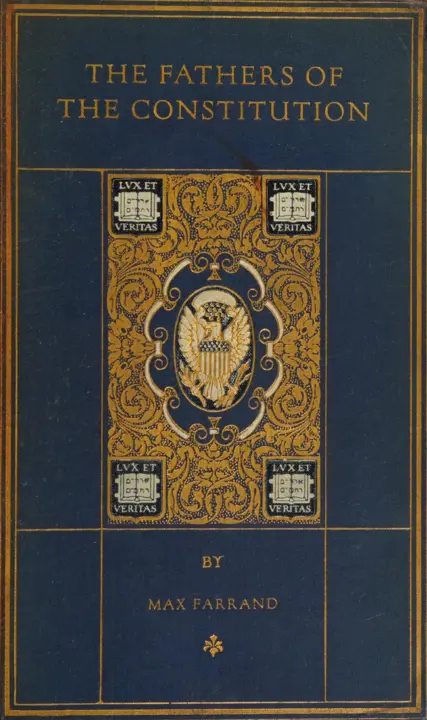
"The Fathers of the Constitution: A Chronicle of the Establishment of the Union" by Max Farrand is a historical account likely written in the early 20th century. The book covers the critical events surrounding the formation of the United States government, focusing on the debates, compromises, and decisions made by the Founding Fathers as they worked to establish a functioning union after gaining independence from Britain. At the start of the book, the author sets the stage by discussing the status of the United States at the conclusion of the Revolution. He explains how, despite the formal recognition of independence from Great Britain, the new nation struggled with issues of legitimacy and respect from other countries. Key figures, including Benjamin Franklin, John Adams, and John Jay, are introduced as influential commissioners involved in negotiating the Treaty of Paris, emphasizing their differing personalities and approaches. The narrative illustrates the challenges faced in achieving international recognition and establishing a cohesive governmental framework during the subsequent years of uncertainty and disunity, highlighting the precarious situation that necessitated the eventual crafting of the Constitution.
Introduction adapted from the source catalogue; source summaries may be automatically generated.
Free to read · English · 52,498 words · No account needed
MAKE TIME FOR A GOOD BOOK
On by default. Untick to stop anonymous reading totals. Each page counts after 10 seconds in view. How this works.
Anonymous counting is on unless you have switched it off.
6. William Samuel Johnson, Emmet 9447, inscribed "Etched by Albert Rosenthal Phila. 1888 from Painting by Gilbert Stuart." A painting by Rosenthal after Stuart hung in Independence Hall. Stuart's portrait of Dr. Johnson "was one of the first, if not the first, painted by Stuart after his return from England." Dated on back 1792. Also copied by Graham.--Mason, Life of Stuart, 208.
7. Roger Sherman, Emmet 9449, inscribed "Etched by Albert Rosenthal Phila. 1888 after Painting by Earle." The identical portrait copied by Thomas Hicks, after Ralph Earle, is in Independence Hall.
8. Alexander Hamilton, Emmet 9452, inscribed "Etched by Albert Rosenthal 1888 after Trumbull." A full length portrait, painted by Col. John Trumbull, is in the City Hall, New York. Other Hamilton portraits by Trumbull are in the Metropolitan Museum of Art, New York, the Boston Museum of Art, and in private possession.
9. William Livingston, Emmet 9454, inscribed "Etched by Albert Rosenthal Phila., 1888." A similar portrait, painted by Rosenthal, formerly hung in Independence Hall. No correspondence relating to it is in the Emmet Collection.
10. David Brearley. There is no portrait. Emmet 9456 is a drawing of a Brearley coat-of-arms taken from a book-plate.
11. William Paterson, Emmet 9458, inscribed "Albert Rosenthal Phila. 1888." A painted portrait by an unknown artist was hung in Independence Hall. The Emmet correspondence reveals nothing.
12. Jonathan Dayton, Emmet 9460, inscribed "Albert Rosenthal." A painting by Rosenthal also formerly hung in Independence Hall. The two are dissimilar. The etching is a profile, but the painting is nearly a full-face portrait. The Emmet correspondence reveals no evidence.
13. Benjamin Franklin, Emmet 9463, inscribed "C. W. Peale Pinxit. Albert
Rosenthal Sc."
14. Thomas Mifflin, Emmet 9466, inscribed "Etched by Albert Rosenthal Phila. 1888 after Painting by Gilbert Stuart." A portrait by Charles Willson Peale, in civilian dress, is in Independence Hall. The Stuart portrait shows Mifflin in military uniform.
15. Robert Morris, Emmet 9470, inscribed "Gilbert Stuart Pinxit. Albert Rosenthal Sc." The original painting is in the Historical Society of Pennsylvania. Stuart painted Morris in 1795. A copy was owned by the late Charles Henry Hart; a replica also existed in the possession of Morris's granddaughter.--Mason, Life of Stuart, 225.
16. George Clymer, Emmet 9475, inscribed "Etched by Albert Rosenthal Phila. 1888 after Painting by C. W. Peale." There is a similar type portrait, yet not identical, in Independence Hall, where the copy was attributed to Dalton Edward Marchant.
17. Thomas Fitzsimons. There is no portrait and the Emmet correspondence
offers no information.
18. Jared Ingersoll, Emmet 9468, inscribed "Etched by Albert Rosenthal after Painting by C. W. Peale." A portrait of the same origin, said to have been copied by George Lambdin, "after Rembrandt Peale," hung in Independence Hall.
Your reading position is saved on this browser. Take it to another device with a library code. Reading pages adapt to text, rather than matching a printed edition.
BEHIND THE BOOK
This eBook is for the use of anyone anywhere in the United States and most other parts of the world at no cost and with almost no restrictions whatsoever. You may copy it, give it away or re-use it under the terms of the Project Gutenberg License included with this eBook or online at www.gutenberg.org. If you are not located in the United States, you will have to check the laws of the country where you are located before using this eBook. Read the source licence.
The original source file, including credits and licence, is retained by this library. Request an original-format copy at no charge. Please include the book title and Project Gutenberg identifier #3032.
KEEP YOUR CURIOSITY GOING
Cécile Tormay

Moritz Busch
John L. Ransom
Frances Wright
Cécile Tormay

Mabel Potter Daggett