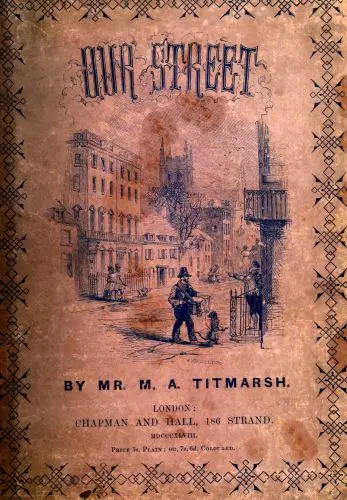
“Our Street”
William Makepeace Thackeray
THE CLASSIC COLLECTION · 1855
"The Fatal Boots" by William Makepeace Thackeray is a satirical novel written during the early 19th century. The story revolves around the misadventures of its main character, Bob Stubbs, who faces a series of unfortunate events largely attributed to his unfortunate obsession with obtaining a pair of fashionable boots. As Stubbs navigates through his trials, his experiences reflect themes of social class, ambition, and the often absurd nature of societal expectations. At the start of the novel, we are introduced to Bob Stubbs, whose life is marked by persistent misfortune, beginning with the circumstances of his birth. He recounts his early years, detailing his childhood experiences including his attempts to navigate school and his peculiar financial dealings with classmates. This opening portion humorously sets the stage for Bob’s character—a somewhat unscrupulous yet endearing young man who aspires to be a gentleman despite his lack of wealth and standing. The narrative plays with the irony of his aspirations against the backdrop of his comically exaggerated misadventures, highlighting the folly and struggles of pursuing one's desires in a rigidly stratified society.
Introduction adapted from the source catalogue; source summaries may be automatically generated.
Free to read · English · 18,641 words · No account needed
MAKE TIME FOR A GOOD BOOK
On by default. Untick to stop anonymous reading totals. Each page counts after 10 seconds in view. How this works.
Anonymous counting is on unless you have switched it off.
“Well,” said I, “they are confoundedly dear; but, as you will have a long time to wait for your money, why, I shall have my revenge you see.” The man looked alarmed, and began a speech: “Sare,--I cannot let dem go vidout”--but a bright thought struck me, and I interrupted--“Sir! don't sir me. Take off the boots, fellow, and, hark ye, when you speak to a nobleman, don't say--Sir.”
“A hundert tousand pardons, my lort,” says he: “if I had known you were a lort, I vood never have called you--Sir. Vat name shall I put down in my books?”
“Name?--oh! why, Lord Cornwallis, to be sure,” said I, as I walked off
in the boots.
“And vat shall I do vid my lort's shoes?”
“Keep them until I send for them,” said I. And, giving him a patronizing bow, I walked out of the shop, as the German tied up my shoes in paper.
This story I would not have told, but that my whole life turned upon these accursed boots. I walked back to school as proud as a peacock, and easily succeeded in satisfying the boys as to the manner in which I came by my new ornaments.
Well, one fatal Monday morning--the blackest of all black-Mondays that ever I knew--as we were all of us playing between school-hours, I saw a posse of boys round a stranger, who seemed to be looking out for one of us. A sudden trembling seized me--I knew it was Stiffelkind. What had brought him here? He talked loud, and seemed angry. So I rushed into the school-room, and burying my head between my hands, began reading for dear life.
“I vant Lort Cornvallis,” said the horrid bootmaker. “His lortship belongs, I know, to dis honorable school, for I saw him vid de boys at chorch yesterday.”
“Lord who?”
“Vy, Lort Cornvallis to be sure--a very fat yong nobeman, vid red hair: he squints a little, and svears dreadfully.”
“There's no Lord Cornvallis here,” said one; and there was a pause.
“Stop! I have it,” says that odious Bunting. “IT MUST BE STUBBS!” And “Stubbs! Stubbs!” every one cried out, while I was so busy at my book as not to hear a word.
At last, two of the biggest chaps rushed into the schoolroom, and seizing each an arm, run me into the playground--bolt up against the shoemaker.
“Dis is my man. I beg your lortship's pardon,” says he, “I have brought your lortship's shoes, vich you left. See, dey have been in dis parcel ever since you vent avay in my boots.”
Your reading position is saved on this browser. Take it to another device with a library code. Reading pages adapt to text, rather than matching a printed edition.
William Makepeace Thackeray
William Makepeace Thackeray
Charles Dickens & William Makepeace Thackeray
William Makepeace Thackeray
BEHIND THE BOOK
This eBook is for the use of anyone anywhere in the United States and most other parts of the world at no cost and with almost no restrictions whatsoever. You may copy it, give it away or re-use it under the terms of the Project Gutenberg License included with this eBook or online at www.gutenberg.org. If you are not located in the United States, you will have to check the laws of the country where you are located before using this eBook. Read the source licence.
The original source file, including credits and licence, is retained by this library. Request an original-format copy at no charge. Please include the book title and Project Gutenberg identifier #2844.
KEEP YOUR CURIOSITY GOING
Coulson Kernahan

Maurice Baring
Frances Wright
Cécile Tormay

Frederic Jesup Stimson

W. H. P. (William Henry Pope) Jarvis