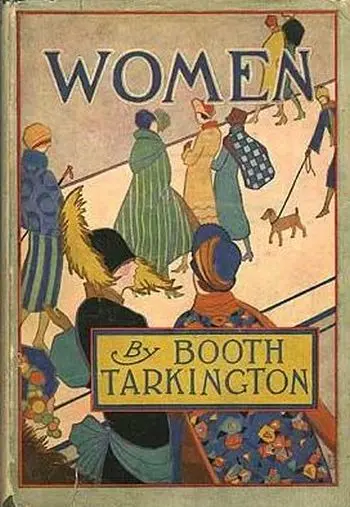
Women
Booth Tarkington
THE CLASSIC COLLECTION · 1923
"The Fascinating Stranger and Other Stories" by Booth Tarkington is a collection of short stories written in the early 20th century. The opening story, "The Fascinating Stranger," introduces Mr. George Tuttle, a down-and-out character who personifies the struggles and disenchantment of modern society in the wake of industrial shifts and the prohibition era. The themes of desperation, identity, and societal critique are likely woven throughout this tale, as Tuttle navigates both his personal plight and broader societal changes. At the start of the book, Mr. Tuttle is depicted waking up in a makeshift bed—a half-assembled limousine body—reflecting his marginalized status in a world moving away from his cherished past of horse-drawn carriages. His inner dialogue reveals his disdain for modernity and automobiles, which he attributes to the ruin of his livelihood as a livery stable owner. As he sets out into the city, Tuttle engages in discussions with a friend that delve into deep societal issues, such as wealth distribution and the perceived moral decay of society, while simultaneously seeking relief from his hangover. This opening sets a tone of both humor and pathos, showcasing Tarkington's ability to depict complex characters within the fabric of early 20th-century American life.
Introduction adapted from the source catalogue; source summaries may be automatically generated.
Free to read · English · 100,891 words · No account needed
MAKE TIME FOR A GOOD BOOK
On by default. Untick to stop anonymous reading totals. Each page counts after 10 seconds in view. How this works.
Anonymous counting is on unless you have switched it off.
Thus, at three o’clock, the next afternoon, Mr. Allen was in fact looking—though somewhat crossly—out of his office window. Below, P. Borodino Thompson was in view, seated in his slowly moving phaeton, exuberantly clad for a man of his special reputation for “closeness,” and with his legs concealed by a new dust-robe, brilliantly bordered; but he was as yet unaccompanied.
A loud and husky voice ascended to the window: “On his way!” And Lucius marked the form and suspender of Mortimer upon the sidewalk below; whereupon Mortimer, seeing that Lucius observed him, clapped hand to mouth, and simulated a jocular writhing in mockery of P. Borodino. “Hay, Bore!” he bellowed. “Floyd Kilbert’s wife’s got a sewin’-machine she wants you to move fer her in that empty seat you’ll have in your phaeton when you git back here to the Square in a few minutes!”
Mr. Thompson waved his whip condescendingly, attempting no other retort; and turned into the maple shade of Pawpaw Street. Five minutes later, “General,” the elderly white horse, was nosing the unyielding hand of the cast-iron darky boy, and the prophecy made by Mr. Allen on the preceding morning was fulfilled.
A neat young woman, descendant of vikings, but tamed in all except accent, showed Mr. Thompson into an Eighteen-Eighty parlour; went away, returned, and addressed him as “yentleman.” Mrs. Ricketts would be glad to see him, she reported, adding: “Yust wait some minute.”
The visitor waited some minutes, then examined his reflection in the glass over the Eastlake mantel; and a slight rustling in the hall, near the doorway, failed to attract his attention, for he was engaged in a fundamental rearrangement of his tie.
“Wookin’ at himseff in the wookin’-gwass!”
This unfavourable comment caused him to tuck his tie back into the neck of his white waistcoat in haste, and to face the doorway somewhat confusedly. Two pretty little children stood there, starchy and fresh, and lustrously clean, dressed in white: a boy about seven and a girl about five—and both had their mother’s blue eyes and amber hair.
“He’s dressin’ himself,” said the boy.
“Wookin’ at himseff in the wookin’-gwass!” the little girl repeated, and, pointing a curling forefinger, she asked: “Who? Who that man?”
“Well, tots,” the visitor said, rather uncomfortably, but with proper graciousness, “who are you? What’s your name, little girl?”
“Maud,” the little girl replied, without any shyness.
“What’s yours, little man?”
“Bill,” said the boy. “Bill Ricketts. You got somep’m stickin’ out of your vest at the top.”
Your reading position is saved on this browser. Take it to another device with a library code. Reading pages adapt to text, rather than matching a printed edition.
Booth Tarkington
Booth Tarkington
Booth Tarkington
Booth Tarkington & Harry Leon Wilson
BEHIND THE BOOK
This eBook is for the use of anyone anywhere in the United States and most other parts of the world at no cost and with almost no restrictions whatsoever. You may copy it, give it away or re-use it under the terms of the Project Gutenberg License included with this eBook or online at www.gutenberg.org. If you are not located in the United States, you will have to check the laws of the country where you are located before using this eBook. Read the source licence.
The original source file, including credits and licence, is retained by this library. Request an original-format copy at no charge. Please include the book title and Project Gutenberg identifier #60529.
KEEP YOUR CURIOSITY GOING
Coulson Kernahan

Maurice Baring
Frances Wright
Cécile Tormay

Frederic Jesup Stimson

W. H. P. (William Henry Pope) Jarvis