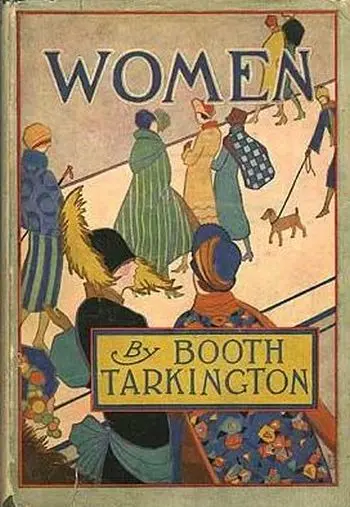
Women
Booth Tarkington
THE CLASSIC COLLECTION · 1923
"The Fascinating Stranger and Other Stories" by Booth Tarkington is a collection of short stories written in the early 20th century. The opening story, "The Fascinating Stranger," introduces Mr. George Tuttle, a down-and-out character who personifies the struggles and disenchantment of modern society in the wake of industrial shifts and the prohibition era. The themes of desperation, identity, and societal critique are likely woven throughout this tale, as Tuttle navigates both his personal plight and broader societal changes. At the start of the book, Mr. Tuttle is depicted waking up in a makeshift bed—a half-assembled limousine body—reflecting his marginalized status in a world moving away from his cherished past of horse-drawn carriages. His inner dialogue reveals his disdain for modernity and automobiles, which he attributes to the ruin of his livelihood as a livery stable owner. As he sets out into the city, Tuttle engages in discussions with a friend that delve into deep societal issues, such as wealth distribution and the perceived moral decay of society, while simultaneously seeking relief from his hangover. This opening sets a tone of both humor and pathos, showcasing Tarkington's ability to depict complex characters within the fabric of early 20th-century American life.
Introduction adapted from the source catalogue; source summaries may be automatically generated.
Free to read · English · 100,891 words · No account needed
MAKE TIME FOR A GOOD BOOK
On by default. Untick to stop anonymous reading totals. Each page counts after 10 seconds in view. How this works.
Anonymous counting is on unless you have switched it off.
“But she didn’t kill us, did she, Elsie?” Laurence urged her. “Our side’s alive, isn’t it, Elsie?”
“I doe’ care whether you are or whether you’re not,” the cold and impartial Miss Threamer returned. “I doe’ care ’nything about it which you are.”
“I am not dead!” Daisy shouted, jumping up and down as she pranced toward the steps where sat the indifferent judge. “I doe’ care if Elsie says I’m dead a thousan’ times, I guess I got my rights, haven’t I?”
“No, you haven’t,” Robert Eliot informed her harshly.
“I have, too!” she cried. “I have, too, got my rights.”
“You haven’t, either,” Laurence said. “You haven’t got any rights. Whatever Elsie says is goin’ to be the rights.”
Daisy strained her voice to its utmost limits: “I got my RIGHTS!” she
bawled.
They crowded about Elsie, arguing, jeering, gesticulating, a shrill and active little mob; meanwhile Elsie, seated somewhat above them, rested her chin on her clean little hand, and looked out over their heads with large, far-away eyes that seemed to take no account of them and their sordid bickerings. And Renfrew, marking how aloof from them she seemed, was conscious of a vague resemblance; Elsie, like Muriel, seemed to dwell above the common herd.
Then, as she watched the clamorous group, he noticed that whenever Laurence Coy appealed to Elsie, his voice, though loud, betrayed a certain breathlessness, while frequently after speaking to her he opened his mouth and took in a little air, which he then swallowed with some difficulty, his neck becoming obviously uneasy. Indeed, this symptom was so pronounced that Renfrew, observing it with great interest, felt that there was something reminiscent about it—that is, it reminded him of something; he could not think just what. But he began to feel that Laurence perceived that Elsie was on a higher plane.
Elsie seemed to think so herself. “I doe’ care ’nything about it,” remained her unaltered verdict. “I doe’ care a thing which is dead or which isn’t.”
“Well, then,” said Laurence Coy, “we might as well play somep’m else.”
“All right,” Daisy agreed. “Le’s play I’m a grea’ big Injun woyer, an’ all the rest of you are children I got to come an’ scalp.”
Her proposal met with no general favour—with no favour at all, in fact. “For heaven’s sakes!” Thomas Kimball said. “I’d like to know what you take us for!” And in this scornful view he was warmly seconded by all his fellows.
Your reading position is saved on this browser. Take it to another device with a library code. Reading pages adapt to text, rather than matching a printed edition.
Booth Tarkington
Booth Tarkington
Booth Tarkington
Booth Tarkington & Harry Leon Wilson
BEHIND THE BOOK
This eBook is for the use of anyone anywhere in the United States and most other parts of the world at no cost and with almost no restrictions whatsoever. You may copy it, give it away or re-use it under the terms of the Project Gutenberg License included with this eBook or online at www.gutenberg.org. If you are not located in the United States, you will have to check the laws of the country where you are located before using this eBook. Read the source licence.
The original source file, including credits and licence, is retained by this library. Request an original-format copy at no charge. Please include the book title and Project Gutenberg identifier #60529.
KEEP YOUR CURIOSITY GOING
Coulson Kernahan

Maurice Baring
Frances Wright
Cécile Tormay

Frederic Jesup Stimson

W. H. P. (William Henry Pope) Jarvis