THE CLASSIC COLLECTION✦Concerning Isabel CarnabyCLASSIC FREE BOOKS
Concerning Isabel Carnaby
Ellen Thorneycroft Fowler
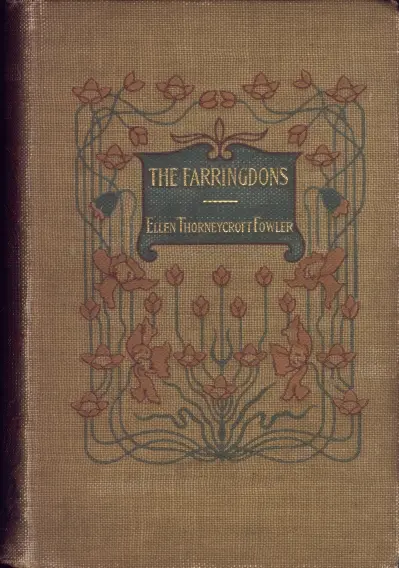
THE CLASSIC COLLECTION · 1900
"The Farringdons" by Ellen Thorneycroft Fowler is a novel written in the late 19th century. The narrative revolves around the Farringdon family, particularly focusing on Maria and Anne Farringdon, who are the daughters and co-heiresses involved in the family business of ironworks in the fictional town of Sedgehill. The story touches on themes of duty, love, and societal expectations, intertwining the characters' personal lives with the backdrop of their Methodist upbringing. At the start of the novel, the reader is introduced to the stark contrast between the industrial east and the picturesque west of Sedgehill. The Farringdons hold a significant social standing, with Maria being a strong-willed manager of the family ironworks while her gentler sister, Anne, navigates life in the shadows of their imposing legacy. The opening chapters also present Elisabeth, their adopted cousin, who yearns for acceptance and grapples with feelings of inadequacy regarding her looks and intelligence. Her vibrant imagination brings her character to life, making her a central figure within the household dynamic, as she seeks to understand her place in a world shaped by family expectations and societal norms. The narrative foreshadows the complexities that will arise as the characters navigate their relationships and personal aspirations.
Introduction adapted from the source catalogue; source summaries may be automatically generated.
Free to read · English · 107,927 words · No account needed
MAKE TIME FOR A GOOD BOOK
On by default. Untick to stop anonymous reading totals. Each page counts after 10 seconds in view. How this works.
Anonymous counting is on unless you have switched it off.
"Oh yes! you have plenty of mind, such as it is; nobody could deny
that."
"But why is the coast-line all irregular, with such a lot of bays and
capes and headlands?"
"To show that you are an undecided person, and given to split hairs, and don't always know your own opinion. First you think you'll do a thing because it is nice; and then you think you won't do it because it is wrong; and in the end you drop between two stools, like Mahomet's coffin."
"I see. And please what are the mountain-ranges that you are drawing
now?"
"These," replied Elisabeth, covering her map with herring-bones, "are your scruples. Like all other mountain-ranges they hinder commerce, make pleasure difficult, and render life generally rather uphill work." "Don't I sound exactly as if I was taking a geography class?"
"Or conducting an Inquisition," added Christopher.
"I thought an Inquisition was a Spanish thing that hurt."
"So certain ignorant people say; but it was originally invented, I believe, to eradicate error and to maintain truth."
"I am going on with my geography class, so don't interrupt. The rivers in this map, which are marked by a few faint lines, are narrow and shallow; they are only found near the coast, and never cross the interior of the country at all. These represent your feelings."
"Very ingenious of you! And what is that enormous blotch right in the middle of the country, which looks like London and its environs?"
"That is your conscience; its outlying suburbs cover nearly the whole country, you will perceive. You will also notice that there are no seaports on the coast of my map; that shows that you are self-contained, and that you neither send exports to, nor receive imports from, the hearts and minds of other people."
"What ever are those queer little castellated things round the coast
that you are drawing now?"
"Those are floating icebergs, to show that it is a cold country. There, my map is finished," concluded Elisabeth, half closing her eyes and contemplating her handiwork through her eyelashes; "and I consider it a most successful sketch."
"It is certainly clever."
"And true, too."
Christopher's eyes twinkled. "Give it me," he said, stretching out his hand; "but sign it with your name first. Not there," he added hastily, as Elisabeth began writing a capital E in one corner; "right across the middle."
Elisabeth looked up in surprise. "Right across the map itself, do you
mean?"
"Yes."
"But it is such a long name that it will cover the whole country."
"I know that."
"It will spoil it."
"I shouldn't be surprised; nevertheless, I always am in favour of
realism."
Your reading position is saved on this browser. Take it to another device with a library code. Reading pages adapt to text, rather than matching a printed edition.
Ellen Thorneycroft Fowler
Ellen Thorneycroft Fowler
BEHIND THE BOOK
This eBook is for the use of anyone anywhere in the United States and most other parts of the world at no cost and with almost no restrictions whatsoever. You may copy it, give it away or re-use it under the terms of the Project Gutenberg License included with this eBook or online at www.gutenberg.org. If you are not located in the United States, you will have to check the laws of the country where you are located before using this eBook. Read the source licence.
The original source file, including credits and licence, is retained by this library. Request an original-format copy at no charge. Please include the book title and Project Gutenberg identifier #19798.
KEEP YOUR CURIOSITY GOING
Coulson Kernahan

Maurice Baring
Frances Wright
Cécile Tormay

Frederic Jesup Stimson

W. H. P. (William Henry Pope) Jarvis