
The Principles of Biology, Volume 2 (of 2)
Herbert Spencer
THE CLASSIC COLLECTION · 1887
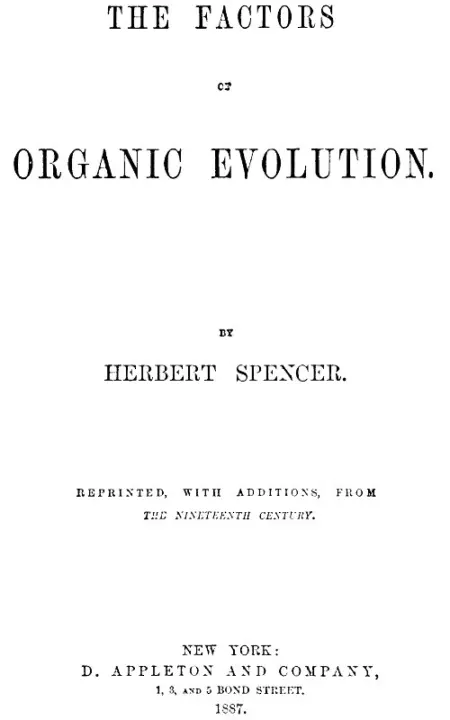
"The Factors of Organic Evolution" by Herbert Spencer is a scientific publication written in the late 19th century. The book discusses the complex processes of biological evolution, emphasizing the interplay between various factors that influence the development of species, including natural selection and inheritance of acquired characteristics. Through its exploration of evolutionary theory, it engages with broader implications for psychology, ethics, and sociology. At the start of this work, the author presents an overview of the chaotic state of scientific opinion regarding organic evolution prior to Darwin's contributions. He reflects on the confusion between creationism and scientific hypotheses and sets the stage for a deeper investigation into how organisms adapt over time. Spencer aims to clarify how both natural selection and the inheritance of functional modifications contribute to the evolutionary process, arguing that neither can explain all phenomena observed in nature on their own. The opening portion lays the groundwork for a more intricate discussion of evolutionary theory, revealing the tensions and debates of the scientific community in the 19th century.
Introduction adapted from the source catalogue; source summaries may be automatically generated.
Free to read · English · 26,496 words · No account needed
MAKE TIME FOR A GOOD BOOK
On by default. Untick to stop anonymous reading totals. Each page counts after 10 seconds in view. How this works.
Anonymous counting is on unless you have switched it off.
But now, recognizing in full this process brought into clear view by Mr. Darwin, and traced out by him with so much care and skill, can we conclude that, taken alone, it accounts for organic evolution? Has the natural selection of favourable variations been the sole factor? On critically examining the evidence, we shall find reason to think that it by no means explains all that has to be explained. Omitting for the present any consideration of a factor which may be distinguished as primordial, it may be contended that the above-named factor alleged by Dr. Erasmus Darwin and by Lamarck, must be recognized as a co-operator. Utterly inadequate to explain the major part of the facts as is the hypothesis of the inheritance of functionally-produced modifications, yet there is a minor part of the facts, very extensive though less, which must be ascribed to this cause.
When discussing the question more than twenty years ago (Principles of Biology, § 166), I instanced the decreased size of the jaws in the civilized races of mankind, as a change not accounted for by the natural selection of favourable variations; since no one of the decrements by which, in thousands of years, this reduction has been effected, could have given to an individual in which it occurred, such advantage as would cause his survival, either through diminished cost of local nutrition or diminished weight to be carried. I did not then exclude, as I might have done, two other imaginable causes. It may be said that there is some organic correlation between increased size of brain and decreased size of jaw: Camper's doctrine of the facial angle being referred to in proof. But this argument may be met by pointing to the many examples of small-jawed people who are also small-brained, and by citing not infrequent cases of individuals remarkable for their mental powers, and at the same time distinguished by jaws not less than the average but greater. Again, if sexual selection be named as a possible cause, there is the reply that, even supposing such slight diminution of jaw as took place in a single generation to have been an attraction, yet the other incentives to choice on the part of men have been too many and great to allow this one to weigh in an adequate degree; while, during the greater portion of the period, choice on the part of women has scarcely operated: in earlier times they were stolen or bought, and in later times mostly coerced by parents. Thus, reconsideration of the facts does not show me the invalidity of the conclusion drawn, that this decrease in size of jaw can have had no other cause than continued inheritance of those diminutions consequent on diminutions of function, implied by the use of selected and well-prepared food. Here, however, my chief purpose is to add an instance showing, even more clearly, the connexion between change of function and change of structure. This instance, allied in nature to the other, is presented by those varieties, or rather sub-varieties, of dogs, which, having been household pets, and habitually fed on soft food, have not been called on to use their jaws in tearing and crunching, and have been but rarely allowed to use them in catching prey and in fighting. No inference can be drawn from the sizes of the jaws themselves, which, in these dogs, have probably been shortened mainly by selection. To get direct proof of the decrease of the muscles concerned in closing the jaws or biting, would require a series of observations very difficult to make. But it is not difficult to get indirect proof of this decrease by looking at the bony structures with which these muscles are connected. Examination of the skulls of sundry indoor dogs contained in the Museum of the College of Surgeons, proves the relative smallness of such parts. The only pug-dog's skull is that of an individual not perfectly adult; and though its traits are quite to the point they cannot with safety be taken as evidence. The skull of a toy-terrier has much restricted areas of insertion for the temporal muscles; has weak zygomatic arches; and has extremely small attachments for the masseter muscles. Still more significant is the evidence furnished by the skull of a King Charles's spaniel, which, if we allow three years to a generation, and bear in mind that the variety must have existed before Charles the Second's reign, we may assume belongs to something approaching to the hundredth generation of these household pets. The relative breadth between the outer surfaces of the zygomatic arches is conspicuously small; the narrowness of the temporal fossæ is also striking; the zygomata are very slender; the temporal muscles have left no marks whatever, either by limiting lines or by the character of the surfaces covered; and the places of attachment for the masseter muscles are very feebly developed. At the Museum of Natural History, among skulls of dogs there is one which, though unnamed, is shown by its small size and by its teeth, to have belonged to one variety or other of lap-dogs, and which has the same traits in an equal degree with the skull just described. Here, then, we have two if not three kinds of dogs which, similarly leading protected and pampered lives, show that in the course of generations the parts concerned in clenching the jaws have dwindled. To what cause must this decrease be ascribed? Certainly not to artificial selection; for most of the modifications named make no appreciable external signs: the width across the zygomata could alone be perceived. Neither can natural selection have had anything to do with it; for even were there any struggle for existence among such dogs, it cannot be contended that any advantage in the struggle could be gained by an individual in which a decrease took place. Economy of nutrition, too, is excluded. Abundantly fed as such dogs are, the constitutional tendency is to find places where excess of absorbed nutriment may be conveniently deposited, rather than to find places where some cutting down of the supplies is practicable. Nor again can there be alleged a possible correlation between these diminutions and that shortening of the jaws which has probably resulted from selection; for in the bull-dog, which has also relatively short jaws, these structures concerned in closing them are unusually large. Thus there remains as the only conceivable cause, the diminution of size which results from diminished use. The dwindling of a little-exercised part has, by inheritance, been made more and more marked in successive generations.
Your reading position is saved on this browser. Take it to another device with a library code. Reading pages adapt to text, rather than matching a printed edition.
Herbert Spencer

Herbert Spencer

Herbert Spencer

Herbert Spencer
BEHIND THE BOOK
This eBook is for the use of anyone anywhere in the United States and most other parts of the world at no cost and with almost no restrictions whatsoever. You may copy it, give it away or re-use it under the terms of the Project Gutenberg License included with this eBook or online at www.gutenberg.org. If you are not located in the United States, you will have to check the laws of the country where you are located before using this eBook. Read the source licence.
The original source file, including credits and licence, is retained by this library. Request an original-format copy at no charge. Please include the book title and Project Gutenberg identifier #52801.
KEEP YOUR CURIOSITY GOING

John Muir

Asa Gray
Asa Gray

Florence Nightingale
Elizabeth Robins Pennell
Denison Olmsted