
The Principles of Biology, Volume 2 (of 2)
Herbert Spencer
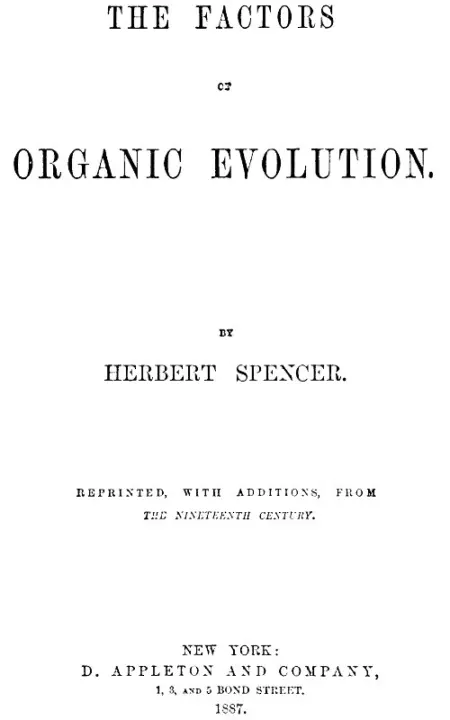
THE CLASSIC COLLECTION · 1887
"The Factors of Organic Evolution" by Herbert Spencer is a scientific publication written in the late 19th century. The book discusses the complex processes of biological evolution, emphasizing the interplay between various factors that influence the development of species, including natural selection and inheritance of acquired characteristics. Through its exploration of evolutionary theory, it engages with broader implications for psychology, ethics, and sociology. At the start of this work, the author presents an overview of the chaotic state of scientific opinion regarding organic evolution prior to Darwin's contributions. He reflects on the confusion between creationism and scientific hypotheses and sets the stage for a deeper investigation into how organisms adapt over time. Spencer aims to clarify how both natural selection and the inheritance of functional modifications contribute to the evolutionary process, arguing that neither can explain all phenomena observed in nature on their own. The opening portion lays the groundwork for a more intricate discussion of evolutionary theory, revealing the tensions and debates of the scientific community in the 19th century.
Introduction adapted from the source catalogue; source summaries may be automatically generated.
Free to read · English · 26,496 words · No account needed
MAKE TIME FOR A GOOD BOOK
On by default. Untick to stop anonymous reading totals. Each page counts after 10 seconds in view. How this works.
Anonymous counting is on unless you have switched it off.
Beginning with the earliest and most minute kinds of living things, we necessarily encounter difficulties in getting direct evidence; since, of the countless species now existing, all have been subject during millions upon millions of years to the evolutionary process, and have had their primary traits complicated and obscured by those endless secondary traits which the natural selection of favourable variations has produced. Among protophytes it needs but to think of the multitudinous varieties of diatoms and desmids, with their elaborately-constructed coverings; or of the definite methods of growth and multiplication among such simple Algæ as the Conjugatæ; to see that most of their distinctive characters are due to inherited constitutions, which have been slowly moulded by survival of the fittest to this or that mode of life. To disentangle such parts of their developmental changes as are due to the action of the medium, is therefore hardly possible. We can hope only to get a general conception of it by contemplating the totality of the facts.
The first cardinal fact is that all protophytes are cellular—all show us this contrast between outside and inside. Supposing the multitudinous specialities of the envelope in different orders and genera of protophytes to be set against one another, and mutually cancelled, there remains as a trait common to them—an envelope unlike that which it envelopes. The second cardinal fact is that this simple trait is the earliest trait displayed in germs, or spores, or other parts from which new individuals are to arise; and that, consequently, this trait must be regarded as having been primordial. For it is an established truth of organic evolution that embryos show us, in general ways, the forms of remote ancestors; and that the first changes undergone, indicate, more or less clearly, the first changes which took place in the series of forms through which the existing form has been reached. Describing, in successive groups of plants, the early transformations of these primitive units, Sachs[4] says of the lowest Algæ that “the conjugated protoplasmic body clothes itself with a cell-wall” (p. 10); that in “the spores of Mosses and Vascular Cryptogams” and in “the pollen of Phanerogams” ... “the protoplasmic body of the mother-cell breaks up into four lumps, which quickly round themselves off and contract, and become enveloped by a cell-membrane only after complete separation” (p. 13); that in the Equisetaceæ “the young spores, when first separated, are still naked, but they soon become surrounded by a cell-membrane” (p. 14); and that in higher plants, as in the pollen of many Dicotyledons, “the contracting daughter-cells secrete cellulose even during their separation” (p. 14). Here, then, in whatever way we interpret it, the fact is that there quickly arises an outer layer different from the contained matter. But the most significant evidence is furnished by “the masses of protoplasm that escape into water from the injured sacs of Vaucheria, which often instantly become rounded into globular bodies,” and of which the “hyaline protoplasm envelopes the whole as a skin” (p. 41) which “is denser than the inner and more watery substance” (p. 42). As in this case the protoplasm is but a fragment, and as it is removed from the influence of the parent-cell, this differentiating process can scarcely be regarded as anything more than the effect of physico-chemical actions: a conclusion which is supported by the statement of Sachs that “not only every vacuole in a solid protoplasmic body, but also every thread of protoplasm which penetrates the sap-cavity, and finally the inner side of the protoplasm-sac which encloses the sap-cavity, is also bounded by a skin” (p. 42). If then “every portion of a protoplasmic body immediately surrounds itself, when it becomes isolated, with such a skin,” which is shown in all cases to arise at the surface of contact with sap or water, this primary differentiation of outer from inner must be ascribed to the direct action of the medium. Whether the coating thus initiated is secreted by the protoplasm, or whether, as seems more likely, it results from transformation of it, matters not to the argument. Either way the action of the medium causes its formation; and either way the many varied and complex differentiations which developed cell-walls display, must be considered as originating from those variations of this physically-generated covering which natural selection has taken advantage of.
Your reading position is saved on this browser. Take it to another device with a library code. Reading pages adapt to text, rather than matching a printed edition.
Herbert Spencer

Herbert Spencer

Herbert Spencer

Herbert Spencer
BEHIND THE BOOK
This eBook is for the use of anyone anywhere in the United States and most other parts of the world at no cost and with almost no restrictions whatsoever. You may copy it, give it away or re-use it under the terms of the Project Gutenberg License included with this eBook or online at www.gutenberg.org. If you are not located in the United States, you will have to check the laws of the country where you are located before using this eBook. Read the source licence.
The original source file, including credits and licence, is retained by this library. Request an original-format copy at no charge. Please include the book title and Project Gutenberg identifier #52801.
KEEP YOUR CURIOSITY GOING

John Muir

Asa Gray
Asa Gray

Florence Nightingale
Elizabeth Robins Pennell
Denison Olmsted