
Last letters from the living dead man
David Patterson (Spirit) Hatch
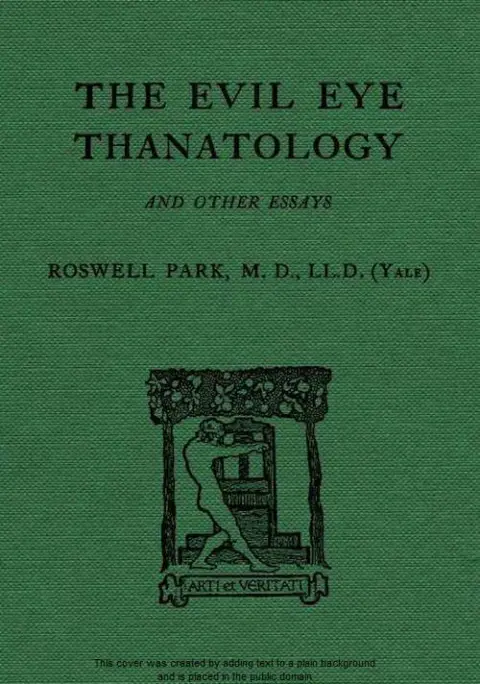
THE CLASSIC COLLECTION · 1912
"The Evil Eye, Thanatology, and Other Essays" by Roswell Park is a collection of essays written in the early 20th century. This volume encompasses a range of interdisciplinary subjects, including anthropology, biology, folklore, and medical studies, exploring beliefs and practices surrounding superstitions and their implications in various cultures. The topics indicate an examination of both historical contexts and contemporary relevance, likely engaging readers interested in the intersections of science, superstition, and history. The opening of the book begins with an in-depth discussion on the concept of the "Evil Eye," wherein the author invites readers to contemplate the historical significance of this belief rooted in envy and malevolence. Park references various cultural interpretations of the Evil Eye, illustrating how it has manifested throughout history—from ancient civilizations to modern-day practices—complemented by examples from different societies, such as the belief in the power of certain gazes or words to incur misfortune. This analysis sets the tone for a thoughtful exploration of how cultural beliefs persist and evolve, inviting readers to consider the interplay of superstition and science in understanding human behavior and societal norms.
Introduction adapted from the source catalogue; source summaries may be automatically generated.
Free to read · English · 92,734 words · No account needed
MAKE TIME FOR A GOOD BOOK
On by default. Untick to stop anonymous reading totals. Each page counts after 10 seconds in view. How this works.
Anonymous counting is on unless you have switched it off.
Inseparably connected with the serpent as a phallic emblem are also the pyramids, and, as is well known, pyramids abound in Mexico and Central America. As Humboldt years ago observed pyramids existed through Mexico, in the forests of Papantha at a short distance above sea-level; on the plains of Cholula and of Teotihuacan, and at an elevation which exceeds those of the passes of the Alps. In most widely different nations, in climates most different, man seems to have adopted the same style of construction, the same ornaments, the same customs, and to have placed himself under the government of the same political institutions. Mayer describing one of his trips says, "I constantly saw serpents in the city of Mexico, carved in stone and in the various collections of antiquities." The symbolic feathered serpent was by no means peculiar to Mexico and Yucatan. Squier encountered it in Nicaragua on the summits of volcanic ridges; even among our historic Indian tribes, for example among the Lenni Lenape, they called the rattlesnake "grandfather," and made offerings of tobacco to it. Furthermore in most of the Indian traditions of the Manitou the great serpent figures most conspicuously.
It has been often remarked that every feature of the religion of the new world discovered by Cortez and Pizarro indicates a common origin for the superstitions of both continents, for we have the same worship of the sun, the same pyramidal monuments, and the same universal veneration of the serpent. Thus it will be seen that the serpent symbol had a wide acceptance upon this continent as well as the other, and among the uncivilized and semi-barbaric races; that it entered widely into all symbolic representation with an almost universal significance. Perhaps the latest evidences of the persistence of this belief may be seen in the tradition ascribing to St. Patrick, the credit of having driven all the serpents from Irish soil; or in the perpetuation of rites, festivals and representations whose obsolete origin is now forgotten. For instance the annual May-day festival, scarcely yet discontinued, is certainly of this origin, yet few if any of those who participate in it are aware that it is only the perpetuation of the vernal solar festival of Baal, and that the garlanded May-pole was anciently a phallic emblem. Among men of my own craft the traditions of Aesculapius are familiar. Aesculapius is, however, inseparably connected with the serpent myth and in statues and pictures he is almost always represented in connection with a serpent. Thus he is seen with the Caduceus or the winged wand entwined by two serpents, or, sometimes with serpents' bodies wound around his own; but rarely ever without some serpent emblem. Moreover the Caduceus is identical with the simple figure of the Cross by which its inventor, Thoth, is said to have symbolized the four elements proceeding from a common center. In connection with the Cross it is interesting also that in many places in the East serpent worship was not immediately destroyed by the advent of Christianity. The Gnostics for example, among Christian sects, united it with the religion of the Cross, as might be shown by many quotations from religious writers. The serpent clinging to the Cross was used as a symbol of Christ, and a form of Christian serpent worship was for a long time in vogue among many beside the professed Ophites. In the celebration of the Bacchic mysteries the mystery of religion, as usual throughout the world, was concealed in a chest or box. The Israelites had their sacred Ark, and every nation has had some sacred receptacle for holy things and symbols. The worshippers of Bacchus carried in their consecrated baskets the mystery of their God, while after their banquet it was usual to pass around the cup which was called "The Cup of the Good Daemon," whose symbol was a serpent. This was long before the institution of the rite of the Last Supper. The fable of the method by which the god Aesculapius was brought from Epidaurus to Rome, and the serpentine form in which he appeared before his arrival in Rome for the purpose of checking the terrible pestilence, are well known. The serpentine column which still stands in the old race course in Constantinople is certainly a relic of serpent worship, though this fact was not appreciated by Constantine when he set it up.
Your reading position is saved on this browser. Take it to another device with a library code. Reading pages adapt to text, rather than matching a printed edition.
BEHIND THE BOOK
This eBook is for the use of anyone anywhere in the United States and most other parts of the world at no cost and with almost no restrictions whatsoever. You may copy it, give it away or re-use it under the terms of the Project Gutenberg License included with this eBook or online at www.gutenberg.org. If you are not located in the United States, you will have to check the laws of the country where you are located before using this eBook. Read the source licence.
The original source file, including credits and licence, is retained by this library. Request an original-format copy at no charge. Please include the book title and Project Gutenberg identifier #50004.
KEEP YOUR CURIOSITY GOING
David Patterson (Spirit) Hatch

David Patterson (Spirit) Hatch

David Patterson (Spirit) Hatch

Ralph Waldo Emerson

Maurice Baring

Oscar Wilde & James McNeill Whistler