
Last letters from the living dead man
David Patterson (Spirit) Hatch
THE CLASSIC COLLECTION · 1912
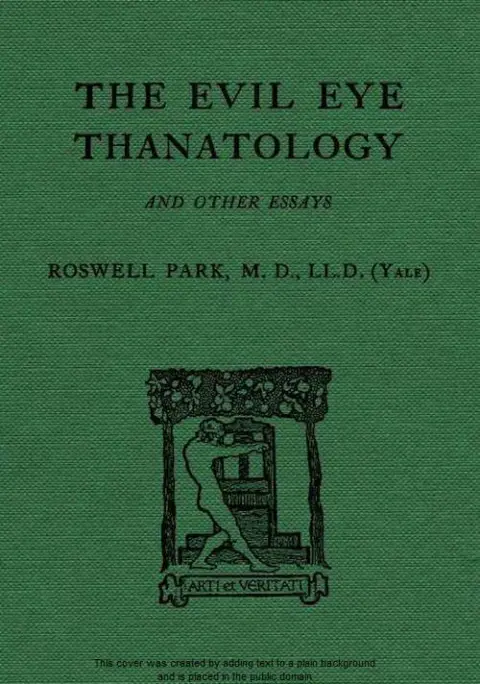
"The Evil Eye, Thanatology, and Other Essays" by Roswell Park is a collection of essays written in the early 20th century. This volume encompasses a range of interdisciplinary subjects, including anthropology, biology, folklore, and medical studies, exploring beliefs and practices surrounding superstitions and their implications in various cultures. The topics indicate an examination of both historical contexts and contemporary relevance, likely engaging readers interested in the intersections of science, superstition, and history. The opening of the book begins with an in-depth discussion on the concept of the "Evil Eye," wherein the author invites readers to contemplate the historical significance of this belief rooted in envy and malevolence. Park references various cultural interpretations of the Evil Eye, illustrating how it has manifested throughout history—from ancient civilizations to modern-day practices—complemented by examples from different societies, such as the belief in the power of certain gazes or words to incur misfortune. This analysis sets the tone for a thoughtful exploration of how cultural beliefs persist and evolve, inviting readers to consider the interplay of superstition and science in understanding human behavior and societal norms.
Introduction adapted from the source catalogue; source summaries may be automatically generated.
Free to read · English · 92,734 words · No account needed
MAKE TIME FOR A GOOD BOOK
On by default. Untick to stop anonymous reading totals. Each page counts after 10 seconds in view. How this works.
Anonymous counting is on unless you have switched it off.
Among Harvey's literary associates were a number of celebrated English poets, for example,--Marlowe (1593), Spenser (1598), Beaumont (1615), Shakespeare (1615), Herbert (1635), Ben Jonson (1637), Massinger (1639). Lord Bacon died a year or two after the appearance of Harvey's book, while Baron Napier, the inventor of logarithms, had passed away. His contemporaries in Italy, where he had studied, included Tasso (1595) and Galileo (1645). Rubens had died in 1640, Michael Angelo in 1564 and Titian in 1576. In France, Calvin, the practical murderer of Servetus, had passed away in 1564, Beza died in 1605, Descartes in 1650, Pascal in 1662 and Gassendi in 1655. Portugal had produced but one great figure in the 16th century, namely Camoens, who died in 1579. In Spain, Loyola, the ascetic and fanatic founder of the Jesuits, had joined the great majority in 1556; but Cervantes did not die until 1616, Lope de Vega in 1635, Velasquez in 1660 and Calderon in 1667.
In Germany some great figures had but recently disappeared. Paracelsus died in 1541, Copernicus in 1543, Luther in 1546, Hans Holbein in 1554, and Melancthon in 1560. Mercator, who introduced a new method of cartography, died in 1594, Tycho Brahe in 1601, Keppler in 1631, Van Dyck in 1641, Grotius, the great scholar, in 1645, Rembrandt in 1668 and Spinoza in 1677.
In philosophy, scepticism was the prevailing doctrine in the time of Harvey. It had been founded a hundred years previously by Montaigne, and continued by Charron, the chaplain of Queen Margaret of Navarre, who died in 1603, and who declared all religion to be opposed to human reason;--a remarkable attitude for a chaplain to assume. Opposed to the scepticism of Harvey's day was the mystic, Cabalistic or supernatural philosophy especially represented by Böhme, a peasant shoemaker, uneducated and yet wonderfully gifted. He had been the philosophical colleague of that great Meistersinger, Hans Sachs. Later philosophers and thinkers, yet belonging to Harvey's time, were Pascal, the great Jansenist, who discovered the variations of atmospheric pressure at different levels, and Malebranche, who figures prominently in the history of philosophy.
Descartes, who died in 1650, held the pineal gland to be the seat of the soul. He was the discoverer of the laws of refraction of light and furnished the explanation for the rainbow. He attained greatest eminence in mathematics, physics and philosophy, and was one of the inventors of modern algebra. One of his greatest opponents was that noble Jew, Spinoza, whose colleagues had expelled him from the Sanhedrim to the sound of the trombone.
The Italian Dominican Campanella, who died in 1639, considered the foundation of knowledge to be supernatural revelation and its perception by the senses. In spite of these views he came before The Inquisition on a charge of heresy and of cooperation with the Turks, was tortured by the rack, and imprisoned for thirty years.
Your reading position is saved on this browser. Take it to another device with a library code. Reading pages adapt to text, rather than matching a printed edition.
BEHIND THE BOOK
This eBook is for the use of anyone anywhere in the United States and most other parts of the world at no cost and with almost no restrictions whatsoever. You may copy it, give it away or re-use it under the terms of the Project Gutenberg License included with this eBook or online at www.gutenberg.org. If you are not located in the United States, you will have to check the laws of the country where you are located before using this eBook. Read the source licence.
The original source file, including credits and licence, is retained by this library. Request an original-format copy at no charge. Please include the book title and Project Gutenberg identifier #50004.
KEEP YOUR CURIOSITY GOING
David Patterson (Spirit) Hatch

David Patterson (Spirit) Hatch

David Patterson (Spirit) Hatch

Ralph Waldo Emerson

Maurice Baring

Oscar Wilde & James McNeill Whistler