THE CLASSIC COLLECTION✦An outlaw’s diary: the CommuneCLASSIC FREE BOOKS
An outlaw’s diary: the Commune
Cécile Tormay
THE CLASSIC COLLECTION · 1890
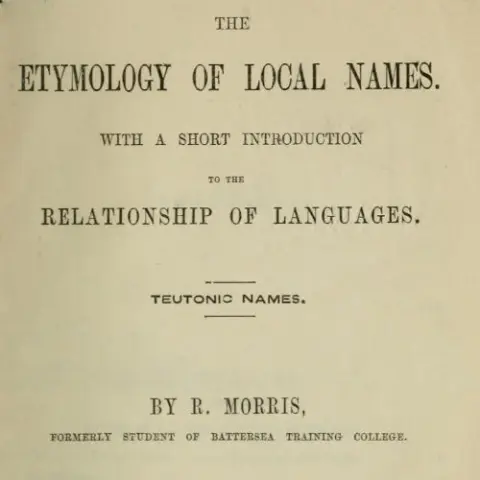
"The Etymology of Local Names" by Richard Morris is a scholarly work that delves into the origins and meanings of place names, likely written in the late 19th century. The book focuses on the historical significance of geographical names and how they reflect the cultures and languages of the peoples who named them. Through exploring both Teutonic and English examples, it aims to reveal the connections between language, history, and local identity. The opening portion introduces the core premise of the text, which is that place names often carry inherent meanings tied to their natural surroundings and historical contexts. Morris discusses how the names bestowed upon various locales provide insights into the linguistic and cultural heritage of their namers, often linked to migrations and settlements over time. He highlights the importance of understanding the etymology of these names, asserting that they are critical to comprehending the geography and history of nations. Various sections are outlined to follow, indicating a comprehensive exploration of local names derived from descriptive elements, tribes, natural features, and other associations relevant to their origins.
Introduction adapted from the source catalogue; source summaries may be automatically generated.
Free to read · English · 14,030 words · No account needed
MAKE TIME FOR A GOOD BOOK
On by default. Untick to stop anonymous reading totals. Each page counts after 10 seconds in view. How this works.
Anonymous counting is on unless you have switched it off.
To connect the idea of plurality with the English word boy, we merely inflect it, and obtain the word boys; but upon the principle of agglutination, a syllable indicative of plurality must be affixed, e.g., singular, boy; plural, boy-crowd. Thus the roots are never obscured, while they admit of a vocal harmony which is altogether peculiar to this family of languages; e.g., (Turkish) aghâ, a lord, becomes in the plural, agha-lar; er, a man becomes in the plural, er-ler, and not er-lar, as in the former case.
The vowels of the agglutinized syllables, it is easily seen, must harmonize with those of the roots; e.g., (Magyar) kert, a garden, makes kert-esz-nek to the gardener, and not kert-asz-nak.
There are two great divisions of this family:—
I. The Northern or Ural-Altaic division includes (a) the Tungusian dialects, spoken in Upper and Lower Tunguska, on the coast of Okhotsk, and by the Mantchoos or Mandshus (in China); (b) the Mongolian dialects, spoken in the North and South of Gobi, in Tibet and Tangut, in the plains on each side of the Volga (by the Olöts or Kalmuks) and by the Buriäts of Lake Baikal; (c) the Turkish dialects, spoken in Derbend, Krimea, Antolia, and Rumelia; (the Yakuts, the Tatars or Turks of Siberia, the Kirghis, the Bashkirs, the Kumians, the Nogais, and the Karatschais, the Usbegs, Uigurs, and Turkomans, speak Turkish dialects); (d) the Finnish dialects, spoken by the Hungarians, Lapps, Finns, Esths, Voguls, Permians, &c.; (e) the dialects of the Samoiedes and Ostiakes.
II. The Southern division comprises the Tamul, the Bhotiya, and the
Malay.
The Caucasian dialects are degenerated branches of the Turanian family; they include the idioms of the Georgians or Grusians, the Suans, the Lazes, the Lesghi, the Mitsgeghi, and the Kerkessians and Abasians.
“Local Nomenclature of the Anglo-Saxons,” by H. Leo.
“Codex Diplomaticus Ævi Saxonici,” edited by Professor Kemble.
“The Germania of Tacitus,” edited by Dr. Latham.
Bosworth’s “Anglo-Saxon Dictionary.”
Meidinger’s “Comparative Dictionary of the Gothic Tongues.”
Jamieson’s “Scottish Dictionary.”
“The Saxons in England,” by Professor Kemble.
Worsaae’s “Danes and Norwegians in England.”
“The Northmen in Cumberland and Westmoreland,” by R. Ferguson.
Wright’s “Provincial Dictionary.”
Names of places in a great measure belong to the oldest and most primitive evidences of language, and they are of the highest importance in the history of nations and dialects.—H. Leo.
It cannot be doubted that local names, and those devoted to distinguish the natural features of a country, possess an inherent vitality which even the urgency of conquest is unable to remove.—Kemble.
Your reading position is saved on this browser. Take it to another device with a library code. Reading pages adapt to text, rather than matching a printed edition.
BEHIND THE BOOK
This eBook is for the use of anyone anywhere in the United States and most other parts of the world at no cost and with almost no restrictions whatsoever. You may copy it, give it away or re-use it under the terms of the Project Gutenberg License included with this eBook or online at www.gutenberg.org. If you are not located in the United States, you will have to check the laws of the country where you are located before using this eBook. Read the source licence.
The original source file, including credits and licence, is retained by this library. Request an original-format copy at no charge. Please include the book title and Project Gutenberg identifier #57658.
KEEP YOUR CURIOSITY GOING
Cécile Tormay

Moritz Busch
John L. Ransom
Frances Wright
Cécile Tormay

Mabel Potter Daggett