THE CLASSIC COLLECTION✦An outlaw’s diary: the CommuneCLASSIC FREE BOOKS
An outlaw’s diary: the Commune
Cécile Tormay
THE CLASSIC COLLECTION · 1890
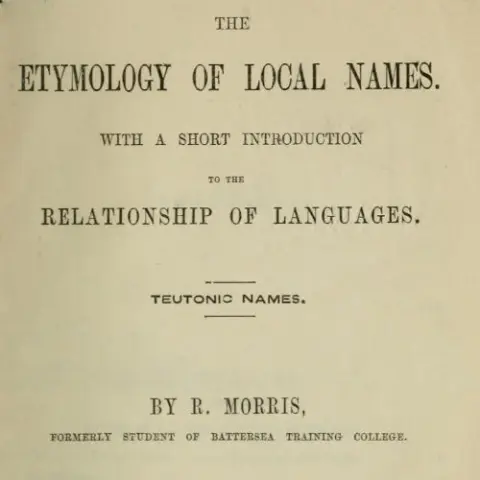
"The Etymology of Local Names" by Richard Morris is a scholarly work that delves into the origins and meanings of place names, likely written in the late 19th century. The book focuses on the historical significance of geographical names and how they reflect the cultures and languages of the peoples who named them. Through exploring both Teutonic and English examples, it aims to reveal the connections between language, history, and local identity. The opening portion introduces the core premise of the text, which is that place names often carry inherent meanings tied to their natural surroundings and historical contexts. Morris discusses how the names bestowed upon various locales provide insights into the linguistic and cultural heritage of their namers, often linked to migrations and settlements over time. He highlights the importance of understanding the etymology of these names, asserting that they are critical to comprehending the geography and history of nations. Various sections are outlined to follow, indicating a comprehensive exploration of local names derived from descriptive elements, tribes, natural features, and other associations relevant to their origins.
Introduction adapted from the source catalogue; source summaries may be automatically generated.
Free to read · English · 14,030 words · No account needed
MAKE TIME FOR A GOOD BOOK
On by default. Untick to stop anonymous reading totals. Each page counts after 10 seconds in view. How this works.
Anonymous counting is on unless you have switched it off.
CRESS-well, nasturtium spring;
CREAS-y, nasturtium dwelling by the stream;
CRESS-ham, nasturtium home;
CRESS-low, nasturtium hill.
MOSS gives name to
MOSE-ley, MOSS-ley, moss meadow;
MOS-ton, moss town;
MUS-borough, moss city;
Gil-MOSS, the rivulet of the moss;
MOSS-soe, moss lake;
MOSEN-berg, moss hill;
MOS-bach, moss stream.
SEDGE appears in
SEDGE-moor;, SEDGE-ly, sedge meadow;
SEDG-barrow, sedge wood.
The RUSH is an element in
RUSH-ley, rush meadow;
RUSH-hulme, rush island;
RUSH-mere, rush marsh;
RIS-borough, rush city;
RUS-combe, rush valley;
RUS-warp, rush mound;
RUSH-worth, rush farm;
RUS-land, RUSH-land, rush district.
The NETTLE in NETTLE-combe, NETTLE-den, NETTLE-stead, and NETTLE-ton.
The REED gives name to
REED-ham, reed home;
RID-ley, reed meadow;
ROR-bach, reed stream; &c.
BARLEY (BIGG) may be traced in
BIG-by, barley town;
BYG-land, barley district.
BEANS appear in
BIN-stead, bean dwelling;
BEEN-ham, bean home;
BINE-gar, bean enclosure;
BIN-don, bean hill;
BIN-field, bean field.
The OAT occurs in OAD-by, OT-ley, and OAT-land.
The Scandinavian HAVER (oats) gives names to HAVER-ham, HAVER-ford, and
HAVER-thwaite.
The SLOW is easily seen in SLOW-burn and SLOW-combe.
HAW-ley and HAW-don derive their name from the haw; APSE, ASP-ley, and ASP-don from the asp (aps).
WHEAT appears in WHIT-field, WHEAT-ley, WHEAT-hamp-stead, WHEAT-on,
WHATE-ly, and WHIT-barrow.
SHROP-ham, SHROP-shire, SCROP-ton, SCROP-ley-hill, SCRAP-loft, and SCROBB are derived from SCRYBE, a shrub; as well as SCREVE-by, SCROO-by, and SCRAF-ton.
WORT-ley, WORT-well, WOR-stead, WORS-borough, WORS-ley, WROOT, WURZ-burg, WURZ-ach, WURZ-em, &c., contain the root WYRT, WORT, an herb.
ERZ (German), Ore, occurs in
ERZ-gebirge, ore mountains;
ERZ-en, ore district.
CLAY in
CLAY-pole,
CLAY-worth,
CLAY-gate, clay street;
CLAY-don, clay hill;
CLAI-borne, clay stream.
CISEL (gravel)
CHISEL-hampton,
CHISEL-don,
CHESIL-borne,
CHISEL-hurst, gravel forest;
CHISEL-bury, gravel city;
CHESIL-bank, gravel bank.
CHALK gives name to CHALK-grove, CHAL-ford, CHILT-ern, KALK-stein, and
CALKE.
GRIES (German), gravel, is found in
GRIES-bach, gravel stream;
GRIES-heim, gravel home;
GRIES-kirch, gravel church; &c.
MARL occurs in MAR-low, MARL-borough, and MARLS-ton.
SALT appears in SALTER-ton, SALT-ash, SALTN-ey, SAL-combe, SALT-coats; SALZ-brunn, SALZ-burg, SALZ-dahl-um, SALZ-wedel, &c.
EISEN (German), iron, is found in EISEN-ach, EISEN-berg, EIS-eld, EIS-leben, EIS-grub, EISEN-burg, &c.
SAND gives name to SAND-wich, SAND-hurst, SANDER-croft, &c.
STONE (STAN) appears in STONE-leigh, STAN-ley, STAN-ton, STAINES, STAN-bury, STAIN-land, STAIN-drop, STAN-hope; STEEN-bergen, STEEN-wyk, STEIN, STEIN-ach, STEIN-au, STEIN-bach, STEIN-borth, STEIN-holm, STEIN-horst, STEIN-weiss, &c.
AL, ALT, ALD, AU (old)—ALD-borough, AL-thorpe, AL-bourne, AL-ton, AL-ford, AL-cester; ALTEN-burg, ALTEN-markt, ALTEN-dorn, ALTEN-feld, AL-torf, OLDE-bach, OLDE-boorn, OLDEN-dorf, OLDEN-burg, AU-burn, and AU-thorpe.
BRAD (broad)—BRAD-well, BRAD-stock, BRAD-ford; BREIT-horn,
BREITEN-bach, &c.
CHEIL, COL, CALD (cold)—COL-burn, COAL-brook, COLD-stream, COLD-side, CHELS-field, COWD-ham, CHILD-hay, CHILT-thorn, CHIL-worthy, CALD-well; CALDE-cote, CAL-bourne, CAUDE-bec (CALDE-bec), COLDEN-weide, COLDEN-hoff, KALT-brun, KALTEN-nord-heim, and KALTEN-sund-heim.
DEOP (deep)—DEPT-ford, DEEP-dale, DIEPEN-beck, DIEPEN-heim, DIEPEN-au,
&c.
KINE, KING (royal, king)—KINE-ton, KINNER-ton, KINGS-bury, KINGER-by.
Your reading position is saved on this browser. Take it to another device with a library code. Reading pages adapt to text, rather than matching a printed edition.
BEHIND THE BOOK
This eBook is for the use of anyone anywhere in the United States and most other parts of the world at no cost and with almost no restrictions whatsoever. You may copy it, give it away or re-use it under the terms of the Project Gutenberg License included with this eBook or online at www.gutenberg.org. If you are not located in the United States, you will have to check the laws of the country where you are located before using this eBook. Read the source licence.
The original source file, including credits and licence, is retained by this library. Request an original-format copy at no charge. Please include the book title and Project Gutenberg identifier #57658.
KEEP YOUR CURIOSITY GOING
Cécile Tormay

Moritz Busch
John L. Ransom
Frances Wright
Cécile Tormay

Mabel Potter Daggett