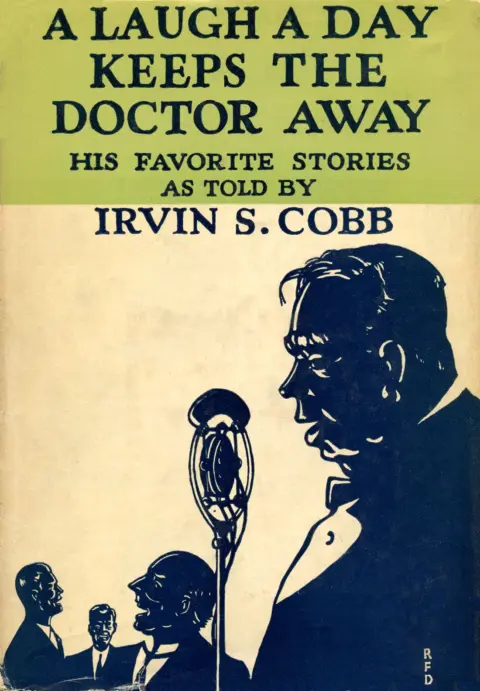
A laugh a day keeps the doctor away
Irvin S. (Irvin Shrewsbury) Cobb
THE CLASSIC COLLECTION · 1910
"The Escape of Mr. Trimm" by Irvin S. Cobb is a novel written in the early 20th century. The story centers around Hobart W. Trimm, a convicted banker who is set to serve a lengthy prison sentence after the collapse of the Thirteenth National Bank. The narrative explores Trimm's experiences as he tries to navigate the humiliation of his situation and ultimately seek a form of escape from the "grips of the law," leading readers into a tale of desperation and ingenuity. The opening of the book details Mr. Trimm's transition from his former life of wealth and power to being handcuffed and escorted on a train to prison. His feelings of detachment and disdain for his situation are evident as he recalls his social standing and the media's portrayal of him throughout the trial and sentencing. As he embarks on this journey, he is determined to maintain his dignity, but chaotic events unfold, particularly when a train collision occurs, leading to his unexpected freedom. After the train wreck, Trimm finds himself alone in the woods, considering the possibility of escaping the justice system entirely, even as he battles the physical constraints of handcuffs that symbolize his fall from grace.
Introduction adapted from the source catalogue; source summaries may be automatically generated.
Free to read · English · 66,546 words · No account needed
MAKE TIME FOR A GOOD BOOK
On by default. Untick to stop anonymous reading totals. Each page counts after 10 seconds in view. How this works.
Anonymous counting is on unless you have switched it off.
"No, sir," spoke up Weil briskly. "I've got no lawyer, commissioner." His speech was the elaborated and painfully emphasized English of the self-taught East Sider. It carried in it just the bare suggestion of the racial lisp, and it made an acute contrast to the menacing Hibernian purr of Donohue's heavier voice. "I kind of thought I'd conduct my own case myself."
Donohue merely grunted.
"Do you desire, Lieutenant Weil, for to ask Captain Meagher any
questions?" he demanded.
Weil shook his oily head of hair.
"No, sir. I wouldn't wish to ask the captain anything."
"Are there any other witnesses?" inquired Donohue next.
There was no answer. Plainly there were no other witnesses.
"Lieutenant Weil, do you desire for to say something in your own behalf?" queried the deputy commissioner.
"I think I'd like to," answered Weil.
He stood to be sworn, took the chair Meagher vacated and sat facing the room, appearing--so La Farge thought--more shamefaced and abashed than ever.
"Now, then," commanded Donohue impressively, "what statement, if any, have you to make, Lieutenant Weil, touchin' on this here charge preferred by your superior officer?"
Weil cleared his throat. Rogers figured that this bespoke embarrassment; but, to the biased understanding of the hostile La Farge, there was something falsely theatrical even in the way Weil cleared his throat.
"Once a grandstander always a grandstander!" he muttered derisively.
"What did you say?" whispered Rogers.
"Nothing," replied La Farge--"just thinking out loud. Listen to what Foxy Issy has to say for himself."
"Well, sir, commissioner," began the accused, "this here thing happens last Thursday, just as Captain Meagher is telling you." He had slipped already into the policeman's trick of detailing a past event in the present tense.
"It's late in the afternoon--round five o'clock I guess--and I'm downstairs in the Detective Bureau alone."
"Alone, you say?" broke in Donohue, emphasizing the word as though the admission scored a point against the man on trial.
"Yes, sir, I'm alone. It happens that everybody else is out and I'm in temporary charge, as you might say. It's getting along toward dark when Patrolman Morgan, who's on duty out in the hall, comes in and says to me there's a woman outside who can't talk English and he can't make out what she wants. So I tells him to bring her in. She comes in. Right away I see she's a Ginney--an Italian," he corrected himself hurriedly. "She's got a child with her--a little boy about two years old."
Your reading position is saved on this browser. Take it to another device with a library code. Reading pages adapt to text, rather than matching a printed edition.
Irvin S. (Irvin Shrewsbury) Cobb
Irvin S. (Irvin Shrewsbury) Cobb
Irvin S. (Irvin Shrewsbury) Cobb
Irvin S. (Irvin Shrewsbury) Cobb
BEHIND THE BOOK
This eBook is for the use of anyone anywhere in the United States and most other parts of the world at no cost and with almost no restrictions whatsoever. You may copy it, give it away or re-use it under the terms of the Project Gutenberg License included with this eBook or online at www.gutenberg.org. If you are not located in the United States, you will have to check the laws of the country where you are located before using this eBook. Read the source licence.
The original source file, including credits and licence, is retained by this library. Request an original-format copy at no charge. Please include the book title and Project Gutenberg identifier #24799.
KEEP YOUR CURIOSITY GOING
Coulson Kernahan

Maurice Baring
Frances Wright
Cécile Tormay

Frederic Jesup Stimson

W. H. P. (William Henry Pope) Jarvis