Lalla Rookh
Thomas Moore
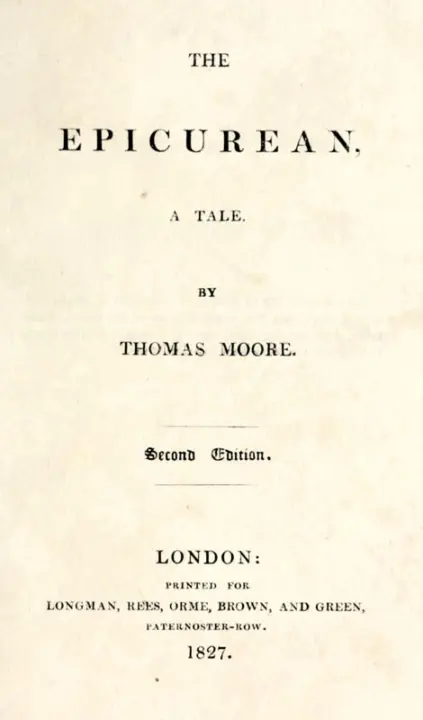
THE CLASSIC COLLECTION · 1827
"The Epicurean: A Tale" by Thomas Moore is a novel written in the early 19th century. The narrative revolves around the philosophy of Epicureanism, exploring themes of pleasure, mortality, and the quest for immortality through the eyes of a young protagonist who is chosen as the leader of the Epicurean sect in Athens. The protagonist's inner turmoil and existential musings set the stage for a rich exploration of human desires and the philosophical debates surrounding life and death. The opening portion of the novel introduces the protagonist, a young Epicurean philosopher, as he reflects on the pleasures of life while grappling with an underlying melancholy regarding mortality. Set against the backdrop of a grand festival celebrating their philosophy, he revels in the beauty of the gardens and the camaraderie of fellow epicureans. However, a dream prompts him to seek eternal life in Egypt, where he believes the secrets of immortality may lie hidden. As he embarks on his journey, the narrative hints at the perils and trials he will face in his pursuit, intricately weaving supernatural and philosophical elements into his quest for understanding life itself.
Introduction adapted from the source catalogue; source summaries may be automatically generated.
Free to read · English · 55,535 words · No account needed
MAKE TIME FOR A GOOD BOOK
On by default. Untick to stop anonymous reading totals. Each page counts after 10 seconds in view. How this works.
Anonymous counting is on unless you have switched it off.
In her tranquillity, however, I could not now sympathize. Impatient to know all that awaited her and myself, I pushed our boat close to the base of the rock,—directly under that lighted window on the summit, to find my way up to which was my first object. Having hastily received my instructions from Alethe, and made her repeat again the name of the Christian whom we sought, I sprang upon the bank, and was not long in discovering a sort of rude stair‐way, cut out of the rock, but leading, I found, by easy windings, up the steep.
After ascending for some time, I arrived at a level space or ledge, which the hand of labour had succeeded in converting into a garden, and which was planted, here and there, with fig‐trees and palms. Around it, too, I could perceive, through the glimmering light, a number of small caves or grottos, into some of which, human beings might find entrance, while others appeared no larger than the tombs of the Sacred Birds round Lake Mœris.
I was still, I found, but half‐way up the ascent to the summit, nor could perceive any further means of continuing my course, as the mountain from hence rose, almost perpendicularly, like a wall. At length, however, on exploring around, I discovered behind the shade of a sycamore a large ladder of wood, resting firmly against the rock, and affording an easy and secure ascent up the steep.
Having ascertained thus far, I again descended to the boat for Alethe,—whom I found trembling already at her short solitude,—and having led her up the steps to this quiet garden, left her safely lodged, amid its holy silence, while I pursued my way upward to the light on the rock.
At the top of the long ladder I found myself on another ledge or platform, somewhat smaller than the first, but planted in the same manner, with trees, and, as I could perceive by the mingled light of morning and the moon, embellished with flowers. I was now near the summit;—there remained but another short ascent, and, as a ladder against the rock, as before, supplied the means of scaling it, I was in a few minutes at the opening from which the light issued.
I had ascended gently, as well from a feeling of awe at the whole scene, as from an unwillingness to disturb too rudely the rites on which I intruded. My approach was, therefore, unheard, and an opportunity, during some moments, afforded me of observing the group within, before my appearance at the window was discovered.
Your reading position is saved on this browser. Take it to another device with a library code. Reading pages adapt to text, rather than matching a printed edition.
BEHIND THE BOOK
This eBook is for the use of anyone anywhere in the United States and most other parts of the world at no cost and with almost no restrictions whatsoever. You may copy it, give it away or re-use it under the terms of the Project Gutenberg License included with this eBook or online at www.gutenberg.org. If you are not located in the United States, you will have to check the laws of the country where you are located before using this eBook. Read the source licence.
The original source file, including credits and licence, is retained by this library. Request an original-format copy at no charge. Please include the book title and Project Gutenberg identifier #49332.
KEEP YOUR CURIOSITY GOING

David Patterson (Spirit) Hatch
Coulson Kernahan

Ralph Waldo Emerson

Maurice Baring
Frances Wright
Cécile Tormay