Lalla Rookh
Thomas Moore
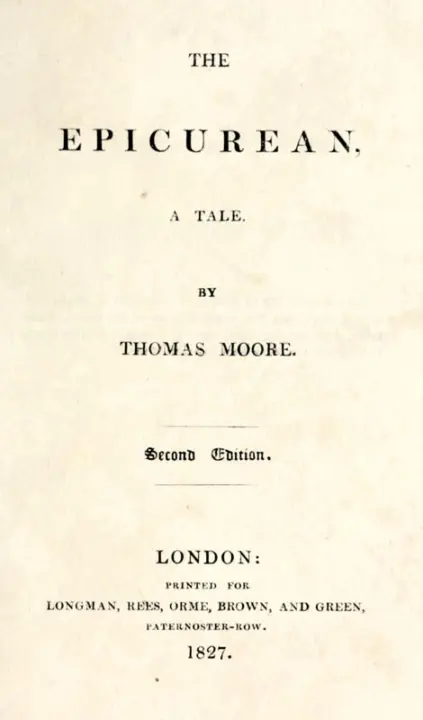
THE CLASSIC COLLECTION · 1827
"The Epicurean: A Tale" by Thomas Moore is a novel written in the early 19th century. The narrative revolves around the philosophy of Epicureanism, exploring themes of pleasure, mortality, and the quest for immortality through the eyes of a young protagonist who is chosen as the leader of the Epicurean sect in Athens. The protagonist's inner turmoil and existential musings set the stage for a rich exploration of human desires and the philosophical debates surrounding life and death. The opening portion of the novel introduces the protagonist, a young Epicurean philosopher, as he reflects on the pleasures of life while grappling with an underlying melancholy regarding mortality. Set against the backdrop of a grand festival celebrating their philosophy, he revels in the beauty of the gardens and the camaraderie of fellow epicureans. However, a dream prompts him to seek eternal life in Egypt, where he believes the secrets of immortality may lie hidden. As he embarks on his journey, the narrative hints at the perils and trials he will face in his pursuit, intricately weaving supernatural and philosophical elements into his quest for understanding life itself.
Introduction adapted from the source catalogue; source summaries may be automatically generated.
Free to read · English · 55,535 words · No account needed
MAKE TIME FOR A GOOD BOOK
On by default. Untick to stop anonymous reading totals. Each page counts after 10 seconds in view. How this works.
Anonymous counting is on unless you have switched it off.
It was in the neighbourhood of this place, as I could collect from the delineations on the leaf,—where a flight of birds represented the name of the mountain,—that the dwelling of the Solitary, to whom Alethe was bequeathed, lay. Imperfect as was my knowledge of the geography of Egypt, it at once struck me, that we had long since left this mountain behind; and, on inquiring of our boatmen, I found my conjecture confirmed. We had, indeed, passed it, as appeared, on the preceding night; and, as the wind had, ever since, blown strongly from the north, and the sun was already declining towards the horizon, we must now be, at least, an ordinary day’s sail to the southward of the spot.
At this discovery, I own, my heart felt a joy which I could with difficulty conceal. It seemed to me as if fortune was conspiring with love, and, by thus delaying the moment of our separation, afforded me at least a chance of happiness. Her look, too, and manner, when informed of our mistake, rather encouraged than chilled this secret hope. In the first moment of astonishment, her eyes opened upon me with a suddenness of splendour, under which I felt my own wink, as if lightning had crossed them. But she again, as suddenly, let their lids fall, and, after a quiver of her lip, which showed the conflict of feeling within, crossed her arms upon her bosom, and looked silently down upon the deck;—her whole countenance sinking into an expression, sad, but resigned, as if she felt, with me, that fate was on the side of wrong, and saw Love already stealing between her soul and heaven.
I was not slow in availing myself of what I fancied to be the irresolution of her mind. But, fearful of exciting alarm by any appeal to tenderer feelings, I but addressed myself to her imagination, and to that love of novelty, which is for ever fresh in the youthful breast. We were now approaching that region of wonders, Thebes. “In a day or two,” said I, “we shall see, towering above the waters, the colossal Avenue of Sphinxes, and the bright Obelisks of the Sun. We shall visit the plain of Memnon, and those mighty statues, that fling their shadows at sunrise over the Libyan hills. We shall hear the image of the Son of the Morning answering to the first touch of light. From thence, in a few hours, a breeze like this will transport us to those sunny islands near the cataracts; there, to wander, among the sacred palm‐groves of Philæ, or sit, at noon‐tide hour, in those cool alcoves, which the waterfall of Syene shadows under its arch. Oh, who, with such scenes of loveliness within reach, would turn coldly away to the bleak desert, and leave this fair world, with all its enchantments, shining behind them, unseen and unenjoyed? At least,”—I added, tenderly taking her by the hand,—“at least, let a few more days be stolen from the dreary fate to which thou hast devoted thyself, and then——”
Your reading position is saved on this browser. Take it to another device with a library code. Reading pages adapt to text, rather than matching a printed edition.
BEHIND THE BOOK
This eBook is for the use of anyone anywhere in the United States and most other parts of the world at no cost and with almost no restrictions whatsoever. You may copy it, give it away or re-use it under the terms of the Project Gutenberg License included with this eBook or online at www.gutenberg.org. If you are not located in the United States, you will have to check the laws of the country where you are located before using this eBook. Read the source licence.
The original source file, including credits and licence, is retained by this library. Request an original-format copy at no charge. Please include the book title and Project Gutenberg identifier #49332.
KEEP YOUR CURIOSITY GOING

David Patterson (Spirit) Hatch
Coulson Kernahan

Ralph Waldo Emerson

Maurice Baring
Frances Wright
Cécile Tormay