Lalla Rookh
Thomas Moore
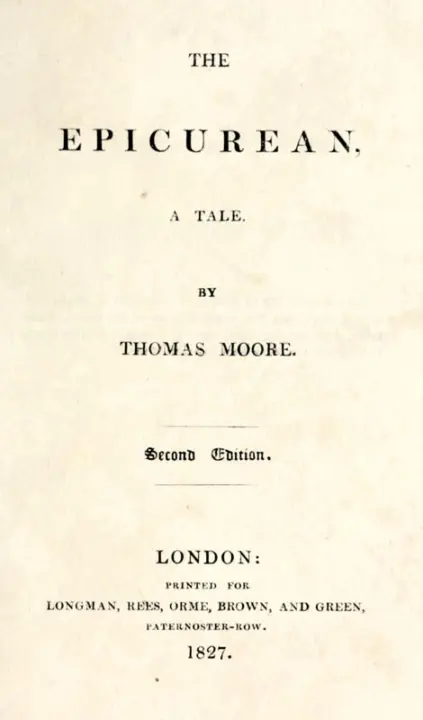
THE CLASSIC COLLECTION · 1827
"The Epicurean: A Tale" by Thomas Moore is a novel written in the early 19th century. The narrative revolves around the philosophy of Epicureanism, exploring themes of pleasure, mortality, and the quest for immortality through the eyes of a young protagonist who is chosen as the leader of the Epicurean sect in Athens. The protagonist's inner turmoil and existential musings set the stage for a rich exploration of human desires and the philosophical debates surrounding life and death. The opening portion of the novel introduces the protagonist, a young Epicurean philosopher, as he reflects on the pleasures of life while grappling with an underlying melancholy regarding mortality. Set against the backdrop of a grand festival celebrating their philosophy, he revels in the beauty of the gardens and the camaraderie of fellow epicureans. However, a dream prompts him to seek eternal life in Egypt, where he believes the secrets of immortality may lie hidden. As he embarks on his journey, the narrative hints at the perils and trials he will face in his pursuit, intricately weaving supernatural and philosophical elements into his quest for understanding life itself.
Introduction adapted from the source catalogue; source summaries may be automatically generated.
Free to read · English · 55,535 words · No account needed
MAKE TIME FOR A GOOD BOOK
On by default. Untick to stop anonymous reading totals. Each page counts after 10 seconds in view. How this works.
Anonymous counting is on unless you have switched it off.
It was true, she was now wholly in my power. I feared no witnesses but those of earth, and the solitude of the desert was at hand. But though I acknowledged not a heaven, I worshipped her who was, to me, its type and substitute. If, at any moment, a single thought of wrong or deceit, towards a creature so sacred, arose in my mind, one look from her innocent eyes averted the sacrilege. Even passion itself felt a holy fear in her presence,—like the flame trembling in the breeze of the sanctuary,—and Love, pure Love, stood in place of Religion.
As long as I knew not her story, I might indulge, at least, in dreams of the future. But, now—what hope, what prospect remained? My sole chance of happiness lay in the feeble hope of beguiling away her thoughts from the plan which she meditated; of weaning her, by persuasion, from that austere faith, which I had before hated and now feared, and of—attaching her, perhaps, alone and unlinked as she was in the world, to my own fortunes for ever!
In the agitation of these thoughts, I had started from my resting‐place, and continued to pace up and down, under a burning sun, till, exhausted both by thought and feeling, I sunk down, amid its blaze, into a sleep, which, to my fevered brain, seemed a sleep of fire.
On awaking, I found the veil of Alethe laid carefully over my brow, while she, herself, sat near me, under the shadow of the sail, looking anxiously at that leaf, which her mother had given her, and apparently employed in comparing its outlines with the course of the river and the forms of the rocky hills by which we passed. She looked pale and troubled, and rose eagerly to meet me, as if she had long and impatiently waited for my waking.
Her heart, it was plain, had been disturbed from its security, and was beginning to take alarm at its own feelings. But, though vaguely conscious of the peril to which she was exposed, her reliance, as is usually the case, increased with her danger, and on me, far more than on herself, did she depend for saving her from it. To reach, as soon as possible, her asylum in the desert, was now the urgent object of her entreaties and wishes; and the self‐reproach she expressed at having permitted her thoughts to be diverted, for a single moment, from this sacred purpose, not only revealed the truth, that she had forgotten it, but betrayed even a glimmering consciousness of the cause.
Your reading position is saved on this browser. Take it to another device with a library code. Reading pages adapt to text, rather than matching a printed edition.
BEHIND THE BOOK
This eBook is for the use of anyone anywhere in the United States and most other parts of the world at no cost and with almost no restrictions whatsoever. You may copy it, give it away or re-use it under the terms of the Project Gutenberg License included with this eBook or online at www.gutenberg.org. If you are not located in the United States, you will have to check the laws of the country where you are located before using this eBook. Read the source licence.
The original source file, including credits and licence, is retained by this library. Request an original-format copy at no charge. Please include the book title and Project Gutenberg identifier #49332.
KEEP YOUR CURIOSITY GOING

David Patterson (Spirit) Hatch
Coulson Kernahan

Ralph Waldo Emerson

Maurice Baring
Frances Wright
Cécile Tormay