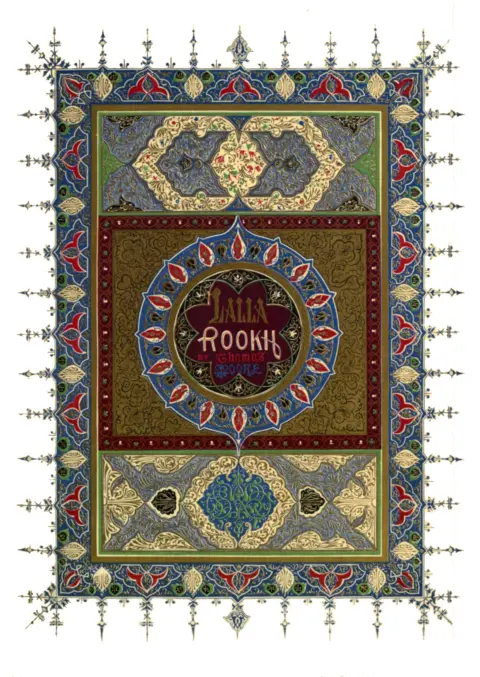
Lalla Rookh
Thomas Moore
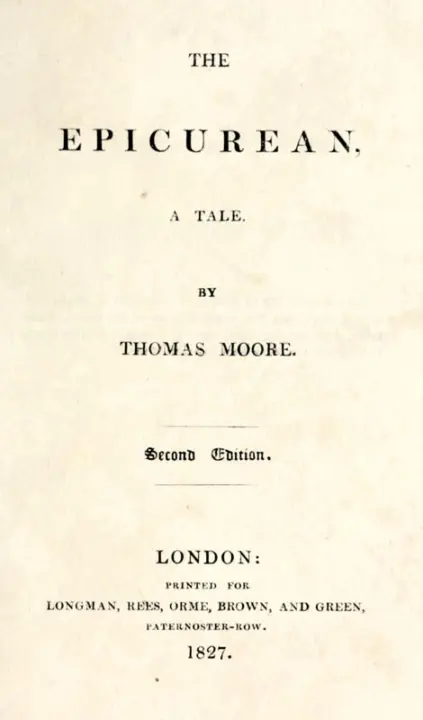
THE CLASSIC COLLECTION · 1827
"The Epicurean: A Tale" by Thomas Moore is a novel written in the early 19th century. The narrative revolves around the philosophy of Epicureanism, exploring themes of pleasure, mortality, and the quest for immortality through the eyes of a young protagonist who is chosen as the leader of the Epicurean sect in Athens. The protagonist's inner turmoil and existential musings set the stage for a rich exploration of human desires and the philosophical debates surrounding life and death. The opening portion of the novel introduces the protagonist, a young Epicurean philosopher, as he reflects on the pleasures of life while grappling with an underlying melancholy regarding mortality. Set against the backdrop of a grand festival celebrating their philosophy, he revels in the beauty of the gardens and the camaraderie of fellow epicureans. However, a dream prompts him to seek eternal life in Egypt, where he believes the secrets of immortality may lie hidden. As he embarks on his journey, the narrative hints at the perils and trials he will face in his pursuit, intricately weaving supernatural and philosophical elements into his quest for understanding life itself.
Introduction adapted from the source catalogue; source summaries may be automatically generated.
Free to read · English · 55,535 words · No account needed
MAKE TIME FOR A GOOD BOOK
On by default. Untick to stop anonymous reading totals. Each page counts after 10 seconds in view. How this works.
Anonymous counting is on unless you have switched it off.
As I stood, gazing with wonder, the orb, with all its ethereal inmates, gradually receded into the dark void, lessening, as it went, and growing more bright, as it lessened;—till, at length, distant, apparently, as a retiring comet, this little world of Spirits, in one small point of intense radiance, shone its last and vanished. “Go,” exclaimed the rapt Priest, “ye happy souls, of whose dwelling a glimpse is thus given to our eyes, go, wander, in your orb, through the boundless heaven, nor ever let a thought of this perishable world come to mingle its dross with your divine nature, or tempt you to that earthward fall, by which spirits, as bright, have been ruined!”
A pause ensued, during which, still under the influence of wonder, I sent my fancy wandering after the inhabitants of that orb,—almost wishing myself credulous enough to believe in a heaven, of which creatures, so like all that I most loved on earth, were inmates.
At length, the Priest, with a sigh at the contrast he was about to draw, between the happy spirits we had just seen and the fallen ones of earth, resumed his melancholy History of the Soul. Tracing it, from the first moment of earthward desire, to its final eclipse in the shadows of this world, he dwelt upon every stage of its darkening descent, with a pathos that sent sadness into the very depths of the heart. The first downward look of the Spirit towards earth—the tremble of her wings on the edge of Heaven—the giddy slide, at length, down that fatal descent, and the Lethæan cup, midway in the sky, of which when she has once tasted, Heaven is forgot,—through all these gradations he mournfully traced her fall, to the last stage of darkness, when, wholly immersed in this world, her celestial nature is changed, she can no longer rise above earth, nor remembers her home, but by glimpses so vague, that, mistaking for hope what is only memory, she believes them to be a light from the Future, not the Past.
“To retrieve this ruin of the once blessed Soul—to clear away, from around her, the clouds of earth, and, restoring her lost wings(5), facilitate their return to Heaven—such,” said the reverend man, “is the great task of our religion, and such the triumph of those divine Mysteries, in which the life and essence of our religion lie. However sunk and changed and clouded may be the Spirit, as long as a single trace of her original light remains, there is yet hope that——”
Your reading position is saved on this browser. Take it to another device with a library code. Reading pages adapt to text, rather than matching a printed edition.
BEHIND THE BOOK
This eBook is for the use of anyone anywhere in the United States and most other parts of the world at no cost and with almost no restrictions whatsoever. You may copy it, give it away or re-use it under the terms of the Project Gutenberg License included with this eBook or online at www.gutenberg.org. If you are not located in the United States, you will have to check the laws of the country where you are located before using this eBook. Read the source licence.
The original source file, including credits and licence, is retained by this library. Request an original-format copy at no charge. Please include the book title and Project Gutenberg identifier #49332.
KEEP YOUR CURIOSITY GOING

David Patterson (Spirit) Hatch
Coulson Kernahan

Ralph Waldo Emerson

Maurice Baring
Frances Wright
Cécile Tormay