Lalla Rookh
Thomas Moore
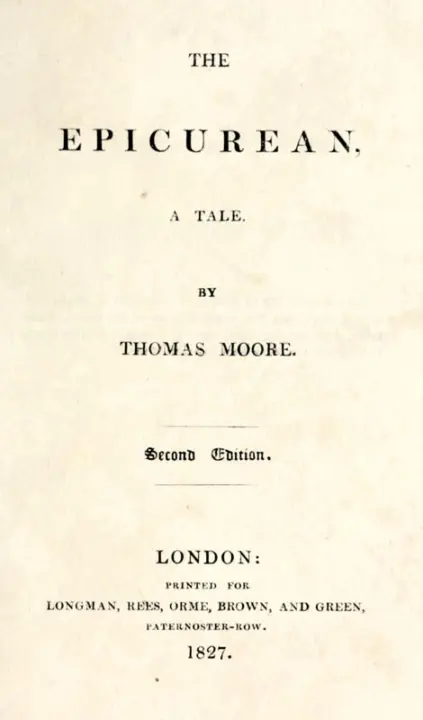
THE CLASSIC COLLECTION · 1827
"The Epicurean: A Tale" by Thomas Moore is a novel written in the early 19th century. The narrative revolves around the philosophy of Epicureanism, exploring themes of pleasure, mortality, and the quest for immortality through the eyes of a young protagonist who is chosen as the leader of the Epicurean sect in Athens. The protagonist's inner turmoil and existential musings set the stage for a rich exploration of human desires and the philosophical debates surrounding life and death. The opening portion of the novel introduces the protagonist, a young Epicurean philosopher, as he reflects on the pleasures of life while grappling with an underlying melancholy regarding mortality. Set against the backdrop of a grand festival celebrating their philosophy, he revels in the beauty of the gardens and the camaraderie of fellow epicureans. However, a dream prompts him to seek eternal life in Egypt, where he believes the secrets of immortality may lie hidden. As he embarks on his journey, the narrative hints at the perils and trials he will face in his pursuit, intricately weaving supernatural and philosophical elements into his quest for understanding life itself.
Introduction adapted from the source catalogue; source summaries may be automatically generated.
Free to read · English · 55,535 words · No account needed
MAKE TIME FOR A GOOD BOOK
On by default. Untick to stop anonymous reading totals. Each page counts after 10 seconds in view. How this works.
Anonymous counting is on unless you have switched it off.
Impatient to know what further trials awaited me, I was about to speak, when the Priest exclaimed, anxiously, “Hush!”—and pointing to this statue at the foot of the couch, said—“Let the spell of that Spirit be on thy lips, young stranger, till the wisdom of thy instructors shall think fit to remove it. Not unaptly doth the same god preside over Silence and Light; since it is only out of the depth of contemplative silence, that the great light of the soul, Truth, arises!”
Little used to the language of dictation or instruction, I was now preparing to rise, when the priest again restrained me; and, at the same moment, two boys, beautiful as the young Genii of the stars, entered the pavilion. They were habited in long garments of the purest white, and bore each a small golden chalice in his hand. Advancing towards me, they stopped on opposite sides of the couch, and one of them, presenting to me his chalice of gold, said, in a tone between singing and speaking,—
“Drink of this cup—Osiris sips
The same in his halls below;
And the same he gives, to cool the lips
Of the Dead, who downward go.
“Drink of this cup—the water within
Is fresh from Lethe’s stream;
’Twill make the past with all its sin,
And all its pain and sorrows, seem
Like a long‐forgotten dream!
“The pleasure, whose charms
Are steep’d in woe;
The knowledge, that harms
The soul to know;
“The hope, that, bright
As the lake of the waste,
Allures the sight,
But mocks the taste;
“The love, that binds
Its innocent wreath,
Where the serpent winds,
In venom, beneath;—
“All that, of evil or false, by thee
Hath ever been known or seen,
Shall melt away in this cup, and be
Forgot, as it never had been!”
Unwilling to throw a slight on this strange ceremony, I leaned forward, with all due gravity, and tasted the cup; which I had no sooner done than the young cup‐bearer, on the other side, invited my attention, and, in his turn, presenting the chalice which he held, sung, with a voice still sweeter than that of his companion, the following strain:—
“Drink of this cup—when Isis led
Her boy, of old, to the beaming sky,
She mingled a draught divine, and said—
‘Drink of this cup, thou’lt never die!’
“Thus do I say and sing to thee,
Heir of that boundless heav’n on high,
Though frail, and fall’n, and lost thou be,
Drink of this cup, thou’lt never die!”
Your reading position is saved on this browser. Take it to another device with a library code. Reading pages adapt to text, rather than matching a printed edition.
BEHIND THE BOOK
This eBook is for the use of anyone anywhere in the United States and most other parts of the world at no cost and with almost no restrictions whatsoever. You may copy it, give it away or re-use it under the terms of the Project Gutenberg License included with this eBook or online at www.gutenberg.org. If you are not located in the United States, you will have to check the laws of the country where you are located before using this eBook. Read the source licence.
The original source file, including credits and licence, is retained by this library. Request an original-format copy at no charge. Please include the book title and Project Gutenberg identifier #49332.
KEEP YOUR CURIOSITY GOING

David Patterson (Spirit) Hatch
Coulson Kernahan

Ralph Waldo Emerson

Maurice Baring
Frances Wright
Cécile Tormay