Lalla Rookh
Thomas Moore
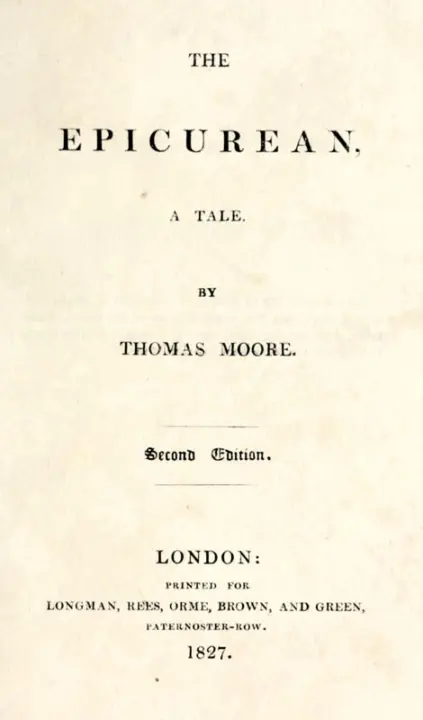
THE CLASSIC COLLECTION · 1827
"The Epicurean: A Tale" by Thomas Moore is a novel written in the early 19th century. The narrative revolves around the philosophy of Epicureanism, exploring themes of pleasure, mortality, and the quest for immortality through the eyes of a young protagonist who is chosen as the leader of the Epicurean sect in Athens. The protagonist's inner turmoil and existential musings set the stage for a rich exploration of human desires and the philosophical debates surrounding life and death. The opening portion of the novel introduces the protagonist, a young Epicurean philosopher, as he reflects on the pleasures of life while grappling with an underlying melancholy regarding mortality. Set against the backdrop of a grand festival celebrating their philosophy, he revels in the beauty of the gardens and the camaraderie of fellow epicureans. However, a dream prompts him to seek eternal life in Egypt, where he believes the secrets of immortality may lie hidden. As he embarks on his journey, the narrative hints at the perils and trials he will face in his pursuit, intricately weaving supernatural and philosophical elements into his quest for understanding life itself.
Introduction adapted from the source catalogue; source summaries may be automatically generated.
Free to read · English · 55,535 words · No account needed
MAKE TIME FOR A GOOD BOOK
On by default. Untick to stop anonymous reading totals. Each page counts after 10 seconds in view. How this works.
Anonymous counting is on unless you have switched it off.
But vain were my efforts and resolves. Even while I swore to fly, my steps were still lingering round the pyramid—my eyes still turned towards the secret portal, which severed this enchantress from the world of the living. Hour after hour did I wander through that City of Silence,—till, already, it was noon, and, under the sun’s meridian eye, the mighty pyramid of pyramids stood, like a great spirit, shadowless.
Again did those wild and passionate feelings, which had, for a moment, been subdued into reverence by her presence, return to kindle up my imagination and senses. I even reproached myself for the awe, that had held me spell‐bound before her. “What would my companions of the Garden say, did they know that their chief,—he, whose path Love had strewed with trophies—was now pining for a simple Egyptian girl, in whose presence he had not dared to give utterance to a sigh, and who had vanquished the victor, without even knowing her triumph!”
A blush came over my cheek at the humiliating thought, and my determination was fixed to await her coming. That she should be an inmate of those gloomy caverns seemed inconceivable; nor did there appear to be any issue from their depths but by the pyramid. Again, therefore, like a sentinel of the dead, did I pace up and down among these tombs, contrasting, in many a mournful reflection, the burning fever within my own veins with the cold quiet of those who slept around.
At length the fierce glow of the sun over my head, and, still more, that ever restless agitation in my heart, were too much for even strength like mine to bear. Exhausted, I lay down at the base of the pyramid—placing myself directly under the portal, where, even should slumber surprise me, my heart, if not my ear, might still be on the watch, and her footstep, light as it was, could not fail to awake me.
After many an ineffectual struggle against drowsiness, I at length sunk into sleep—but not into forgetfulness. The same image still haunted me, in every variety of shape, with which imagination, assisted by memory, could invest it. Now, like Neïtha, upon her throne at Saïs, she seemed to sit, with the veil just raised from that brow, which mortal had never, till then, beheld,—and now, like the beautiful enchantress Rhodope, I saw her rise out of the pyramid in which she had dwelt for ages,—
“Fair Rhodope, as story tells,
The bright, unearthly nymph, who dwells
Mid sunless gold and jewels hid,
The Lady of the Pyramid!”
Your reading position is saved on this browser. Take it to another device with a library code. Reading pages adapt to text, rather than matching a printed edition.
BEHIND THE BOOK
This eBook is for the use of anyone anywhere in the United States and most other parts of the world at no cost and with almost no restrictions whatsoever. You may copy it, give it away or re-use it under the terms of the Project Gutenberg License included with this eBook or online at www.gutenberg.org. If you are not located in the United States, you will have to check the laws of the country where you are located before using this eBook. Read the source licence.
The original source file, including credits and licence, is retained by this library. Request an original-format copy at no charge. Please include the book title and Project Gutenberg identifier #49332.
KEEP YOUR CURIOSITY GOING

David Patterson (Spirit) Hatch
Coulson Kernahan

Ralph Waldo Emerson

Maurice Baring
Frances Wright
Cécile Tormay