Lalla Rookh
Thomas Moore
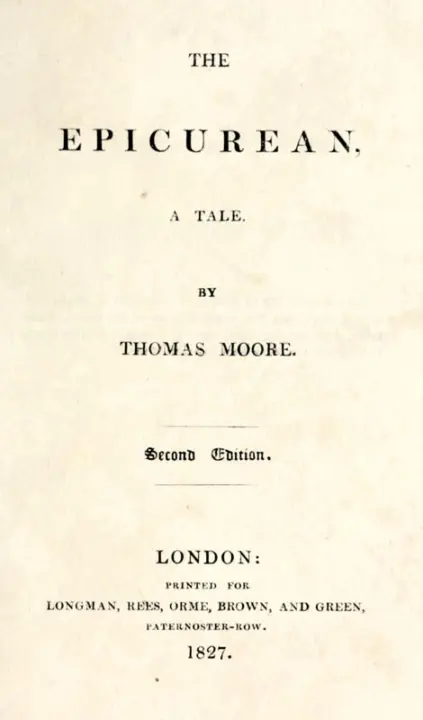
THE CLASSIC COLLECTION · 1827
"The Epicurean: A Tale" by Thomas Moore is a novel written in the early 19th century. The narrative revolves around the philosophy of Epicureanism, exploring themes of pleasure, mortality, and the quest for immortality through the eyes of a young protagonist who is chosen as the leader of the Epicurean sect in Athens. The protagonist's inner turmoil and existential musings set the stage for a rich exploration of human desires and the philosophical debates surrounding life and death. The opening portion of the novel introduces the protagonist, a young Epicurean philosopher, as he reflects on the pleasures of life while grappling with an underlying melancholy regarding mortality. Set against the backdrop of a grand festival celebrating their philosophy, he revels in the beauty of the gardens and the camaraderie of fellow epicureans. However, a dream prompts him to seek eternal life in Egypt, where he believes the secrets of immortality may lie hidden. As he embarks on his journey, the narrative hints at the perils and trials he will face in his pursuit, intricately weaving supernatural and philosophical elements into his quest for understanding life itself.
Introduction adapted from the source catalogue; source summaries may be automatically generated.
Free to read · English · 55,535 words · No account needed
MAKE TIME FOR A GOOD BOOK
On by default. Untick to stop anonymous reading totals. Each page counts after 10 seconds in view. How this works.
Anonymous counting is on unless you have switched it off.
Page 272.—“Glistened over its silver letters.”—The Codex Cottonianus of the New Testament is written in silver letters on a purple ground. The Codex Cottonianus of the Septuagint version of the Old Testament is supposed to be the identical copy that belonged to Origen.
Page 289.—“Some denier of Christ.”—Those Christians who sacrificed to idols to save themselves were called by various names, Thurificati, Sacrificati, Mittentes, Negatores, &c. Baronius mentions a bishop of this period (253), Marcellinus, who, yielding to the threats of the Gentiles, threw incense upon the altar. v. Arnob. contra Gent. lib. 7.
Page 297.—“The clear voice with which,” &c.—The merit of the confession “Christianus sum,” or “Christiana sum,” was considerably enhanced by the clearness and distinctness with which it was pronounced. Eusebius mentions the martyr Vetius as making it λαμπροτατη φωνη.
Page 304.—“The band round the young Christian’s brow.”—We find poisonous crowns mentioned by Pliny, under the designation of “coronæ ferales.” Paschalius, too, gives the following account of these “deadly garlands,” as he calls them:—“Sed mirum est tam salutare inventum humanam nequitiam reperisse, quomodo ad nefarios usus traducent. Nempe, repertæ sunt nefandæ coronæ harum, quas dixi, tam salubrium per nomen quidem et speciem imitatrices, at re et effectu ferales, atque adeo capitis, cui imponuntur, interfectrices.” De Coronis.
LONDON:
Printed by A. & R. Spottiswoode,
New‐Street‐Square.
1 The description, here alluded to, may also be found, copied verbatim from Sethos, in the “Voyages d’Anténor.”—“In that philosophical romance, called ‘La Vie de Séthos,’” says Warburton, “we find a much juster account of old Egyptian wisdom, than in all the pretended ‘Histoire du Ciel.’” Div. Leg. book 4. sect. 14.
2 A cross was, among the Egyptians, the emblem of a future life.
3 “On s’étoit même avisé, depuis la première construction de ces demeures, de percer en plusieurs endroits jusq’au haut les terres qui les couvroient; non pas, à la vérité, pour tirer un jour qui n’auroit jamais été suffisant, mais pour recevoir un air salutaire, &c.”—Sethos.
4 Osiris.
5 In the language of Plato, Hierocles, &c. to “restore to the soul its wings,” is the main object both of religion and philosophy.
6 See an account of this sensitive tree, which bends down its branches to those who approach it, in M. Jomard’s Description of Syene and the Cataracts.
7 The province of Arsinoë, now Fioum.
8 In the original the discourses of the Hermit are given much more at
length.
9 A rank, resembling that of Colonel.
10 “Une de ces couronnes de grain de corail, dont les vierges martyres ornoient leurs cheveaux en allant à la mort.” Les Martyrs.
Your reading position is saved on this browser. Take it to another device with a library code. Reading pages adapt to text, rather than matching a printed edition.
BEHIND THE BOOK
This eBook is for the use of anyone anywhere in the United States and most other parts of the world at no cost and with almost no restrictions whatsoever. You may copy it, give it away or re-use it under the terms of the Project Gutenberg License included with this eBook or online at www.gutenberg.org. If you are not located in the United States, you will have to check the laws of the country where you are located before using this eBook. Read the source licence.
The original source file, including credits and licence, is retained by this library. Request an original-format copy at no charge. Please include the book title and Project Gutenberg identifier #49332.
KEEP YOUR CURIOSITY GOING

David Patterson (Spirit) Hatch
Coulson Kernahan

Ralph Waldo Emerson

Maurice Baring
Frances Wright
Cécile Tormay