Lalla Rookh
Thomas Moore
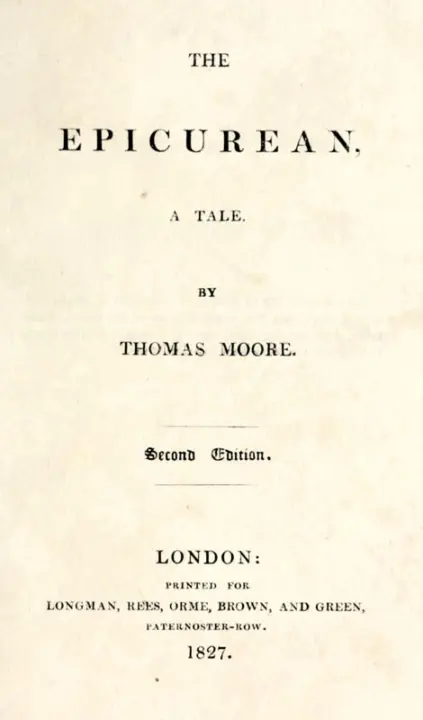
THE CLASSIC COLLECTION · 1827
"The Epicurean: A Tale" by Thomas Moore is a novel written in the early 19th century. The narrative revolves around the philosophy of Epicureanism, exploring themes of pleasure, mortality, and the quest for immortality through the eyes of a young protagonist who is chosen as the leader of the Epicurean sect in Athens. The protagonist's inner turmoil and existential musings set the stage for a rich exploration of human desires and the philosophical debates surrounding life and death. The opening portion of the novel introduces the protagonist, a young Epicurean philosopher, as he reflects on the pleasures of life while grappling with an underlying melancholy regarding mortality. Set against the backdrop of a grand festival celebrating their philosophy, he revels in the beauty of the gardens and the camaraderie of fellow epicureans. However, a dream prompts him to seek eternal life in Egypt, where he believes the secrets of immortality may lie hidden. As he embarks on his journey, the narrative hints at the perils and trials he will face in his pursuit, intricately weaving supernatural and philosophical elements into his quest for understanding life itself.
Introduction adapted from the source catalogue; source summaries may be automatically generated.
Free to read · English · 55,535 words · No account needed
MAKE TIME FOR A GOOD BOOK
On by default. Untick to stop anonymous reading totals. Each page counts after 10 seconds in view. How this works.
Anonymous counting is on unless you have switched it off.
We were already passing each other when, with a desperate effort, I sprang from my boat and lighted upon the edge of their vessel. I knew not what I did, for despair was my only prompter. Snatching at the sword of one of the soldiers, as I stood tottering on the edge, I had succeeded in wresting it out of his hands, when, at the same moment, I received a thrust of a lance from one of his comrades, and fell backward into the river. I can just remember rising again and making a grasp at the side of the vessel;—but the shock, the faintness from my wound, deprived me of all consciousness, and a shriek from Alethe, as I sunk, is all I can recollect of what followed.
Would I had then died!—Yet, no, Almighty Being,—I should have died in darkness, and I have lived to know Thee!
On returning to my senses, I found myself reclined on a couch, in a splendid apartment, the whole appearance of which being Grecian, I, for a moment, forgot all that had passed, and imagined myself in my own home at Athens. But too soon the whole dreadful certainty flashed upon me; and, starting wildly—disabled as I was—from my couch, I called loudly, and with the shriek of a maniac, on Alethe.
I was in the house, I found, of my friend and disciple, the young Tribune, who had made the Governor acquainted with my name and condition, and had received me under his roof, when brought, bleeding and insensible, to Antinoë. From him I now learned at once,—for I could not wait for details,—the sum of all that had happened in that dreadful interval. Melanius was no more,—Alethe, still alive, but in prison!
“Take me to her”—I had but time to say—“take me to her instantly, and let me die by her side,”—when, nature again failing under such shocks, I relapsed into insensibility. In this state I continued for near an hour, and, on recovering, found the Tribune by my side. The horrors, he said, of the Forum were, for that day, over,—but what the morrow might bring, he shuddered to contemplate. His nature, it was plain, revolted from the inhuman duties in which he was engaged. Touched by the agonies he saw me suffer, he, in some degree, relieved them, by promising that I should, at night‐fall, be conveyed to the prison, and, if possible, through his influence, gain access to Alethe. She might yet, he added, be saved, could I succeed in persuading her to comply with the terms of the edict, and make sacrifice to the Gods.—“Otherwise,” said he, “there is no hope;—the vindictive Orcus, who has resisted even this short respite of mercy, will, to‐morrow, inexorably demand his prey.”
Your reading position is saved on this browser. Take it to another device with a library code. Reading pages adapt to text, rather than matching a printed edition.
BEHIND THE BOOK
This eBook is for the use of anyone anywhere in the United States and most other parts of the world at no cost and with almost no restrictions whatsoever. You may copy it, give it away or re-use it under the terms of the Project Gutenberg License included with this eBook or online at www.gutenberg.org. If you are not located in the United States, you will have to check the laws of the country where you are located before using this eBook. Read the source licence.
The original source file, including credits and licence, is retained by this library. Request an original-format copy at no charge. Please include the book title and Project Gutenberg identifier #49332.
KEEP YOUR CURIOSITY GOING

David Patterson (Spirit) Hatch
Coulson Kernahan

Ralph Waldo Emerson

Maurice Baring
Frances Wright
Cécile Tormay