
Love
Elizabeth Von Arnim
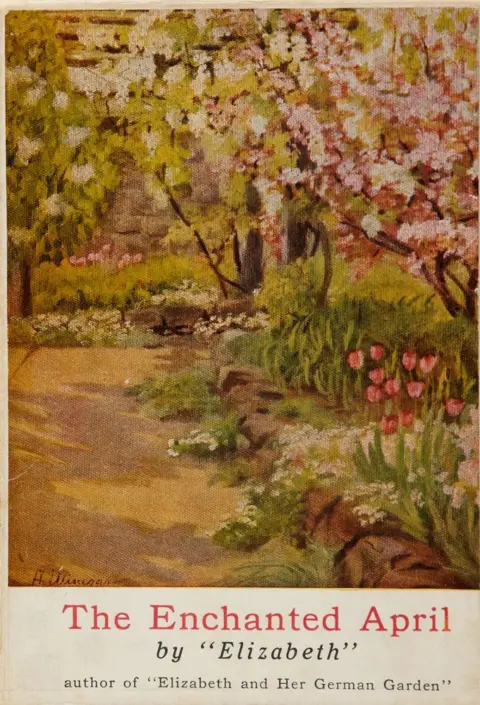
THE CLASSIC COLLECTION · 1922
"The Enchanted April" by Elizabeth von Arnim is a novel published in 1922. Four dissimilar women escape their dreary lives in 1920s England for a month-long holiday at a medieval Italian castle. Mrs. Arbuthnot and Mrs. Wilkins struggle with unhappy marriages, Lady Caroline seeks refuge from shallow London society, and elderly Mrs. Fisher clings to her Victorian past. Despite initial tensions, the tranquil Mediterranean setting begins to work its magic on each woman, offering possibilities for transformation and renewal.
Introduction adapted from the source catalogue; source summaries may be automatically generated.
Free to read · English · 79,797 words · No account needed
MAKE TIME FOR A GOOD BOOK
On by default. Untick to stop anonymous reading totals. Each page counts after 10 seconds in view. How this works.
Anonymous counting is on unless you have switched it off.
Her face when she lifted her head was full of laughter. Too extraordinary, the developments produced by San Salvatore. She and Mrs. Fisher . . . but she saw them being fast friends.
“Where are the others?” asked Mrs. Fisher. “Thank you—dear,” she added, as Mrs. Wilkins put a footstool under her feet, a footstool obviously needed, Mrs. Fisher’s legs being short.
“I see myself throughout the years,” thought Mrs. Wilkins, her eyes dancing, “bringing footstools to Mrs. Fisher. . .”
“The Roses,” she said, straightening herself, “have gone into the lower garden—I think lovemaking.”
“The Roses?”
“The Fredericks, then, if you like. They’re completely merged and
indistinguishable.”
“Why not say the Arbuthnots, my dear?” said Mr. Wilkins.
“Very well, Mellersh—the Arbuthnots. And the Carolines—”
Both Mr. Wilkins and Mrs. Fisher started. Mr. Wilkins, usually in such complete control of himself, started even more than Mrs. Fisher, and for the first time since his arrival felt angry with his wife.
“Really—” he began indignantly.
“Very well, Mellersh—the Briggses, then.”
“The Briggses!” cried Mr. Wilkins, now very angry indeed; for the implication was to him a most outrageous insult to the entire race of Desters—dead Desters, living Desters, and Desters still harmless because they were yet unborn. “Really—”
“I’m sorry, Mellersh,” said Mrs. Wilkins, pretending meekness, “if you don’t like it.”
“Like it! You’ve taken leave of your senses. Why, they’ve never set eyes on each other before to-day.”
“That’s true. But that’s why they’re able now to go ahead.”
“Go ahead!” Mr. Wilkins could only echo the outrageous words.
“I’m sorry, Mellersh,” said Mrs. Wilkins again, “if you don’t like it,
but—”
Her grey eyes shone, and her face rippled with the light and conviction that had so much surprised Rose the first time they met.
“It’s useless minding,” she said. “I shouldn’t struggle if I were you.
Because—”
She stopped, and looked first at one alarmed solemn face and then at the other, and laughter as well as light flickered and danced over her.
“I see them being the Briggses,” finished Mrs. Wilkins.
Your reading position is saved on this browser. Take it to another device with a library code. Reading pages adapt to text, rather than matching a printed edition.
Elizabeth Von Arnim

Elizabeth Von Arnim
Elizabeth Von Arnim
Elizabeth Von Arnim
BEHIND THE BOOK
This eBook is for the use of anyone anywhere in the United States and most other parts of the world at no cost and with almost no restrictions whatsoever. You may copy it, give it away or re-use it under the terms of the Project Gutenberg License included with this eBook or online at www.gutenberg.org. If you are not located in the United States, you will have to check the laws of the country where you are located before using this eBook. Read the source licence.
The original source file, including credits and licence, is retained by this library. Request an original-format copy at no charge. Please include the book title and Project Gutenberg identifier #16389.
KEEP YOUR CURIOSITY GOING
Coulson Kernahan

Maurice Baring
Frances Wright
Cécile Tormay

Frederic Jesup Stimson

W. H. P. (William Henry Pope) Jarvis