THE CLASSIC COLLECTION✦An outlaw’s diary: the CommuneCLASSIC FREE BOOKS
An outlaw’s diary: the Commune
Cécile Tormay
THE CLASSIC COLLECTION · 1907
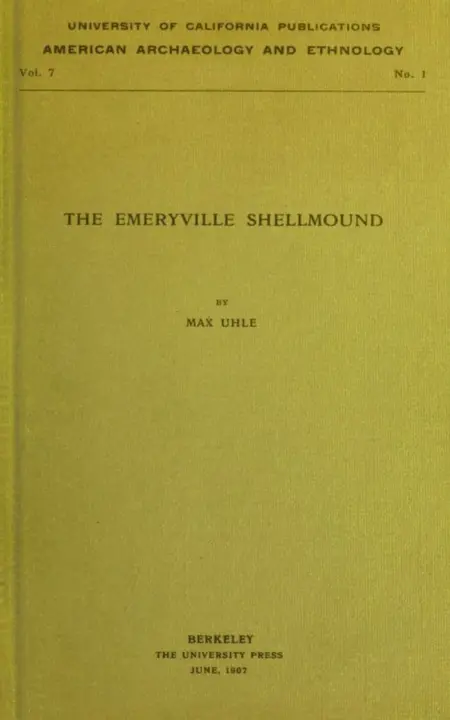
"The Emeryville Shellmound" by Max Uhle is a scientific publication written in the early 20th century. This work chronicles archaeological excavations and findings at the Emeryville Shellmound, a significant site located on the eastern shore of San Francisco Bay. The text focuses on the archaeological evidence of early inhabitants of the area, their artifacts, and the cultural practices reflected in the mound's structure and contents. The opening of the work introduces the importance of the shellmounds found along the California coast, noting their rarity compared to other archaeological remains in the United States. It describes the collaborative effort of Professor John C. Merriam and Dr. Uhle in excavating the Emeryville mound, emphasizing its notable size and the various strata of artifacts within it. Initial observations about the mound's topography are accompanied by a historical context detailing past human settlements and the significance of the excavation as a window into the lives of the region's early inhabitants.
Introduction adapted from the source catalogue; source summaries may be automatically generated.
Free to read · English · 31,397 words · No account needed
MAKE TIME FOR A GOOD BOOK
On by default. Untick to stop anonymous reading totals. Each page counts after 10 seconds in view. How this works.
Anonymous counting is on unless you have switched it off.
No. 9. A child’s grave, in stratum VIIa, in the tunnel about 18 feet below the surface. The associated objects were convex shell beads (cf. pl. 11, figs. 5a and 5b) and a cockleshell upon the crown of the head (cf. grave No. 1).
No. 10. Grave of an infant with very delicate bones. It was found in the lowest part of section VIII, 23 feet below the surface.
[37] See P. Schumacher, Bull. l. c., p. 38, for burials in the mounds on the Island of San Miguel.
[38] Virchow found them in the Spanish shellmounds (Ranke, l. c., II, p. 533), while in those of Denmark they are absent. Schumacher (Smiths. Rep., 1874, p. 337) states that he observed shellmounds in Southern California which had been temporary abodes only and were devoid of graves; while D. G. Brinton asserts that in Florida graves occurred in natural shellmounds, while artificial shellmounds were free of them (l. c., 1866, p. 357). Such general statements cannot be accepted unless they are supported by observations over larger fields than these.
[39] H. C. Yarrow, Introduction to the mortuary custom among the North American Indians, 1880, p. 58, points out that this custom was general among those Indians who cremated their dead.
[40] Bulletin U. S. Geol. and Geogr. Survey, III, p. 34. In other places shellmound graves lie deeper; thus sometimes three to six feet on the Island of San Miguel (P. Schumacher, Bull. l. c., p. 38).
[41] Charles Rau, Ancient Aboriginal Trade in North America, Smithson. Rep., 1872, p. 361 (from G. Squier).
[42] l. c., p. 360.
[43] Art in Shell, Second Annual Report of the Bureau of Ethnology, 1880 to 1881, pl. XXIII, fig. 6.
[44] P. Schumacher, Smithson. Rep., 1874, p. 349.
[45] Central California, cf. also Moorehead, l. c., p. 259.
[46] P. Schumacher, Bull. l. c., p. 34.
[47] F. W. Putnam, Rep. upon U. S. Geogr. Surveys, l. c., p. 30; Schumacher, Smithson. Rep., 1874, p. 341.
[48] Smithson. Rep., 1874, p. 342.
[49] Putnam, l. c., p. 22; Schumacher, Smithson. Reports, 1874, p.
350.
[50] Yarrow, Introduction to the Study of Mortuary Customs among the North American Indians, 1880, p. 54.
[51] Schoolcraft, Archives of Aboriginal Knowledge, 1860, IV, p. 156.
[52] Yarrow, l. c., p. 71.
[53] Bulletin l. c., p. 34.
[54] Art in Shell, pl. XXXII, fig. 2.
[55] W. H. Dall, for instance, found them among other places in shellmounds on the Aleutian Islands (Smithson. Contrib., 1878, No. 318, pl. 10, No. 17261.)
The shellmounds of the environs of San Francisco Bay are almost the only witnesses of a practically unknown period in the early history of this region.[56] They appear to us at first investigation unintelligible, both as regards the beginning and the end of the period during which they served as human abodes. For a solution of the problem before us the most diverse kinds of investigations must be carried on, before the principal facts of this history can be clearly brought out.
Your reading position is saved on this browser. Take it to another device with a library code. Reading pages adapt to text, rather than matching a printed edition.
BEHIND THE BOOK
This eBook is for the use of anyone anywhere in the United States and most other parts of the world at no cost and with almost no restrictions whatsoever. You may copy it, give it away or re-use it under the terms of the Project Gutenberg License included with this eBook or online at www.gutenberg.org. If you are not located in the United States, you will have to check the laws of the country where you are located before using this eBook. Read the source licence.
The original source file, including credits and licence, is retained by this library. Request an original-format copy at no charge. Please include the book title and Project Gutenberg identifier #67841.
KEEP YOUR CURIOSITY GOING
Cécile Tormay

Moritz Busch
John L. Ransom
Frances Wright
Cécile Tormay

Mabel Potter Daggett