THE CLASSIC COLLECTION✦An outlaw’s diary: the CommuneCLASSIC FREE BOOKS
An outlaw’s diary: the Commune
Cécile Tormay
THE CLASSIC COLLECTION · 1907
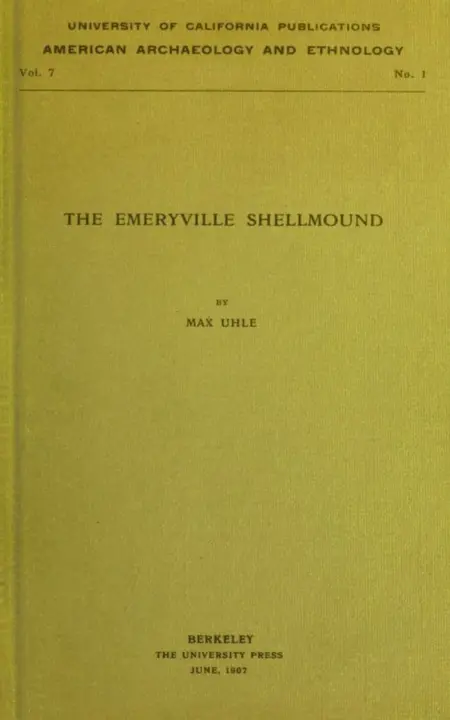
"The Emeryville Shellmound" by Max Uhle is a scientific publication written in the early 20th century. This work chronicles archaeological excavations and findings at the Emeryville Shellmound, a significant site located on the eastern shore of San Francisco Bay. The text focuses on the archaeological evidence of early inhabitants of the area, their artifacts, and the cultural practices reflected in the mound's structure and contents. The opening of the work introduces the importance of the shellmounds found along the California coast, noting their rarity compared to other archaeological remains in the United States. It describes the collaborative effort of Professor John C. Merriam and Dr. Uhle in excavating the Emeryville mound, emphasizing its notable size and the various strata of artifacts within it. Initial observations about the mound's topography are accompanied by a historical context detailing past human settlements and the significance of the excavation as a window into the lives of the region's early inhabitants.
Introduction adapted from the source catalogue; source summaries may be automatically generated.
Free to read · English · 31,397 words · No account needed
MAKE TIME FOR A GOOD BOOK
On by default. Untick to stop anonymous reading totals. Each page counts after 10 seconds in view. How this works.
Anonymous counting is on unless you have switched it off.
Other evidences of early Indian settlements in this section of the eastern shore country of the Bay are the shellmounds, twelve of which may be found along the coast between Point Richmond and Alameda in a stretch of twelve miles (pl. 1). They may be seen near Point Richmond upon the eastern side, facing the peninsula, upon Brooks Island, near Ellis Landing, northeast from Stege upon a marshy ground intersected by narrow channels, near Seaver’s Ranch to the west from Stege, on Point Isabel, in West Berkeley, in Emeryville, and in the eastern section of Alameda between Mound, Central, and Lincoln avenues. There is also said to have been one in East Oakland on the canal between Oakland Harbor and Lake Merritt, but it has disappeared owing to building over that section of ground. In all probability many others may have met with a similar fate.
All these evidences of an early occupation of the country are but a few of the mounds that skirt the Bay upon all sides, continuing along Suisun Bay and the Sacramento and Feather rivers. Besides these, there are numerous mounds dotting the coast land of Northern California, those surrounding swamps and rivers along the Tulare and Kern lakes in southern California,[3] and on the shore near Santa Cruz. Others are found in the regions of San Luis Obispo,[4] of Santa Barbara,[5] and the islands opposite that place.
[1] Cf. H. H. Bancroft, The Native Races, 1886, II, p. 595.
[2] Cf. also “San Francisco Quadrangle” with the topographical maps of California by the U. S. Geological Survey.
[3] Warren K. Moorehead, Prehistoric Implements, 1900, p. 258.
[4] Paul Schumacher, Smithson. Reports, 1874, p. 335 ff.
[5] Schumacher, Bulletin of the U. S. Geol. and Geogr. Survey of the Territories (F. V. Hayden), 1877, III, p. 73 ff.; F. W. Putnam, Reports upon Archaeological and Ethnological Collections from vicinity of Santa Barbara, Cal., etc.; Report upon U. S. Geogr. Surveys west of the 100th Meridian (G. M. Wheeler), 1879, VII, Archaeology. From more northern sections of the Pacific Coast may be mentioned specifically the shellmounds of Oregon (P. Schumacher, Bulletin, l. c.), of Vancouver, and of the mainland of British Columbia opposite (H. H. Bancroft, Native Races of the Pacific States, 1886, IV, p. 739), also those upon the Aleutian Islands, explored exhaustively by W. H. Dall (in U. S. Geogr. and Geol. Survey of the Rocky Mountain Region, J. W. Powell, Contributions to the North American Ethnology, 1877, I, p. 41 ff.). Together with those of California these shellmounds are an important counterpart to those found along the Atlantic coast, found from Nova Scotia to the Gulf of Mexico, as well as in the river valleys of nearly all the southern states (Charles C. Abbott, Primitive Industry, 1881, p. 439; Short, The North Americans of Antiquity, 1892, p. 106), and almost all of which have been carefully studied in some of their aspects, although not yet conclusively.
Your reading position is saved on this browser. Take it to another device with a library code. Reading pages adapt to text, rather than matching a printed edition.
BEHIND THE BOOK
This eBook is for the use of anyone anywhere in the United States and most other parts of the world at no cost and with almost no restrictions whatsoever. You may copy it, give it away or re-use it under the terms of the Project Gutenberg License included with this eBook or online at www.gutenberg.org. If you are not located in the United States, you will have to check the laws of the country where you are located before using this eBook. Read the source licence.
The original source file, including credits and licence, is retained by this library. Request an original-format copy at no charge. Please include the book title and Project Gutenberg identifier #67841.
KEEP YOUR CURIOSITY GOING
Cécile Tormay

Moritz Busch
John L. Ransom
Frances Wright
Cécile Tormay

Mabel Potter Daggett