
The Writing of News A Handbook with Chapters on Newspaper Correspondence and Copy Reading
Charles G. (Charles Griffith) Ross
THE CLASSIC COLLECTION · 1918
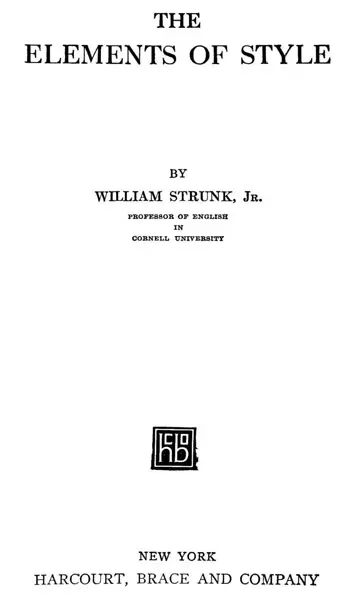
"The Elements of Style" by William Strunk is a style guide first published in 1920. This compact manual distills the essentials of clear English prose into rules about grammar, punctuation, composition, and word usage. Strunk's original "little book" urged writers to omit needless words and embrace brevity. Later enlarged by his former student E. B. White in 1959, it became the influential writing guide known as "Strunk & White," selling millions of copies and shaping generations of American writers with its prescriptive approach to craft.
Introduction adapted from the source catalogue; source summaries may be automatically generated.
Free to read · English · 13,726 words · No account needed
MAKE TIME FOR A GOOD BOOK
On by default. Untick to stop anonymous reading totals. Each page counts after 10 seconds in view. How this works.
Anonymous counting is on unless you have switched it off.
As noun, often loosely used in perfunctory writing about fashions, music, painting, and other arts: "an Oriental effect;" "effects in pale green;" "very delicate effects;" "broad effects;" "subtle effects;" "a charming effect was produced by." The writer who has a definite meaning to express will not take refuge in such vagueness.
=Etc.= Equivalent to and the rest, and so forth, and hence not to be used if one of these would be insufficient, that is, if the reader would be left in doubt as to any important particulars. Least open to objection when it represents the last terms of a list already given in full, or immaterial words at the end of a quotation.
At the end of a list introduced by such as, for example, or any similar expression, etc. is incorrect.
=Fact.= Use this word only of matters of a kind capable of direct verification, not of matters of judgment. That a particular event happened on a given date, that lead melts at a certain temperature, are facts. But such conclusions as that Napoleon was the greatest of modern generals, or that the climate of California is delightful, however incontestable they may be, are not properly facts.
On the formula the fact that, see under Rule 13.
=Factor.= A hackneyed word; the expressions of which it forms part can usually be replaced by something more direct and idiomatic.
His superior training was the great factor in his winning the match.
He won the match by being better trained.
Heavy artillery has become an increasingly important factor in
deciding battles.
Heavy artillery has played a constantly larger part in deciding
battles.
=Feature.= Another hackneyed word; like factor it usually adds nothing to the sentence in which it occurs.
A feature of the entertainment especially worthy of mention was the
singing of Miss A.
(Better use the same number of words to tell what Miss A. sang, or if the programme has already been given, to tell how she sang.)
As a verb, in the advertising sense of offer as a special attraction,
to be avoided.
=Fix.= Colloquial in America for arrange, prepare, mend. In writing restrict it to its literary senses, fasten, make firm or immovable, etc.
=Get.= The colloquial have got for have should not be used in writing. The preferable form of the participle is got.
=He is a man who.= A common type of redundant expression; see Rule 13.
He is a man who is very ambitious.
He is very ambitious.
Spain is a country which I have always wanted to visit.
I have always wanted to visit Spain.
=Help.= See under =But=.
=However.= In the meaning nevertheless, not to come first in its
sentence or clause.
Your reading position is saved on this browser. Take it to another device with a library code. Reading pages adapt to text, rather than matching a printed edition.
BEHIND THE BOOK
This eBook is for the use of anyone anywhere in the United States and most other parts of the world at no cost and with almost no restrictions whatsoever. You may copy it, give it away or re-use it under the terms of the Project Gutenberg License included with this eBook or online at www.gutenberg.org. If you are not located in the United States, you will have to check the laws of the country where you are located before using this eBook. Read the source licence.
The original source file, including credits and licence, is retained by this library. Request an original-format copy at no charge. Please include the book title and Project Gutenberg identifier #37134.
KEEP YOUR CURIOSITY GOING
Charles G. (Charles Griffith) Ross
Hannah Webster Foster

Emily Lawless
Edwin Hamlin Carr

Charles De Lano Hine
Andrew Ure