
Letters to a Friend, Written to Mrs. Ezra S. Carr, 1866-1879
John Muir
THE CLASSIC COLLECTION · 1911
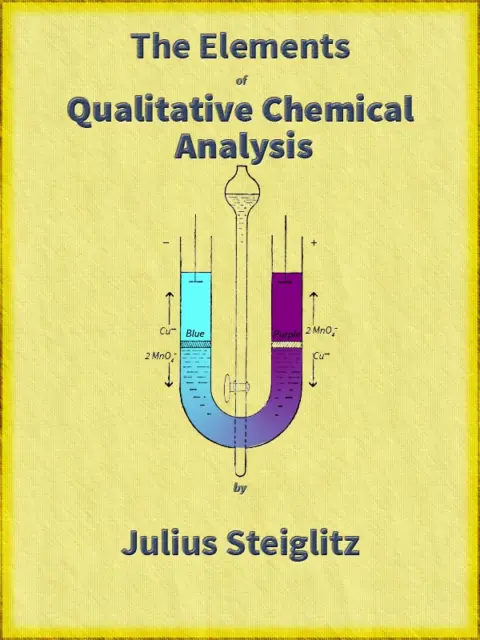
"The Elements of Qualitative Chemical Analysis, vol. 1, parts 1 and 2" by Julius Stieglitz is a scientific publication written in the early 20th century. This work focuses on qualitative chemical analysis, exploring the fundamental principles of chemistry as they relate to analytical procedures and methods. It is designed for students, aiming to enhance their understanding of various chemical reactions, solutions, and equilibrium which are critical in performing chemical analyses. At the start of this volume, the author outlines the importance of qualitative analysis in chemistry, highlighting its significance in identifying the presence of both common and rare elements in various substances. Stieglitz emphasizes the necessity for students to develop a solid theoretical foundation before engaging in laboratory work. The opening chapters introduce foundational topics such as osmotic pressure, the theory of ionization, and chemical equilibrium, laying the groundwork for systematic analytical methods. The text emphasizes a critical approach to learning, encouraging students to consult original literature and reference works to deepen their understanding of analytical techniques.
Introduction adapted from the source catalogue; source summaries may be automatically generated.
Free to read · English · 123,865 words · No account needed
MAKE TIME FOR A GOOD BOOK
On by default. Untick to stop anonymous reading totals. Each page counts after 10 seconds in view. How this works.
Anonymous counting is on unless you have switched it off.
[33] This term ‹must not be confounded with the term osmotic pressure›, which has been defined on p. 10.
[34] See Chapter VII on the law of physical or heterogeneous equilibrium, where the relations are discussed in detail.
[35] ‹Z. phys. Chem.›, «5», 175 (1890).
[36] ‹Ibid.›, «3», 119 (1889).
[37] ‹Phil. Mag.›, «38», 206 (1894).
[38] ‹Cf.› van 't Hoff's ‹Lectures on Physical Chemistry›, Vol. II,
40 (1899).
[39] The molecules may have different masses in the different conditions, and the principle of the mean kinetic energy would always apply to them as ‹they are›, in the condition under observation, and not as they are in some other condition; any change in mass, in solution, for instance, would show itself in the osmotic pressure measurements (see p. 18), just as it is shown in the measurements of gases, when the gas molecules show a change in composition, as is the case with hydrogen fluoride (H{2}F{2} ⇄ 2 HF), nitrogen tetroxide (N{2}O{4} ⇄ 2 NO{2}), phosphorus pentachloride (PCl{5} ⇄ PCl{3} + Cl{2}) and other compounds.
[40] The molecular weight of alcohol in dilute aqueous solution is the same (46) as in vapor form. Raoult, ‹Z. phys. Chem.›, «27», 656; Loomis, ‹ibid.›, «32», 592.
[41] Nernst, ‹Theoretical Chemistry›, p. 245.
[42] This assumption is not made in the rigorous development of the above relations on the basis of the kinetic theory, but it leads to the same net result.
[43] Even for gases of ordinary concentration, the introduction of the same correction gives an expression for the relation of pressure and volume, which is more exact than Boyle's law and is used in all exact calculations with gases.
[44] One may imagine, first, ‹n› molecules of the solute as a ‹gas›, with the pressure ‹P›{gas}, in 1 c.c. Then, one may imagine, crudely, the ‹n› molecules of solute, in a free (gas) space of (1 − ‹v›) c.c., in the center of 1 c.c. of the solvent, and exerting by their impacts a pressure ‹P›{osm.}, against the solvent. According to Boyle's law, we should then have, ‹P›{gas} × 1 = ‹P›{osm.} × (1 − ‹v›), and therefore ‹P›{osm.} = ‹P›{gas} / (1 − ‹v›).
[45] ‹Vide› Nernst, ‹Theoretical Chemistry›, p. 245, for the detailed discussion of this relation.
[46] This conclusion is reached more rigorously and more simply by
thermodynamic analysis.
[47] ‹Lectures on Physical Chemistry›, Part II, p. 35.
[48] Rigorous developments of the relations between solute and solvent, for dilute and concentrated solutions, have been made by van der Waals, ‹Z. phys. Chem.›, «5», 133 (1890); van Laar, ‹ibid.›, «15», 457 (1894); G. N. Lewis, ‹J. Am. Chem. Soc.›, «30», 675 (1908), and Washburn, ‹ibid.›, «32», 653 (1910). An admirable review of the theories of osmotic pressure, by Lovelace, will be found in the ‹Am. Chem. J.›, «39», 546 (1908) («Stud.»).
[p033]
Your reading position is saved on this browser. Take it to another device with a library code. Reading pages adapt to text, rather than matching a printed edition.
BEHIND THE BOOK
This eBook is for the use of anyone anywhere in the United States and most other parts of the world at no cost and with almost no restrictions whatsoever. You may copy it, give it away or re-use it under the terms of the Project Gutenberg License included with this eBook or online at www.gutenberg.org. If you are not located in the United States, you will have to check the laws of the country where you are located before using this eBook. Read the source licence.
The original source file, including credits and licence, is retained by this library. Request an original-format copy at no charge. Please include the book title and Project Gutenberg identifier #44986.
KEEP YOUR CURIOSITY GOING
John Muir

Asa Gray
Asa Gray

Florence Nightingale
Elizabeth Robins Pennell
Denison Olmsted